

What do you think?
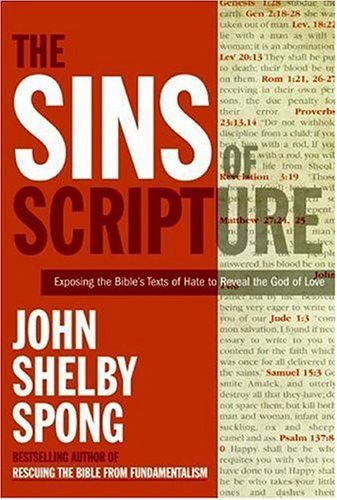
The Sins of Scripture: Exposing the Bible's Texts of Hate to Reveal the God of Love
In The Sins of Scripture, Bishop John Shelby Spong takes on a thematic exploration of the Bible, carefully analyzing those passages that inform some of our key debates, like the role of women in the church and in society, and homosexuality, to name just two. Beyond that he also looks at scriptures that have helped shape culture and history -- bringing to light the undercurrent of anti-Semitism he finds in the Gospels, for example. The journey is particularly compelling because Bishop Spong believes in and values the good the Bible has brought to many through the ages. His goal is not to define the Bible itself as something to be set aside, but instead to honor and value what he loves about it while still labeling what he dramatically calls "texts of terror" for what they are.
The true joy of the book is found in Spong's vigorous intellect, which he shines bright in an attempt to catch a reflection of the age, culture and circumstances in which the texts he examines were written. Like an archaeologist working with ideas instead of tools, he removes the rocks, brushes away the sediment and reports on what he finds. What were the roots and cultural realities behind the Scriptures that define the role of women in the church? What were the hopes and fears driving the writers who condemned homosexuality in such stark terms? What is the justification behind scriptures recommending "the rod of correction" (or as Bishop Spong simply labels it: "[t]he physical abuse of children…".)
Whether or not you agree with some of his musings along the way, many of his conclusions are hard to argue with. Putting aside the issue of divine origin of the Bible, no one can deny passages have been used in service of very human ends. Finally, The Sins of Scriptures can be seen as a careful observer of what those ends have been. And when taken on those terms, it makes an interesting read, regardless of one's religious background.--Ed Dobeas
The true joy of the book is found in Spong's vigorous intellect, which he shines bright in an attempt to catch a reflection of the age, culture and circumstances in which the texts he examines were written. Like an archaeologist working with ideas instead of tools, he removes the rocks, brushes away the sediment and reports on what he finds. What were the roots and cultural realities behind the Scriptures that define the role of women in the church? What were the hopes and fears driving the writers who condemned homosexuality in such stark terms? What is the justification behind scriptures recommending "the rod of correction" (or as Bishop Spong simply labels it: "[t]he physical abuse of children…".)
Whether or not you agree with some of his musings along the way, many of his conclusions are hard to argue with. Putting aside the issue of divine origin of the Bible, no one can deny passages have been used in service of very human ends. Finally, The Sins of Scriptures can be seen as a careful observer of what those ends have been. And when taken on those terms, it makes an interesting read, regardless of one's religious background.--Ed Dobeas
315 pages, Paperback
First published January 1, 2005
About the author
John Shelby Spong
49 books308 followersJohn Shelby Spong was the Episcopal bishop of Newark before his retirement in 2000. As a leading spokesperson for an open, scholarly, and progressive Christianity, Bishop Spong has taught at Harvard and at the Graduate Theological Union in Berkeley, California. He has also lectured at universities, conference centers, and churches in North America, Europe, Asia, and the South Pacific. His books include: A New Christianity for a New World, Rescuing the Bible from Fundamentalism, Resurrection: Myth or Reality? Why Christianity Must Change or Die, and his autobiography, Here I Stand.
Ratings & Reviews
Friends & Following
Create a free account to discover what your friends think of this book!
Community Reviews
Displaying 1 - 30 of 102 reviews

March 17, 2011
The subtitle of this book is Exposing the Bible’s Texts of Hate to Reveal the God of Love. I read this book a few years back, and the reason it came to mind today is because I am feeling overwhelmed by the aggressiveness of anti-Bible crusaders. Unquestionably, there are many passages in the Bible that are not only questionable theology, but downright appalling. Unquestionably, there are “Christians” today who pounce on these texts in order to promote discrimination or oppression. But the majority of Christians do not; the majority of Christians worship a God of love, and either spiritualize or completely discard those scriptures that reveal, not God’s will, but human weakness.
Can we really worship a God who murdered all the firstborn males in every Egyptian household? How about a God who stops the sun in the sky, providing more daylight so that Joshua can slaughter more of his enemies? Would the God you worship instruct Samuel to “Go and smite Amalek, and utterly destroy all that they have; do not spare them, but kill both man and woman, infant and suckling, ox and sheep, camel and ass”?
Is it ok to possess slaves, or sell your daughter into slavery? Should cursing or violating the Sabbath be cause for death? Is it right to stone disobedient children? Of course not, neither today or 2,500 years ago, and we know this.
How about the treatment of women as chattel? Encouragement of homophobia? Anti-Semitism? Spong guides us into a more liberal understanding of the Bible, pointing out the texts that exhibit human thinking, human fear, and comparing them to texts where the love of God shows through, and briefly touching on his vision of the Kingdom of God. It’s true that this book is one of the more negative of Spong’s works, but it sets us up for books yet to come.
Can we really worship a God who murdered all the firstborn males in every Egyptian household? How about a God who stops the sun in the sky, providing more daylight so that Joshua can slaughter more of his enemies? Would the God you worship instruct Samuel to “Go and smite Amalek, and utterly destroy all that they have; do not spare them, but kill both man and woman, infant and suckling, ox and sheep, camel and ass”?
Is it ok to possess slaves, or sell your daughter into slavery? Should cursing or violating the Sabbath be cause for death? Is it right to stone disobedient children? Of course not, neither today or 2,500 years ago, and we know this.
How about the treatment of women as chattel? Encouragement of homophobia? Anti-Semitism? Spong guides us into a more liberal understanding of the Bible, pointing out the texts that exhibit human thinking, human fear, and comparing them to texts where the love of God shows through, and briefly touching on his vision of the Kingdom of God. It’s true that this book is one of the more negative of Spong’s works, but it sets us up for books yet to come.

June 11, 2012
Read this years ago after reading about it in the paper. He "debunks" the Bible as a man-made text full of sexism and obvious untruth.
I think he had many errors in both research and logic, but I can respect the man's position to not believe. What I cannot respect is his masquerading as a religious person. He's a bishop and apparently ministers to congregations. His last chapters are about how there is no man in the sky to listen to our prayers; mankind must solve our own problems.
Go be an academic or a skeptic, but don't claim you have some sort of "new faith" that mocks the meaning of the word.
I think he had many errors in both research and logic, but I can respect the man's position to not believe. What I cannot respect is his masquerading as a religious person. He's a bishop and apparently ministers to congregations. His last chapters are about how there is no man in the sky to listen to our prayers; mankind must solve our own problems.
Go be an academic or a skeptic, but don't claim you have some sort of "new faith" that mocks the meaning of the word.

November 23, 2011
This book had some very interesting perspectives on a variety of topics, and I bet it has pissed a lot of people off. I think a lot what Spong has to say is quite valid though.
First and foremost is his assertion that the Bible is not, and never has been, the literal word of god. This is a belief I have held for a long time. God did not set pen to paper (or chisel to stone) and write this book. Men wrote this book. Even if we accept the notions that it was written as a result of divine inspiration or revelation, and that god is indeed infallible and incapable of making mistakes, those men who wrote this book were not. Ever since I've been old enough to give any rational thought to religion and the Bible, I have felt that if a lot of what's in that book is truly exactly what god intended to say, then I have no use whatsoever for that god.
Just one example, the one oh-so-frequently used to oppose homosexuality: in the part dealing with Sodom, the behaviour of the men of that town led god to destroy them and their families, and the whole bloody town. Only one family was spared, that of Lot, because he was a "righteous" man. He's considered righteous because he protected the incognito angel travellers to whom he had offered hospitality. This is fine; I can support this so far. However, as part of his efforts to protect these men, he offers his daughters up to be gang-raped in their place. That's righteous? So a passage that essentially condones the gang-rape of women while condemning the gang-rape of men is supposed to be not only the "word of god," but also an indication than consensual gay sex is bad? Yeah, sorry, can't accept either of these propositions.
The part of this book I found truly fascinating, however, was the part dealing with the Judas story and its severely anti-Semitic roots. Some years ago, there was a spate of new books with new perspectives on the Judas story, and eventually I will get around to reading at least one of them, but I can't help but feel that Spong's chapter on the subject probably pretty much sums it up. The gist is that Judas existed, but the betrayal did not, and that whole story was concocted as part of the battle between the traditional Jews and the reformer Jews (not Christians yet), with most of its elements lifted directly out of the Old Testament. Really interesting stuff.
At the end of this book, Spong leaves us in kind of an awkward place. He's rejected a lot of the more commonly cited parts of the Bible, and advocates for a new way of pursuing religion and truth, but he doesn't entirely suggest what the new path should be, nor does he really offer much insight on how to reconcile one's faith with the notion of reading the Bible a little more critically rather than accepting everything it says as, well, gospel. In fact, it comes across very much as picking and choosing which parts to follow and which to disregard, which seems like cheating. On the other hand, that itself is endorsed in the Bible, by Paul, who wholeheartedly supports disregarding some of the traditions made very explicit in the earlier parts of the Bible. And if Paul says it's OK...
In any case, like I said, this book was very fascinating, and made me think that Bible scholarship really is a fascinating topic in and of itself.
I have to call Spong out on two things, though. The first is his use of "literally" when he really doesn't mean literally. Twice. I know it's a common usage these days, and eventually I'll have to just accept it, but I still hate it. And the second is his use of "equally as." I trust I don't even need to attempt to justify my objection to that one. Slap on the wrist for Spong, and straight to his room with no dinner for his editor, who should certainly know better than that. I mean, seriously.
First and foremost is his assertion that the Bible is not, and never has been, the literal word of god. This is a belief I have held for a long time. God did not set pen to paper (or chisel to stone) and write this book. Men wrote this book. Even if we accept the notions that it was written as a result of divine inspiration or revelation, and that god is indeed infallible and incapable of making mistakes, those men who wrote this book were not. Ever since I've been old enough to give any rational thought to religion and the Bible, I have felt that if a lot of what's in that book is truly exactly what god intended to say, then I have no use whatsoever for that god.
Just one example, the one oh-so-frequently used to oppose homosexuality: in the part dealing with Sodom, the behaviour of the men of that town led god to destroy them and their families, and the whole bloody town. Only one family was spared, that of Lot, because he was a "righteous" man. He's considered righteous because he protected the incognito angel travellers to whom he had offered hospitality. This is fine; I can support this so far. However, as part of his efforts to protect these men, he offers his daughters up to be gang-raped in their place. That's righteous? So a passage that essentially condones the gang-rape of women while condemning the gang-rape of men is supposed to be not only the "word of god," but also an indication than consensual gay sex is bad? Yeah, sorry, can't accept either of these propositions.
The part of this book I found truly fascinating, however, was the part dealing with the Judas story and its severely anti-Semitic roots. Some years ago, there was a spate of new books with new perspectives on the Judas story, and eventually I will get around to reading at least one of them, but I can't help but feel that Spong's chapter on the subject probably pretty much sums it up. The gist is that Judas existed, but the betrayal did not, and that whole story was concocted as part of the battle between the traditional Jews and the reformer Jews (not Christians yet), with most of its elements lifted directly out of the Old Testament. Really interesting stuff.
At the end of this book, Spong leaves us in kind of an awkward place. He's rejected a lot of the more commonly cited parts of the Bible, and advocates for a new way of pursuing religion and truth, but he doesn't entirely suggest what the new path should be, nor does he really offer much insight on how to reconcile one's faith with the notion of reading the Bible a little more critically rather than accepting everything it says as, well, gospel. In fact, it comes across very much as picking and choosing which parts to follow and which to disregard, which seems like cheating. On the other hand, that itself is endorsed in the Bible, by Paul, who wholeheartedly supports disregarding some of the traditions made very explicit in the earlier parts of the Bible. And if Paul says it's OK...
In any case, like I said, this book was very fascinating, and made me think that Bible scholarship really is a fascinating topic in and of itself.
I have to call Spong out on two things, though. The first is his use of "literally" when he really doesn't mean literally. Twice. I know it's a common usage these days, and eventually I'll have to just accept it, but I still hate it. And the second is his use of "equally as." I trust I don't even need to attempt to justify my objection to that one. Slap on the wrist for Spong, and straight to his room with no dinner for his editor, who should certainly know better than that. I mean, seriously.

March 9, 2016
Early in this book it becomes apparent that the author may not be the “deeply committed Christian” he claims to be, as much as he is a charlatan...
At page 25, Spong makes the assertion of what constitutes a disciple of Jesus: “We are to build a world inwhich every person can live more fully, love more wastefully and be all that God intends each person to be.” Well, that’s nice: but the reader is ultimately left abandoned with the incredulity of Spong’s following chapters which proceed to isolate one single biblical verse out of context for what seems to be a short sighted, self serving desire to have it vanquished - in spite of the authors earlier proclamation.
The verse in question reads: “God blessed them and said to them: Be fruitful and increase in number; fill the earth and subdue it...” Somewhat illogically, the author show-pony’s his way through a litany of modern day environmental issues and pins them on traditional Christianity, and specifically that which may equate to the original first commandment for mankind: multiply and be fruitful...
Spong’s answer to the ecological concerns that now confront the global population is to effectively erase Genesis 1:28 so that people may automatically repulse against the idea of beginning a family.
The illogical short sightedness of Spong’s argument resounds as he continues to promote the stifling of natural human behaviour (namely, procreation) over the prevailing bad habits which prove mankind guilty of unnatural environmental management, disordered social design, and abusive energy consumption. Rather than a considered view point, the author succeeds only in demonstrating contempt for his subject: one suspects that Spong, in his old age, seems intent on appearing both progressive and impartial in the eyes of the audience he seeks to woo, while garnering some vague measure of secular popularity, rather than reforming a collectively beneficial perspective on the scriptures - which was supposed to be his express intention.
Irrespective of the authors submission that, "We are to build a world inwhich every person can live more fully, love more wastefully and be all that God intends each person to be”, his narrow minded, ill conceived argument against human reproduction is what caused me to give up on this book after just 60 pages, with the impression that John Shelby Spong (retired Bishop or not) earns himself little credibility in this particular work,.. neither as a progressive Christian nor intelligent author. Infact, if "Sins of Scripture" is to serve as any indication on the retiree's faculty, one shudders to imagine this fellow designing any kind of useful bible study.
I do not recommend this book.
At page 25, Spong makes the assertion of what constitutes a disciple of Jesus: “We are to build a world inwhich every person can live more fully, love more wastefully and be all that God intends each person to be.” Well, that’s nice: but the reader is ultimately left abandoned with the incredulity of Spong’s following chapters which proceed to isolate one single biblical verse out of context for what seems to be a short sighted, self serving desire to have it vanquished - in spite of the authors earlier proclamation.
The verse in question reads: “God blessed them and said to them: Be fruitful and increase in number; fill the earth and subdue it...” Somewhat illogically, the author show-pony’s his way through a litany of modern day environmental issues and pins them on traditional Christianity, and specifically that which may equate to the original first commandment for mankind: multiply and be fruitful...
Spong’s answer to the ecological concerns that now confront the global population is to effectively erase Genesis 1:28 so that people may automatically repulse against the idea of beginning a family.
The illogical short sightedness of Spong’s argument resounds as he continues to promote the stifling of natural human behaviour (namely, procreation) over the prevailing bad habits which prove mankind guilty of unnatural environmental management, disordered social design, and abusive energy consumption. Rather than a considered view point, the author succeeds only in demonstrating contempt for his subject: one suspects that Spong, in his old age, seems intent on appearing both progressive and impartial in the eyes of the audience he seeks to woo, while garnering some vague measure of secular popularity, rather than reforming a collectively beneficial perspective on the scriptures - which was supposed to be his express intention.
Irrespective of the authors submission that, "We are to build a world inwhich every person can live more fully, love more wastefully and be all that God intends each person to be”, his narrow minded, ill conceived argument against human reproduction is what caused me to give up on this book after just 60 pages, with the impression that John Shelby Spong (retired Bishop or not) earns himself little credibility in this particular work,.. neither as a progressive Christian nor intelligent author. Infact, if "Sins of Scripture" is to serve as any indication on the retiree's faculty, one shudders to imagine this fellow designing any kind of useful bible study.
I do not recommend this book.

January 31, 2012
In general, when I read John Shelby Spong, I am tremendously impressed with his grasp of the breadth and depth of the material and his ability to tell the story in such a straightforward, courageous, no-holds-barred fashion as well as in a very accessible style. He speaks my language, so to speak. In fact, he says/writes plainly and boldly what he thinks, and so often my response is "Yes, exactly; why have we Christians been so slow...perhaps reluctant...to see/say the obvious?"
The gist of this work is that much evil hath been done in the world, based on the belief that the Bible is the inspired "Word of God." That is, specific passages have been used to justify evil that we do to one another and, in fact, to all of creation. Have you not seen this? Felt this at some deep level? at some point? Have you not said, "I don't buy that...that's just wrong...it doesn't describe the God I believe in"? Have you, like me, just sort of ignored or de-emphasized these problem passages? Have you, like me, stayed somewhat in the closet or at least a little guarded about to whom you confess your real beliefs about the Bible and specific passages? Or have you perhaps been as courageous as Spong in saying, no...no way should this be considered literally the "Word of God"?
Spong treats in considerable detail a number of problems: our relationship to the earth (our environment..."fouling our own nest"), the possessive and abusive treatment of women, prejudice based on sexual preference (homosexuality), the abuse of children ("Spare the rod and spoil the child"), anti-Semitism, and religious certainty/bigotry. What a breath of fresh air to hear this from a committed Christian!
The final section of the book is a helpful guide to how he thinks one should approach the Bible--as epic history. This is a way of understanding the faith journey of our spiritual tradition, how our forbears have understood their God and how that understanding has grown and developed over time. This section, by the way, includes a condensed but very helpful treatment of how the Bible came together.
Finally, Spong lays out his vision for the next stage of the faith journey...an interfaith future.
The gist of this work is that much evil hath been done in the world, based on the belief that the Bible is the inspired "Word of God." That is, specific passages have been used to justify evil that we do to one another and, in fact, to all of creation. Have you not seen this? Felt this at some deep level? at some point? Have you not said, "I don't buy that...that's just wrong...it doesn't describe the God I believe in"? Have you, like me, just sort of ignored or de-emphasized these problem passages? Have you, like me, stayed somewhat in the closet or at least a little guarded about to whom you confess your real beliefs about the Bible and specific passages? Or have you perhaps been as courageous as Spong in saying, no...no way should this be considered literally the "Word of God"?
Spong treats in considerable detail a number of problems: our relationship to the earth (our environment..."fouling our own nest"), the possessive and abusive treatment of women, prejudice based on sexual preference (homosexuality), the abuse of children ("Spare the rod and spoil the child"), anti-Semitism, and religious certainty/bigotry. What a breath of fresh air to hear this from a committed Christian!
The final section of the book is a helpful guide to how he thinks one should approach the Bible--as epic history. This is a way of understanding the faith journey of our spiritual tradition, how our forbears have understood their God and how that understanding has grown and developed over time. This section, by the way, includes a condensed but very helpful treatment of how the Bible came together.
Finally, Spong lays out his vision for the next stage of the faith journey...an interfaith future.

April 30, 2026
This is a miserable work. I made it to page 28, which contained the prologue and two chapters. In that time, Spong, who was a priest for 20 years and bishop for another 20, embarked on one of the most poorly sourced historical analyses and shallow theological dives I’ve ever seen. On at least two occasions he states that “scholars agree that…” without providing a single reference or quote. Furthermore I’ve read books on what scholars agree on, such as the order the gospels were written, and they disagree with Spong, who proclaims his historical conclusion as fact (with no sources).
Spong appeals to Humian philosophy to dispute miracles, which has been roundly handled by people such a William Lane Craig and John Lennox. In fairness the book was written in 2005, so perhaps their responses had not come out yet, but I’m very confident they were not the first to pitch their solutions since Hume. As a result, however, Spong denied all miraculous occurrences in the Bible and chalks them up to underdeveloped and tribal minds of the time the Bible was written.
Spong takes these stances to avoid wrestling with difficult passages in scripture. Instead of dealing with it he simply claims the whole thing is hokey. He denies inspiration, which, since he is Catholic he can MAYBE get away with (I doubt it), but he also denies things such as the virgin birth and the miracles of Christ. I cannot imagine what the Roman Catholic Church makes of this.
My breaking point was when I turned the page to page 140 and saw that Spong believes “Paul of Tarsus was gay”. This is based on the story of Paul’s conversion apparently mimicking someone’s feeling of acceptance they had when they embraced their sexual orientation. Friends, the point here isn’t related to homosexuality: this is just the worst scholarship I’ve ever seen in my life. Spong then goes on to say that two critical passages in Jude and 2 Peter that discuss homosexuality are “not worth further comment”. An absolute travesty to biblical scholarship regardless of political stance or opinion.
Spong has good intentions. My problem with it is this: he proclaims to be a Christian while denying every core foundational Christian belief and resource, both the church and the Bible. If he were an atheist, or even just not a Christian, this book would be fine. It still lacks exegesis, references, historical analysis, and more, but his overall views on miracles would align better with that stance. I don’t understand how he was a proclaimed and professing Christian but was not willing to wrestle with some of the difficult portions of the Bible. Instead he abandoned the entire endeavour, while still somehow claiming to belong to the Roman Catholic Church. I wish he went a different route as I had high hopes for this book.
For another review that speaks more critically of what I’ve stated here, you can see this link: https://www.tektonics.org/books/spong...
Edit: he also claims overpopulation is a primary cause of climate change and a problem to be addressed, but the Bible commands us to have kids and thus it is evil. Friends, the argument that overpopulation causes global warming stems from first-world capitalist society because it is a wonderful scapegoat. In reality the top 1% of the world make up a large proportion of emissions despite third world countries having high reproduction rates. Overpopulation is not the problem - overconsumption is.
Spong appeals to Humian philosophy to dispute miracles, which has been roundly handled by people such a William Lane Craig and John Lennox. In fairness the book was written in 2005, so perhaps their responses had not come out yet, but I’m very confident they were not the first to pitch their solutions since Hume. As a result, however, Spong denied all miraculous occurrences in the Bible and chalks them up to underdeveloped and tribal minds of the time the Bible was written.
Spong takes these stances to avoid wrestling with difficult passages in scripture. Instead of dealing with it he simply claims the whole thing is hokey. He denies inspiration, which, since he is Catholic he can MAYBE get away with (I doubt it), but he also denies things such as the virgin birth and the miracles of Christ. I cannot imagine what the Roman Catholic Church makes of this.
My breaking point was when I turned the page to page 140 and saw that Spong believes “Paul of Tarsus was gay”. This is based on the story of Paul’s conversion apparently mimicking someone’s feeling of acceptance they had when they embraced their sexual orientation. Friends, the point here isn’t related to homosexuality: this is just the worst scholarship I’ve ever seen in my life. Spong then goes on to say that two critical passages in Jude and 2 Peter that discuss homosexuality are “not worth further comment”. An absolute travesty to biblical scholarship regardless of political stance or opinion.
Spong has good intentions. My problem with it is this: he proclaims to be a Christian while denying every core foundational Christian belief and resource, both the church and the Bible. If he were an atheist, or even just not a Christian, this book would be fine. It still lacks exegesis, references, historical analysis, and more, but his overall views on miracles would align better with that stance. I don’t understand how he was a proclaimed and professing Christian but was not willing to wrestle with some of the difficult portions of the Bible. Instead he abandoned the entire endeavour, while still somehow claiming to belong to the Roman Catholic Church. I wish he went a different route as I had high hopes for this book.
For another review that speaks more critically of what I’ve stated here, you can see this link: https://www.tektonics.org/books/spong...
Edit: he also claims overpopulation is a primary cause of climate change and a problem to be addressed, but the Bible commands us to have kids and thus it is evil. Friends, the argument that overpopulation causes global warming stems from first-world capitalist society because it is a wonderful scapegoat. In reality the top 1% of the world make up a large proportion of emissions despite third world countries having high reproduction rates. Overpopulation is not the problem - overconsumption is.

September 17, 2017
I always enjoy Bishop Spong's approach to Christianity, the Bible, religion, and spirituality. This book is no exception. First he goes through the various "clobber passages" that are commonly used to condemn people, showing in all cases that such clobbering isn't "biblical" or "Christian" at all. Then he traces, quickly but clearly, the development of the Bible itself: how the various parts of it came to be written, combined, and canonized; and how it came to be seen and wielded as the "(s)Word of God" rather than as the sociological history of one kind of human spiritual development that it is. Finally, he envisions how Christianity can--and needs to--evolve if it is to have any meaning in the future.
Along with Marcus Borg, John Dominic Crossan, and Father Richard Rohr, Bishop Spong keeps me from abandoning Christianity altogether. If it weren't for Spong and these other modern, wise, articulate teachers, I think my personal history with a toxic and abusive church would have ended my relationship with Christianity years ago.
Along with Marcus Borg, John Dominic Crossan, and Father Richard Rohr, Bishop Spong keeps me from abandoning Christianity altogether. If it weren't for Spong and these other modern, wise, articulate teachers, I think my personal history with a toxic and abusive church would have ended my relationship with Christianity years ago.

July 2, 2012
What can I say? I love Spong. There is much to rejoice about - and learn from - a person who earnestly, courageously, seeks to explore his faith without shying away from the ugly truths and inconsistencies in the institutionalised structures and dangerous dogma that lead to so much wrong being done in the name of God.

January 6, 2008
Goes into many of the aspects of the Bible that the author feels are harmful to accept as true today because they reflect the consciousness of the more primitive societies in which the Biblical texts were written, rather than the divine word of God.

March 13, 2018
Loved this book! Bishop Spong identifies specific verses that have been used to justify prejudice and violence. For most of his life, Spong has studied the bible, its sources, languages and history. He shows how these verses have been taken out of context, mistranslated and/or misinterpreted to support violence. I wish everyone would read this book whether they are believers or not because these verses and their incorrect use have impacted every person in our culture for centuries.

July 13, 2022
My goodness, what have I just read. I've really struggled to finish this book and to also put my many thoughts on this book in a coherent manner. First of all, even adding it to my "christian" Goodreads bookshelf doesn't seem appropriate to say the least, as the author is clearly not a Christian. He professes to be, but it becomes clear as you get through the chapters that he actually denies that God as a deity exists, or that Jesus is God's Son, which are the few core tenets of Christianity. It's like claiming to be a triangle, but then turning around and defining a triangle as having four sides, which is just appalling. I know I definitely have a bias as a Christian, and I do not know enough about all the points he raises nor have all the answers, but here are my thoughts below:
I experienced a range of emotions reading this book, starting with curiosity (I knew I was going to disagree with at least a few of the author's points), then a kind of fear (in reading such bold claims which I did not necessarily have a direct rebuttal), incredulity and anger (at the broad strokes and generalised conclusions), and even pity (as the author doesn't believe we live in a world of miracles or the supernatural really, yet somehow claims to love studying the Bible and his faith - the Bible is full of the supernatural!).
Spong cherry picks verses and sections of the Bible (which is the very thing he is condemning, except he is not "spewing hate" like other Christians are doing), and even attempts to rewrite entire sections from his perspective, e.g. miracles and the like do not actually occur in the Gospels, instead, something must have caused the writers to try and encapsulate their "Jesus experience" with such supernatural imagery, and thus we need to read between the lines to get to that hidden knowledge or revelation. He also tries to retell the Creation narrative, and tries to attribute the Bible to the worst parts of many topics, e.g. the environment, stigma around periods, child discipline. While I do acknowledge that many awful things such as war, hate and discrimination have been committed in the name of the God and the Bible, and they should be condemned, the way I see it, I think the Bible is often taken out of context and used as justification for human's own evilness.
Essentially, I think the author's position is this: There is no God figure and Jesus was a man in history who inspired others to "enter a new consciousness" and gain a different aspect of humanity. Jesus' claims to be God and the latter claims by his disciples all require reinterpretation, especially if they make any supernatural statements. The Bible is really a Jewish epic/myth that tries to explain the Jewish people and their history, and the latter New Testament is a continuation of that epic. We as humans need to find the divine in our humanity and "be God for one another". All faiths present their own version of what that means, and they can be complementary.
If it's not already clear, I disagree with the author's position. Though, I will say that the last few chapters or so on how the Hebrew Scriptures came to be was quite fascinating, and so was the section on anti-Semitism and how that came to be, both of which I have been curious about and would like to understand better.
I experienced a range of emotions reading this book, starting with curiosity (I knew I was going to disagree with at least a few of the author's points), then a kind of fear (in reading such bold claims which I did not necessarily have a direct rebuttal), incredulity and anger (at the broad strokes and generalised conclusions), and even pity (as the author doesn't believe we live in a world of miracles or the supernatural really, yet somehow claims to love studying the Bible and his faith - the Bible is full of the supernatural!).
Spong cherry picks verses and sections of the Bible (which is the very thing he is condemning, except he is not "spewing hate" like other Christians are doing), and even attempts to rewrite entire sections from his perspective, e.g. miracles and the like do not actually occur in the Gospels, instead, something must have caused the writers to try and encapsulate their "Jesus experience" with such supernatural imagery, and thus we need to read between the lines to get to that hidden knowledge or revelation. He also tries to retell the Creation narrative, and tries to attribute the Bible to the worst parts of many topics, e.g. the environment, stigma around periods, child discipline. While I do acknowledge that many awful things such as war, hate and discrimination have been committed in the name of the God and the Bible, and they should be condemned, the way I see it, I think the Bible is often taken out of context and used as justification for human's own evilness.
Essentially, I think the author's position is this: There is no God figure and Jesus was a man in history who inspired others to "enter a new consciousness" and gain a different aspect of humanity. Jesus' claims to be God and the latter claims by his disciples all require reinterpretation, especially if they make any supernatural statements. The Bible is really a Jewish epic/myth that tries to explain the Jewish people and their history, and the latter New Testament is a continuation of that epic. We as humans need to find the divine in our humanity and "be God for one another". All faiths present their own version of what that means, and they can be complementary.
If it's not already clear, I disagree with the author's position. Though, I will say that the last few chapters or so on how the Hebrew Scriptures came to be was quite fascinating, and so was the section on anti-Semitism and how that came to be, both of which I have been curious about and would like to understand better.
March 29, 2013
I have had this book on my shelf for a number of years, but had only briefly browsed through it on occasion. I had originally purchased it when I was feeling particularly separated from the Church, and, I thought, God. I have since come to terms with the fact that my beliefs do not necessarily reflect the Church I grew up in, and that surprisingly, I feel closer to God because of it.
With all of the hub-bub surrounding the monumental Human Rights cases before the Supreme Court this week, I sat down to read the section on homosexuality, and ended up reading the book. I found it incredibly cathartic to find a biblical scholar who validated my own reservations toward the Bible, and provided a historical and humanitarian interpretation that restores my faith in the Book.
Bishop Spong lost me a bit in the final chapters where he describes his understanding of the Universality of God and what it meant for the disciples to see God in Jesus. I do think it is possible to be an educated, twenty-first century realist and still believe in the divinity of Jesus and a theistic God who may not intercede on our behalf, but greatly cares about our struggles and our triumphs.
I found his interpretation of the crucifixion to be thought provoking-- if God is a God of love, why was it necessary for Jesus to carry the weight of the Universe's sins on his back? Why did He demand a blood sacrifice in order to permit us eternal life? This is something I wish had not been brought to my attention, especially during Holy Week, as I do not have an answer, nor, I suppose, will I ever.
In any case, I greatly enjoyed this book. The way in which Bishop Spong places the terrible texts regarding homosexuality in the context of the time in which they were written makes me wonder how anyone could ever use them in defense of homophobia and the persecution of homosexuals. I especially liked his historical tour of antisemitism and how and why it appears in the Bible. And lastly, I greatly enjoyed his look at the role of Judas. I have long been a Judas sympathizer, as I could never understand how the church could villainize the catalyst of salvation. The Gospels would have us believe that Jesus knew of his own death, and who better to hand him over to join his Father than one of his beloved disciples? But why did Jesus need to be handed over at all? His appearance was not a secret, nor was he hiding and therefore inaccessible to the Romans. Bishop's Spong theory that the betrayal appeared in the Jesus story only after the future Christians had broken from the traditionalist Jews is very telling.
With all of the hub-bub surrounding the monumental Human Rights cases before the Supreme Court this week, I sat down to read the section on homosexuality, and ended up reading the book. I found it incredibly cathartic to find a biblical scholar who validated my own reservations toward the Bible, and provided a historical and humanitarian interpretation that restores my faith in the Book.
Bishop Spong lost me a bit in the final chapters where he describes his understanding of the Universality of God and what it meant for the disciples to see God in Jesus. I do think it is possible to be an educated, twenty-first century realist and still believe in the divinity of Jesus and a theistic God who may not intercede on our behalf, but greatly cares about our struggles and our triumphs.
I found his interpretation of the crucifixion to be thought provoking-- if God is a God of love, why was it necessary for Jesus to carry the weight of the Universe's sins on his back? Why did He demand a blood sacrifice in order to permit us eternal life? This is something I wish had not been brought to my attention, especially during Holy Week, as I do not have an answer, nor, I suppose, will I ever.
In any case, I greatly enjoyed this book. The way in which Bishop Spong places the terrible texts regarding homosexuality in the context of the time in which they were written makes me wonder how anyone could ever use them in defense of homophobia and the persecution of homosexuals. I especially liked his historical tour of antisemitism and how and why it appears in the Bible. And lastly, I greatly enjoyed his look at the role of Judas. I have long been a Judas sympathizer, as I could never understand how the church could villainize the catalyst of salvation. The Gospels would have us believe that Jesus knew of his own death, and who better to hand him over to join his Father than one of his beloved disciples? But why did Jesus need to be handed over at all? His appearance was not a secret, nor was he hiding and therefore inaccessible to the Romans. Bishop's Spong theory that the betrayal appeared in the Jesus story only after the future Christians had broken from the traditionalist Jews is very telling.

July 16, 2016
As a recoverng fundamentalist Christian (I fully understand that one is always "recovering" from any addiction), I decided to read this book I guess to make sure that I was right in my decision years ago to throw over my childhood training - or maybe just to get some reassurance and support - sort of like going to an AA meeting I suppose - to find friends and support to stay on the path towards wholeness, health and freedom. I got all of that from Spong's book.
Religious fundamentalism in all of its forms (Protestant, Catholic, Jewish, Islamic) are all of the same type: "our way or the highway." We've got it right - and all the rest of you are going to hell. When you are IN one of those traditions, you feel good to be on the right side - having all the "right" answers, going to heaven, with God loving you - and, coincidentally sending all of your enemies to hell.
But, when you eventually grow up and put "childish" things behind you, it's a lonely path. Your parents try to convince you that you are wrong/mistaken/foolish; your friends desert you as a traitor to the "true faith," and you are thrown into the unknown, with almost no help from anyone (except, thank God - excuse the trite comment - my psychologists, who kept telling me to find my own path).
But - back to the book. The "sins" of Scripture does a GREAT job of "exposing the Bible's Tests of Hate" (how can anyone read the Old Testament especially, without being scared to death of that "god"), but, I'm afraid, it didn't do for me what Bishop Spong says he wanted to do: Reveal the God of Love."
Religious fundamentalism in all of its forms (Protestant, Catholic, Jewish, Islamic) are all of the same type: "our way or the highway." We've got it right - and all the rest of you are going to hell. When you are IN one of those traditions, you feel good to be on the right side - having all the "right" answers, going to heaven, with God loving you - and, coincidentally sending all of your enemies to hell.
But, when you eventually grow up and put "childish" things behind you, it's a lonely path. Your parents try to convince you that you are wrong/mistaken/foolish; your friends desert you as a traitor to the "true faith," and you are thrown into the unknown, with almost no help from anyone (except, thank God - excuse the trite comment - my psychologists, who kept telling me to find my own path).
But - back to the book. The "sins" of Scripture does a GREAT job of "exposing the Bible's Tests of Hate" (how can anyone read the Old Testament especially, without being scared to death of that "god"), but, I'm afraid, it didn't do for me what Bishop Spong says he wanted to do: Reveal the God of Love."
January 29, 2020
TRASH! BIBLE CHRISTIANS BEWARE! I only read a couple chapters and could not continue. Mr. Shelby Spong claims to be a Christian but his writing betrays his true nature. For Christians the Bible is the Word of God not a collection of stories where you can pick the ones that suit you. He “exposes” the Bible verses he calls the terrible texts because they contradict his political agenda. He then goes on to portray St. Paul as a sexually repressed, religious extremist so he can discredit anything Paul ever said that Mr. Shelby Spong disagrees with. What he does not realize is that Paul wrote most of the New Testament. Basically, Mr. Shelby Spong disagrees with most of the Bible. How can he call himself a Christian? The title of the book is completely misleading since it is not talking about sins portrayed in the Bible like adultery, murder, etc. It talks about what he considers sins because they contradict his very anti-Christian, anti-Bible views. If you are a Christian and decide to read it, you do so at the peril of your soul. Jews will also be offended when he bashes Old Testament books. If you are an atheist you will probably enjoy the Christian/Bible bashing, but realize this is not what real Christians or Jews believe.

December 27, 2013
I've read many Spong books, and they all tend to overlap quite a bit. I wish that he'd space his books out a bit more so that he isn't repeating himself so much. This book was novel mostly in the organization. He looks at several ways in which biblical texts have been used to exclude, kills, and hate, and he demonstrates how even though these texts *are* in the bible, it is possible to refute them while still remaining a Christian. Some of the things he says are rather outlandish. In the chapter on misogyny he talks about how men are really just jealous of women and their ability to bleed from their genitals without dying. He actually uses that specific phrase to describe menstruation. But if you overlook some kookiness, you are left with examples of how bible verses that are homophobic, misogynistic, anti-Semitic, etc, are much weaker than other verses in the Bible that love and include these groups of people. If I were going to choose a book to give to a Spong-newbie it would be this one, but if you've already read a bunch of his books you won't learn very much that is new.

October 19, 2007
The author offers his analysis and thoughts on some of what he calls the Bible's "terrible texts" which have been used by too many Christians as justification for judgmental/hateful attitudes and actions. As a Christian who is in a personal battle to separate the essence of beauty in Chritianity from all of the violence and oppression that has come out of these texts, I found it to be a worthwhile read and to offer serious challenges to some of the assumptions and beliefs I carry. I don't share some of Spong's theological assumptions, but I believe his progressive approach to interpreting scripture is worth considering for believers who are seeking to move out of a literalist approach. He definitely challenges many mainstream / evangelical assumptions from a variety of angles.
December 29, 2007
This is one of the many progressive Christian books I've read by Spong, Borg, Crossin, Armstrong, et. al.
Spong doesn't pull any punches and flat out points out the hateful and down-right evil parts of Christian scripture out there and how a modern person can reconsile oneself with it. These scriptures were all written by violent ancient people who really had no real understanding of the world they lived in. When you take the cultural crap out of it, the wisdom teachings can be very instructive. If you take this stuff literally, then I'm sorry for you.
Spong doesn't pull any punches and flat out points out the hateful and down-right evil parts of Christian scripture out there and how a modern person can reconsile oneself with it. These scriptures were all written by violent ancient people who really had no real understanding of the world they lived in. When you take the cultural crap out of it, the wisdom teachings can be very instructive. If you take this stuff literally, then I'm sorry for you.
September 8, 2008
If you deal with people who like to use the bible to put you in your place, this book is your ammunition for fighting back. It's not hard to catch a bible-quoter in a contradiction, so that's the easiest part of this book. What I appreciate is the repeated argument against the bible as the Word of God and the repeated illustration of how it is simple a collection of stories that reflect the time, place, and authors of it's origin. If more Christians saw the bible as literature, we'd all be better off.
January 30, 2009
A fantastic book. Spong is a great writer and has a great understanding of what Christianity should be. He carefully discusses the uses and abuses to which the Bible has been used for centuries. Anyone who wants to see Christianity mature and shed its discriminating past should read this book. I would recommend this book to anyone who is interesting in seeing Christianity become more than what it it.
February 14, 2019
I thought this was really lightweight material, especially considering the author is usually intellectually stimulating and thought provoking. I've read numerous books and other resources that provide much more material, in greater detail, with less unnecessary verbiage while still getting their points across. I've seen more and better from Christians, agnostics, and atheists. I was very disappointed in this book. Not remotely recommended.
December 29, 2007
This is a book written by a devout Christian looking to save his religion from doing more harm than good. In doing so he makes many beautiful points, which even a non-Christian like myself can appreciate.

October 29, 2012
This is a great book, one I wish more Christians should read. Spong makes many good arguments as to the Bible and how we interpret it. He does not disparage the Creator in any way. He is only asking people to reexamine a book written by man.
January 24, 2008
Extended anti-Catholic rant.

Want to Read
November 5, 2008the title intrigues me greatly!

April 24, 2012
Excellent book. The section on Women and the Bible bordered on brilliance.

June 3, 2012
This book definitely has the inclusiveness thing down but I doubt you can have it both ways. How does anyone decide what to throw away and what to keep? And, how will we ever agree on it?

August 13, 2012
Just trying to figure it out.

May 29, 2013
A thought-provoking look at the Bible, and well worth a look.

February 1, 2018
In this book, Reverend Spong does an excellent job of detailing many of the reasons why I have never been able to accept Christianity; many of the verses in the bible that are so often referred to when defending some indefensible bias or political attitude are not merely irrelevant to the modern world, but are actively evil. He does an excellent job of tracing the origins of those verses, and of the bible in general, and explaining the source of the vile spew that is so often referred to as "the word of God". He still finds it possible to move beyond these words to a valid, worthwhile divine experience rooted in Christianity; he explains himself well, and I can intellectually accept the validity of what he says. It doesn't work for me; the religion is too rooted in the poison of centuries of misunderstanding to have value any more, and I will shed no tears when it passes from the memory of the world (and not only because that won't happen until I am long dead.) But whether one shares my animus toward the religion or not, this book is well worth reading for anyone who wishes to face and acknowledge the poison that has infiltrated the teachings of Christianity, whether to make it easier to sever ties with it or to find ways to work toward a purer and more worthwhile iteration of it.

July 17, 2019
I much preferred this book to another of Spong's I read a few months ago, even though this one also contains some of the same irritating prose qualities as the other one, like long lists of rhetorical questions and overused exclamation points. I found that stuff much easier to look over in this book, though, perhaps because the chapters are so focused and short. Many of them pack quite a punch, and really get at the heart of what is wrong with fundamentalist/mainline Christianity today and how it got to be that way.
I especially loved that he opened the book with chapters on the "sin" of overbreeding and how the "be fruitful and multiply" scripture has had the effect of sanctifying the overpopulation of the earth. This seems to be such a touchy subject for many people, both Christian and not, maybe even more so than the acceptance of homosexuality. Spong points out how people have learned to take their ability to reproduce as not only a right but a duty, and at the expense of reduced resources and increased environmental degradation for everyone. I hope his message on this and the other topics covered in the book gets heard by people who might not have considered their beliefs in such a light.
I especially loved that he opened the book with chapters on the "sin" of overbreeding and how the "be fruitful and multiply" scripture has had the effect of sanctifying the overpopulation of the earth. This seems to be such a touchy subject for many people, both Christian and not, maybe even more so than the acceptance of homosexuality. Spong points out how people have learned to take their ability to reproduce as not only a right but a duty, and at the expense of reduced resources and increased environmental degradation for everyone. I hope his message on this and the other topics covered in the book gets heard by people who might not have considered their beliefs in such a light.
Displaying 1 - 30 of 102 reviews