

What do you think?
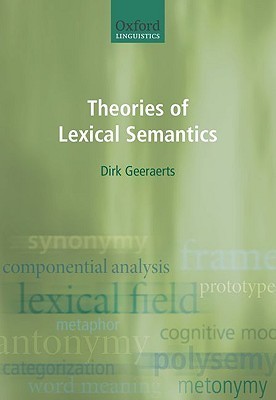
Theories of Lexical Semantics
Theories of Lexical Semantics offers a comprehensive overview of the major traditions of word meaning research in linguistics. In spite of the growing importance of the lexicon in linguistic theory, no overview of the main theoretical trends in lexical semantics is currently available. This book fills that gap by charting the evolution of the discipline from the mid nineteenth century to the present day. It presents the main ideas, the landmark publications, and the dominant figures of five historical-philological semantics, structuralist semantics, generativist semantics, neostructuralist semantics, and cognitive semantics. The theoretical and methodological relationship between the approaches is a major point of attention throughout the going well beyond a mere chronological enumeration, the book does not only describe the theoretical currents of lexical semantics, but also the undercurrents that have shaped its evolution.
- GenresLinguisticsNonfiction
341 pages, Paperback
First published October 31, 2004
About the author
Dirk Geeraerts
21 books5 followersDirk Geeraerts holds the chair of theoretical linguistics at the University of Leuven, Belgium. He is the founder of the research unit Quantitative Lexicology and Variational Linguistics (QLVL). His main research interests involve the overlapping fields of lexical semantics, lexicology, and lexicography, with a theoretical focus on cognitive semantics.
His involvement with cognitive linguistics dates from the 1980s, when in his PhD thesis he was one of the first in Europe to explore the possibilities of a prototype-theoretical model of categorization. As the founder of the journal Cognitive Linguistics and as the editor (with Hubert Cuyckens) of the Handbook of Cognitive Linguistics, he played an instrumental role in the international expansion of cognitive linguistics.
Geeraerts is one of the outspoken advocates of the implementation of empirical methodologies, such as corpus linguistics in cognitive linguistic research and also argues for the involvement of more pragmatic elements such as contextual factors that influence the construal of word meanings and the choice of 'names' for concepts and the historical implications these have in relation to etymology and lexicology.
His involvement with cognitive linguistics dates from the 1980s, when in his PhD thesis he was one of the first in Europe to explore the possibilities of a prototype-theoretical model of categorization. As the founder of the journal Cognitive Linguistics and as the editor (with Hubert Cuyckens) of the Handbook of Cognitive Linguistics, he played an instrumental role in the international expansion of cognitive linguistics.
Geeraerts is one of the outspoken advocates of the implementation of empirical methodologies, such as corpus linguistics in cognitive linguistic research and also argues for the involvement of more pragmatic elements such as contextual factors that influence the construal of word meanings and the choice of 'names' for concepts and the historical implications these have in relation to etymology and lexicology.
Ratings & Reviews
Friends & Following
Create a free account to discover what your friends think of this book!
Community Reviews
Displaying 1 - 3 of 3 reviews

Read
September 16, 2026takedown of natural semantic metalanguage so brutal i googled "anna wierzbicka dirk geeraerts enemies"

May 31, 2021
unreadable.

January 20, 2013
verbose.
Displaying 1 - 3 of 3 reviews