

What do you think?
Oxford Logic Guides #34
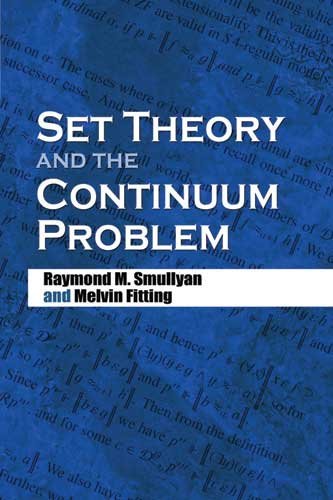
Set Theory and the Continuum Problem
A lucid, elegant, and complete survey of set theory, this volume is drawn from the authors' substantial teaching experience. The first of three parts focuses on axiomatic set theory. The second part explores the consistency of the continuum hypothesis, and the final section examines forcing and independence results.
Part One's focus on axiomatic set theory features nine chapters that examine problems related to size comparisons between infinite sets, basics of class theory, and natural numbers. Additional topics include author Raymond Smullyan's double induction principle, super induction, ordinal numbers, order isomorphism and transfinite recursion, and the axiom of foundation and cardinals. The six chapters of Part Two address Mostowski-Shepherdson mappings, reflection principles, constructible sets and constructibility, and the continuum hypothesis. The text concludes with a seven-chapter exploration of forcing and independence results. This treatment is noteworthy for its clear explanations of highly technical proofs and its discussions of countability, uncountability, and mathematical induction, which are simultaneously charming for experts and understandable to graduate students of mathematics.
Part One's focus on axiomatic set theory features nine chapters that examine problems related to size comparisons between infinite sets, basics of class theory, and natural numbers. Additional topics include author Raymond Smullyan's double induction principle, super induction, ordinal numbers, order isomorphism and transfinite recursion, and the axiom of foundation and cardinals. The six chapters of Part Two address Mostowski-Shepherdson mappings, reflection principles, constructible sets and constructibility, and the continuum hypothesis. The text concludes with a seven-chapter exploration of forcing and independence results. This treatment is noteworthy for its clear explanations of highly technical proofs and its discussions of countability, uncountability, and mathematical induction, which are simultaneously charming for experts and understandable to graduate students of mathematics.
336 pages, Paperback
First published November 14, 1996
About the author
Raymond M. Smullyan
64 books285 followersRaymond M. Smullyan was a logician, musician, Zen master, puzzle master, and writer.
Ratings & Reviews
Friends & Following
Create a free account to discover what your friends think of this book!
Community Reviews
Displaying 1 - 1 of 1 review

December 25, 2009
Axiomatic set theory is much simpler in NBG than in ZF.
Displaying 1 - 1 of 1 review