This work has been selected by scholars as being culturally important and is part of the knowledge base of civilization as we know it.
This work is in the public domain in the United States of America, and possibly other nations. Within the United States, you may freely copy and distribute this work, as no entity (individual or corporate) has a copyright on the body of the work.
Scholars believe, and we concur, that this work is important enough to be preserved, reproduced, and made generally available to the public. To ensure a quality reading experience, this work has been proofread and republished using a format that seamlessly blends the original graphical elements with text in an easy-to-read typeface.
We appreciate your support of the preservation process, and thank you for being an important part of keeping this knowledge alive and relevant.
Homer (Greek: Όμηρος born c. 8th century BC) was a Greek poet who is credited as the author of the Iliad and the Odyssey, two epic poems that are foundational works of ancient Greek literature. Homer is considered one of the most revered and influential authors in history. Homer's Iliad centers on a quarrel between King Agamemnon and the warrior Achilles during the last year of the Trojan War. The Odyssey chronicles the ten-year journey of Odysseus, king of Ithaca, back to his home after the fall of Troy. The poems are in Homeric Greek, also known as Epic Greek, a literary language which shows a mixture of features of the Ionic and Aeolic dialects from different centuries; the predominant influence is Eastern Ionic. Most researchers believe that the poems were originally transmitted orally. Despite being predominantly known for its tragic and serious themes, the Homeric poems also contain instances of comedy and laughter. Homer's epic poems shaped aspects of ancient Greek culture and education, fostering ideals of heroism, glory, and honor. To Plato, Homer was simply the one who "has taught Greece" (τὴν Ἑλλάδα πεπαίδευκεν). In Dante Alighieri's Divine Comedy, Virgil refers to Homer as "Poet sovereign", king of all poets; in the preface to his translation of the Iliad, Alexander Pope acknowledges that Homer has always been considered the "greatest of poets". From antiquity to the present day, Homeric epics have inspired many famous works of literature, music, art, and film. The question of by whom, when, where and under what circumstances the Iliad and Odyssey were composed continues to be debated. Scholars remain divided as to whether the two works are the product of a single author. It is thought that the poems were composed at some point around the late eighth or early seventh century BC. Many accounts of Homer's life circulated in classical antiquity; the most widespread account was that he was a blind bard from Ionia, a region of central coastal Anatolia in present-day Turkey. Modern scholars consider these accounts legendary.
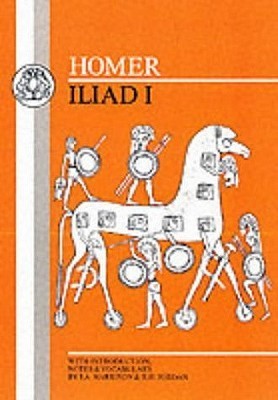
This a handy little book. Iliad Book I is a stand alone dramatic masterpiece, and all students wishing to appreciate Homer must read it very early on -- all 611 lines. It has an excellent summary of Homeric grammar, a complete vocabulary, and helpful notes. Unlike Draper's Iliad, Book 1, this book leaves the student on his own to do the work of actually translating. Unfortunately, in its reprinted form today the font quality is rather poor and even difficult to read in places -- a drawback.
I dare not and need not comment on the great beauty of this classic. I can only say that this student edition provides a good introductory text with pertinent commentary that aids the sense of the Greek. There is a front-facing literal English translation that can be helpful if the student becomes hopelessly stuck, but hurtful if the student is hopelessly undisciplined. I did find that the binding does not take much abuse (and frequently translation requires long periods with the book open to a single page; soon the pages start to come out of the book.)