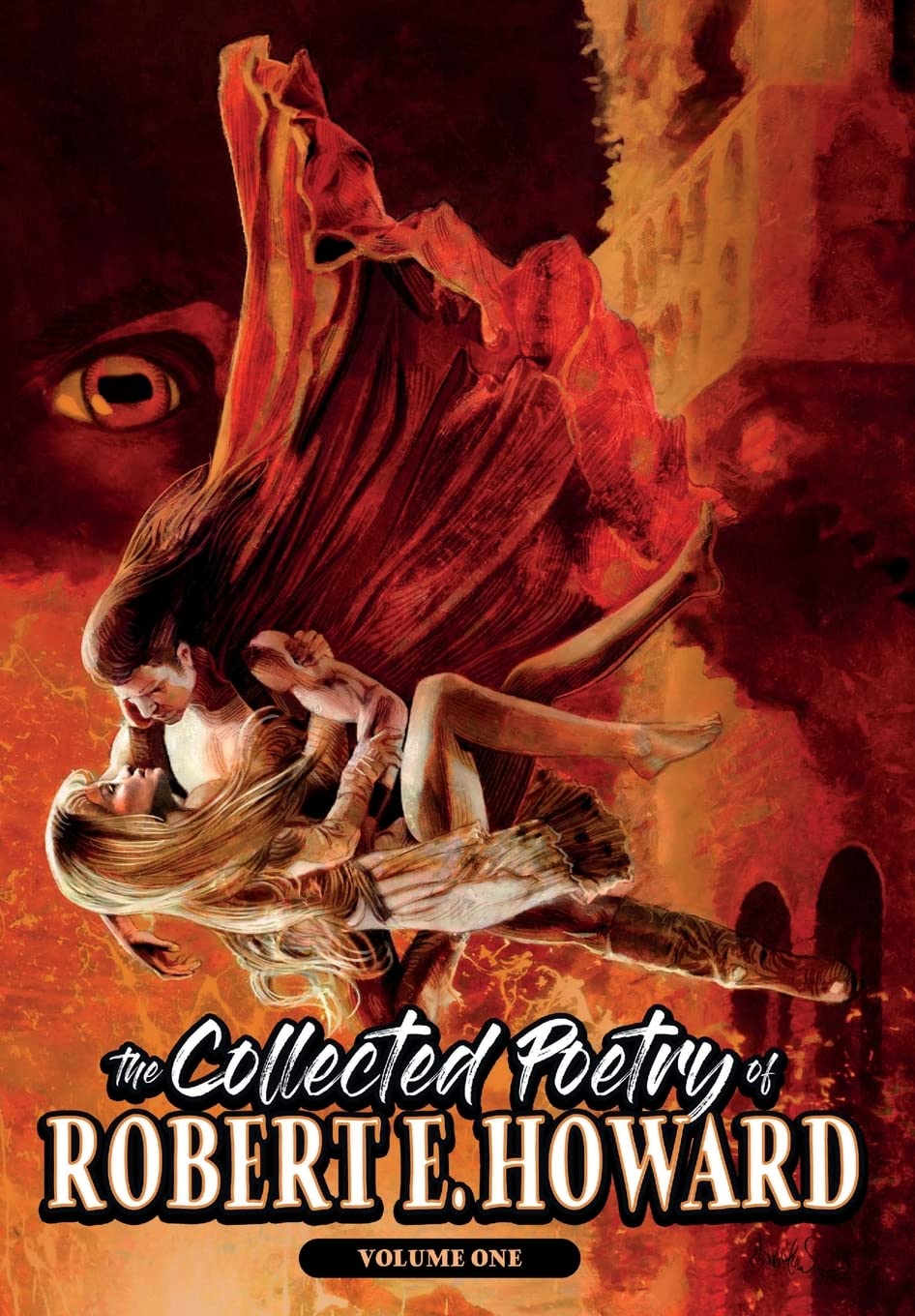
Robert E. Howard wrote poetry. He wrote it first in life, last in life, and throughout life. Howard completed around 300 stories for commercial sale and worked on 300 more. But he wrote over 700 poems, virtually none of them meant for commercial markets. His first publication outside of school was his poem “The Sea”, published in a local paper. His famous “All fled, all done…” couplet, borrowed from Viola Garvin, was allegedly the last words he typed. And in between, poetry gushed from him.
Howard poured himself into his poetry, undisguised. What amazed him, what drew him, what scared him, what sickened him. He wasn’t worried about what we the eventual readers would think of him as an author. And perhaps this is true of any real poet, the fearlessness of saying what one really wants to say.
This three-volume set, The Collected Poems of Robert E. Howard includes all of Howard’s poetry that has been found, including all the earlier draft versions, where such exist. This is indeed the Ultimate collection of Robert E. Howard’s poetry.
This is the “Ultimate Edition” which just means that it’s printed on demand. Each volume is printed in hardback with a dust jacket. The cover design and artwork are by Mark Wheatley.
Robert Ervin Howard was an American pulp writer of fantasy, horror, historical adventure, boxing, western, and detective fiction. Howard wrote "over three-hundred stories and seven-hundred poems of raw power and unbridled emotion" and is especially noted for his memorable depictions of "a sombre universe of swashbuckling adventure and darkling horror."
He is well known for having created—in the pages of the legendary Depression-era pulp magazine Weird Tales—the character Conan the Cimmerian, a.k.a. Conan the Barbarian, a literary icon whose pop-culture imprint can only be compared to such icons as Tarzan of the Apes, Count Dracula, Sherlock Holmes, and James Bond.
—Wikipedia
Librarian Note: There is more than one author in the Goodreads database with this name.
I did not realize how prolific a poet Howard was. This first of three volumes of his poetry contains his published and finalized poems. It was a great experience to encounter his poems. They are as full of energy and color as his well known prose.
The Collected Poetry of Robert E Howard volume 1. Contains roughly 300 poems of the 700-plus poems that Howard wrote in his lifetime. There are some good poems in this collection the majority of which never saw publication. Much like Robert E Howard’s short stories, each of one of his poems tells a story with the same style and vigour. The book splits the poems into sections, section one is finished and professional. Section two - titled drafts. Each of the poems covers a wide variety of subject matter. I can just imagine many of these poems being sung to music in some backwater tavern. Brilliant stuff!
The book began with a "Finished and Professional" section called "Singers in the Shadows." I was delighted that "Zukala's Hour" was first up, then discovered a new poem that I love, "Rebel," and I shuddered in fearful delight at the last few of this section. I am typically ambivalent toward poetry in general, but REH likes to tell stories more than some weird word-picture of a vague emotion. I like that.
The second collection was, "Images out of the sky," a collection put together in REH's younger years with Tevis Clyde Smith and Lenore Preece. This only includes REH's portion, presented in the order he intended. It was interesting reading the collection as a collection, in the order he wanted. Usually I only see these poems by themselves in various volumes.
Next up was a set of REH's cycles, "Sonnets Out of Bedlam." Most of the poems in this cycle were sold to Weird Tales individually. I particularly enjoyed "The Dream and the Shadow" and "The Soul-Eater."
This was followed by REH's second cycle, "The Voices of the Night, aka The Iron Harp." Only a few poems were assigned to this cycle. I liked "Moon Shame" and "A Crown for a King" the best, probably because they told stories instead of just described a scene or feeling.
REH's next cycle was "Black Dawn." I found these poems a little less accessible for me, meaning I found them a little hard to follow. The story-telling wasn't there so much as in the previous poems. Shadows (1) was probably my favorite of this particular cycle, but mostly because I thought the end had an interesting and thoughtful twist that I didn't expect.
The "Finished and Professional" section was followed by a "Poetry Journals, etc" section, which contained poems REH sold or sent into various poetry journals around the country. I liked "Tides" and "Flaming Marble (1)" the best in this section.
This was followed by the "Poetry in the Pulps" section, which were mostly poems sold to Weird Tales (and one to The Ring). Most of these have been reprinted time and again, and I've read them all before, but I feel like I gave them a more "real" read this time around (instead of just quickly glossing them over, which is my tendency with poetry).
"Poetry in Pulp Stories" came next, which were mostly chapter headings and the like. It was interesting seeing the poems divorced from their stories, and allowed them to be seen as the poems they are. While I've read them before (as I've read the stories), this presentation gives them a difference reading, which I enjoyed.
"Ready to Send Drafts" section came next in the book. Many great poems that I liked in here, and a few that didn't work for me. "The King and the Oak" of course, with King Kull, I have read before, but it's still great. And more of the Zukala poems which I like (The Tower of Zukala, an alternate version of that one, and Zukala's Jest). I really like these. "Buccaneer Treasure" is excellent, with a fun story.
The next section was "Ready to Send Poetry in Pulp Stories," which were poems included in short stories that failed to sell. I've read most of these before when I read the stories in various collections. A lot of these were from "Men of the Shadows" (Bran Mak Morn).
After all of this, a new section called "Titled Drafts" came next, which was then subdivided. The first subsection was called "Introductory Sampling." "Flight" was my favorite of this section, but I also have loved "Musings (1)" and "A Word from the Outer Dark" for a long time. "The Tempter" was particularly haunting, and I'd love to know when it was written as it foreshadows REH's suicide rather poignantly.
The next section of "Titled Drafts" were poems about "Seeking Adventure and Freedom." I liked "Men Build Them Houses" the best, although "To the Old Men" struck me as particularly wonderful too.
The next section of REH's titled drafts was called "Fantastical." I really enjoyed "The Rhyme of the Three Slavers" and the untitled draft version of "The Coming of Bast" was quite good. I don't quite get prose poems, which this section ended with, but I liked reading them. I just don't know why they are called poems instead of essays. "Skulls and Orchids" surprised me, with a woman discarded by a man in favor of a young boy.
The "Historical and Observational" section of "Titled Drafts" was next. These were not among my favorite of REH's poems in general, but I did like "Thor's Son" and "Swamp Murder" reasonably well.
The next sections of Titled Drafts were "Humor" and "Naughty." "The Cooling of Spike McRue" was entertaining, as was "The Whoopansat of Humorous Kookooyam". I also enjoyed "The Ballad of Singapore Nell." Again, you will note I tend to prefer the ones that tell a story. The Cooling of Spike McRue was a boxing poem. The Whoopansat... was pretty much about wives who cheat on their husbands while the husbands are out playing poker. The Ballad of Singapore Nell is about a tough woman who knifes a pirate who cheats on her and ends up working in Hollywood.
The final section of the poetry was, "Darker Moods." These were definitely that. I am not a particularly dark person, so these weren't necessarily my cup of tea, but I do like a lot of dark characters, so "The Road to Hell" did appeal to that part of me. "Emancipation" felt like quintessential REH.
I would have liked some additional annotations, such as publication dates, writing dates (if known), and some information about some of the subject matter (I had to look up a few, like Mihiragula), but overall I think this was a good presentation of REH's finished poems and titled drafts. I am looking forward to the final two volumes of this series.
This book is what it says, a collection of Robert E Howard's (Conan, Kull, Solomon Kane, etc.) poetry. I had seen some of his poems read on Youtube, so had some idea what I was getting into. The man had a gift for setting a mood, darker moods especially. The imagery he sues is as vivid as his stories, often even more so, giving a lot of these a dream-like quality. Some of these poems are narrative stories, others just lyric pieces capturing his moods, and a few revel in (sometimes bawdy) humor. And they all pretty much all rhyme, sometimes in creative rhyme schemes you don't see much (though a few patterns don't quite hit). One thing I would say, Robert E Howard, who suffered from depressive moods and ultimately took his own life, can go to dark places. His prose, by comparison, focused more on adventure, even when it worked the horror it. These poems often get very broody, often 'Goth,' for lack of a better word. And he seemed to have a juvenile obsession with Satan and Hell, which crops up several times. It's easy to understand how such a man got along so well with Lovecraft. I could see some readers finding a few of these poems quite morose. Something to pay attention to, if that's not your thing. But altogether a good collection displaying the skills of a gifted, if tragic, writer.