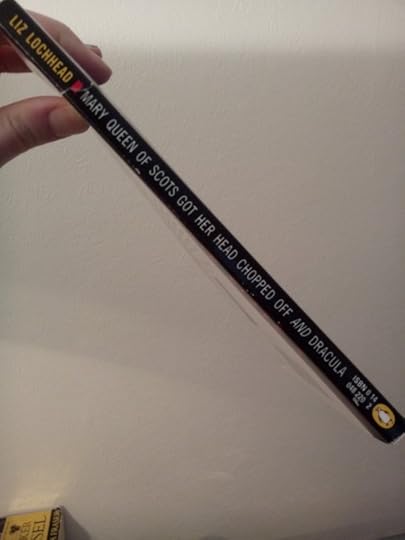
This was a huge success at the 1987 Edinburgh Festival, subsequently performed elsewhere in Britain and in Europe. Written in Lallan Scots, it is a most exciting piece of poetic drama.
Liz Lochhead is a Scottish poet and dramatist, originally from Newarthill in North Lanarkshire. In the early 1970s she joined Philip Hobsbaum's writers' group, a crucible of creative activity - other members were Alasdair Gray, James Kelman, and Tom Leonard. Her plays include Blood and Ice, Mary Queen of Scots Got Her Head Chopped Off (1987), Perfect Days (2000) and a highly acclaimed adaptation into Scots of Molière's Tartuffe (1985). Her adaptation of Euripides' Medea won the Saltire Society Scottish Book of the Year Award in 2001. Like her work for theatre, her poetry is alive with vigorous speech idioms; collections include True Confessions and New Clichés (1985), Bagpipe Muzak (1991) and Dreaming Frankenstein: and Collected Poems (1984). She has collaborated with Dundee singer-songwriter Michael Marra.
In January 2011 she was named as the second Scots Makar, or national poet, succeeding Edwin Morgan who had died the previous year.
Haven't fully decided about this yet -- however, it's not true that it's written in Lallans Scots. Parts of it are in Scots, parts are in English, parts switch in and out of the old ballads. Queen Elizabeth definitely speaks in English.
About to see this on stage, so although I have read the play now three times -- and I think I like it very well -- the jury is out until I see it in action.
It's always hard to read plays when you haven't seen or cannot see them on stage. I really would've liked to see "Mary Queen of Scots got her Head chopped off" or "Dracula" on stage.
I liked the mixture of languages in connection to "Mary", especially the old Scots is grand. It's interesting to see who switches to what language where.
"Dracula" manages to go beyond Stoker, while staying true to the original. It's really tragic and not that gory (as far as I can tell).
However, both plays were hard to read in places. It was hard to distinguish between characters when loads of them are all in one scene. (I'm not good with names, especially not when reading plays.)
Yet, this was entertaining and I would love to see the plays on stage (the text doesn't work for me that much), so...
L'ho letto per preparare un esame universitario e non e' stato un testo semplice. Un mix di inglese e "scot" (dialetto scozzese) ha sicuramente reso la lettura un po' complicata.
Quello che invece ha colpito e' stato il modo in cui la Lochead sia andata oltre la storiografia ufficiale per descrivere due personaggi storici molto complessi quali Elizabeth I e Mary Stuart, cugine e rivali, cosi' lontane in vedute politiche e agli antipodi in credenze religiose ma cosi' vicine dal punto di vista psicologico e sentimentale. Elizabeth e Mary amano, soffrono, combattono le loro fragilita' e le loro battaglie. Una piece vista dal punto di vista femminile e introspettivo, in un epoca in cui entrambi dovevano essere messi da parte in nome della ragion di stato.
Never read her before. Not sure how she slipped me by, given the local unanimity about her, as literary. figurehead. Hard to picture – there’s lots of disjointed speech and speaking to camera. No doubt it was important to take Mary off the shortbread tin and into her real betrayal at the time.