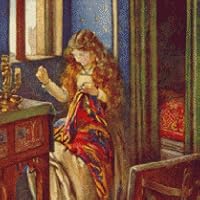
Well do I, Hugo Gottfried, remember the night of snow and moonlight when first they brought the Little Playmate home. I had been sleeping -- a sturdy, well-grown fellow I, ten years or so as to my age -- in a stomacher of blanket and a bed-gown my mother had made me before she died at the beginning of the cold weather. Suddenly something awoke me out of my sleep. So, all in the sharp chill of the night, I got out of my bed, sitting on the edge with my legs dangling, and looked curiously at the bright streams of moonlight which crossed the wooden floor of my garret. I thought if only I could swim straight up one of them, as the motes did in the sunshine, I should be sure to come in time to the place where my mother was -- the place where all the pretty white things came from -- the sunshine, the moonshine, the starshine, and the snow. "Come down and be killed, foul brood of the Red Axe " the children cried. And with that they ran as near as they dared, and spat on the wall of our house, or at least on the little wooden panel which opened inward in the great trebly spiked iron door of the Duke's courtyard.
Samuel Rutherford Crockett was a Scottish novelist. He was born at Duchrae, Balmaghie, Kirkcudbrightshire, the illegitimate son of dairymaid Annie Crocket. He was raised on his grandfather's Galloway farm, won a bursary to Edinburgh University in 1876, and graduated from there during 1879.
After some years of travel, he became in 1886 the Free Kirk minister of Penicuik. During that year he produced his first publication, Dulce Cor (Latin: Sweet Heart), a collection of verse under the pseudonym Ford Brereton. He eventually abandoned the Free Church ministry for full-time novel-writing in 1895.
The success of J. M. Barrie and the Kailyard school of sentimental, homey writing had already created a demand for stories in Lowland Scots when Crockett published his successful story of The Stickit Minister in 1893. It was followed by a rapidly produced series of popular novels frequently featuring the history of Scotland or his native Galloway. Crockett made considerable sums of money from his writing and was a friend and correspondent of R. L. Stevenson, but his later work has been criticised as being over-prolific and feebly sentimental.
Crockett was well travelled in Europe and beyond, spending time in most European countries and he wrote several novels of European history including The Red Axe (1898), A Tatter of Scarlet (1913), and the non-fiction The Adventurer in Spain (1903) which holds its own against Robert Louis Stevenson's travel writing.
A dystopian fantasy novel set in medieval Central Europe. It comes with a good duke, a bad duke, a good princess, a bad princess and an hereditary executioner. Mostly entertaining.
Not my favorite S.R. Crockett novel. But still quite interesting and enjoyable.
The Red Axe is told in the first-person past tense by Hugo Gottfried-son of 'The Red Axe', the hated and feared interrogator and executioner of Duke Casimere. the equally hated and feared tyrannical ruler of the Wolfsmark. The Red Axe dwells in the foreboding Red Tower alone (since the death of his beloved wife) with his only son. Until one night the Duke returns from his warring with the neighboring Kingdom with many noble prisoners. Including a little girl whom Hugo convinces his father to claim as his portion of the booty. This little girl becomes The Red Axe's adopted daughter, as well as Hugo's "Little Playmate" and eventual love interest. Hugo's father is the fifteenth in his line and as a matter of course Hugo must become the sixteenth 'Red Axe' at the death of his father. Hugo hates the idea of this eventuality and has made a vow never to take up his hereditary office.
One reviewer called this dystopian. It's most definitely not what I would think of as dystopian but it is gothic. Contrasts are strong in both locations and characters; The two kingdoms. The two rulers. The two ladies. And even in The Red Axe himself- a dour and immovable interrogator and headsman to the outside world. Yet a loving and gentle father at home.