This catalogue accompanies the first exhibition dedicated to landscapes bythe Symbolists, the innovative movement whose artists took imaginative andemotional approaches to painting and embraced themes like music, nationalism,science, and modernity.The book focuses on major artists of the avant-garde such as Gauguin, van Gogh,Munch, Mondrian, and Kandinsky, and also showcases other inventive artists fromthroughout Europe such as Hammershoi, Hodler, Khnopff, and Gallen-Kallela, whoare set alongside the visionary British artistry of Crane, Leighton, Watts, and Millais.The works illustrated here offer a range of poetic and suggestive interpretations ofnature from the period 1880–1910, with essays by acknowledged experts in thefield providing a new chapter in the history of landscape painting.
...the reaction against naturalism and the desire for more evocative art was simultaneous and widespread. [...] Symbolism was not a single style... Rather, it was a frame of mind that artists shared, responding to the mood or emotion they found in nature... they therefore chose the means of expression to conjure up a mental state in the spectators.
"Landscapes and Symbols" Rodolphe Rapetti symbolist art, which focuses on content and is conditioned by an underlying narrative... offers inexhaustible iconography, concealing hidden meanings and connections with literature.
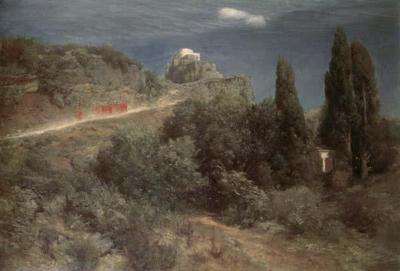
Arnold Bocklin, "Mountain Castle with Procession" 1871
"Arcadia Contested" Richard Thomson The last three decades of the nineteenth century brought enormous changes to European society, and with those changes came great anxieties. The imagery of landscape... was used by artists to provide a balm and escape from such pressures. But much the same imagery, cast in a gloomy light, could also be subverted into a melancholic meditation.
"Dream Landscapes" Anna-Maria von Bonsdorff Symbolist artists attempted to open the door to the unconscious and to depict the world from a completely new viewpoint -- from beyond visible reality. ... Symbolism represented a necessary response to the single-track approach of Naturalism, which replicated the material world and depicted human existence from a rationalist point of view.
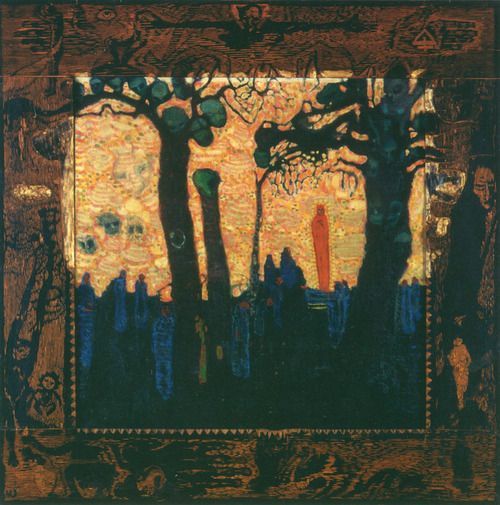
Josef Vachal, "Invokers of the Devil" 1909
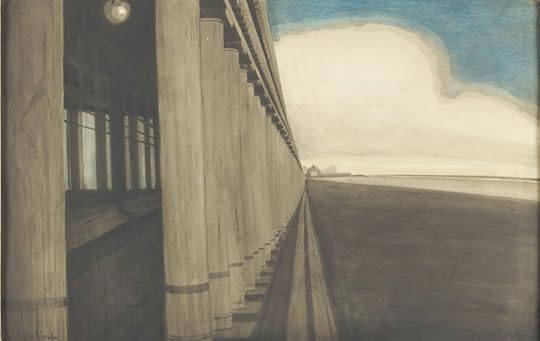
"Silent Cities" Frances Fowle To many symbolist artists the modern city was overcrowded, dirty, disease-ridden and potentially threatening; it signified joylessness, claustrophobia and anonymity. Symbolist art rejected progress and modernity, and many of its protagonists withdrew into an imaginary world of darkness and silence. ...A recurrent theme in symbolist art is the loss or concelament of identity.
Leon Spilliaert, "Royal Galleries"
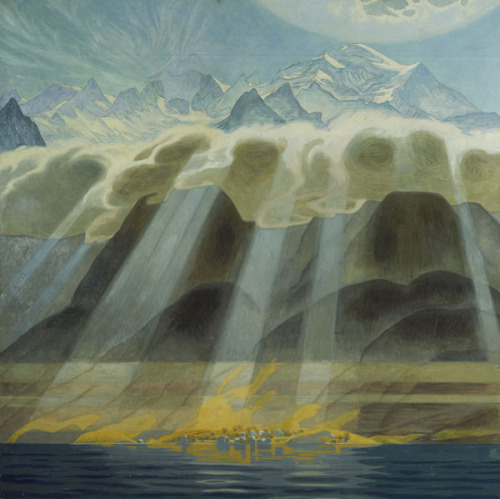
"The Cosmos and the Rhythms of Nature" Richard Thomson During the second half of the nineteenth century science was making enormous advances. ... Old systems of belief, in which man was the centre of the universe, had been shattered, New ways of understanding the world around us, as a constantly shifting cosmos in which man is subject to immense forces...
Jens Ferdinand Willumsen "Sun Shining on the Southern Mountains" 1902
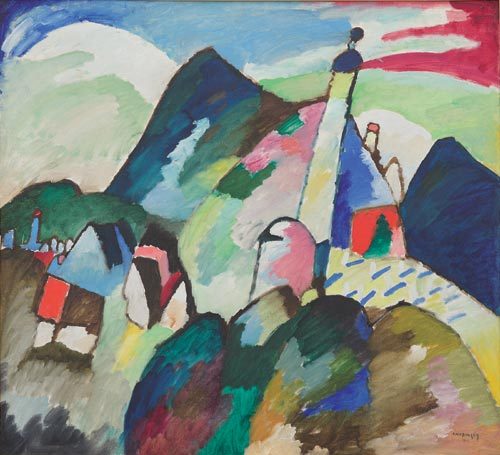
"Into the Mystic" Richard Thomson landscape a treatment of motif and a choice of chromatics which, by contrast, evoked parallels with other, less materialistic, forms of expression such as the musical and the spiritual.
Vasily Kandinsky "Murnau with a Church II" 1910
There are appended endnotes, bibliography, and biographic thumbnails of the artists.
Art selection: 5 stars. I've read a number of books on this area of art and they tend to include the same works over and over; this collection included a greater variety, even some I wasn't familiar with.
Essays: 3 stars. Some are better than others, but taken as a whole they are prone to over-generalizations and also show a lack of coordination; by which I mean that there is quite a bit of repetition (I think I read nearly the same sentences about landscape three times in different essays) and once in a while they contradict one another. There are also some arguable statements such as impressionism: painting with no subject, the outcome of an immediate response to nature which could be substantially misleading to someone who didn't know better.
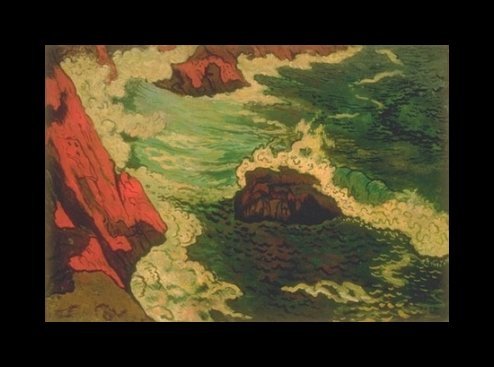
Georges Lacombe "Le mer grise"
My recommendation, in brief: if you're familiar with period, skip the essays and look at the art. If you're new to the subject, read at least the introductory pages of each section, but take them with a grain of salt.
I gather, from publication histories and the like, that Rodolphe Rapetti is a well-respected authority on the Symbolist movement of the late 19th-Century. Unfortunately, his essays in Van Gogh to Kandinsky: Symbolist Landscape in Europe 1880-1910 are the weakest of the volume. Thankfully, his essays are only two of the seven presented therein. The others range from good to excellent, with Anna Maria von Bonsdorff's essay on "Dream Landscapes" and Frances Fowle's on "Silent Cities" being the standout contributions to the volume. And while I enjoyed Richard Thomson's "Into the Mystic," I don't really buy his implied argument that there is a direct line of succession from the Symbolists to early abstractionists. There's a little too much looseness in the connections he hints at.
This is my biggest problem with the volume as a whole. While Thomson's "Arcadia Contested" is rigorous and convincing in showing how certain landscapes clearly fell within Symbolist philosophical bounds, Rapetti, in "Symbolism and Naturalism" claims that some art created in the Symbolist era "remains unclassifiable according to the style labels in use today" then uses this unclassifiability to shoehorn anyone whose work appeared during that time period into the Symbolist bucket. It's unconvincing and feels contrived to anyone who has studied history, let alone art history. Just because a work was created during a certain time period does not mean that it was influenced by or that it influenced the dominate movement of the time. Else how do historians account for transitions from one movement to another?