Jump to ratings and reviews
Rate this book

Evidence of Evolution

Rate this book
Published to commemorate the 150th anniversary of Charles Darwin's On the Origin of Species, Evidence of Evolution uses exquisite images by distinguished photographer Susan Middleton to reveal beautiful and surprising patterns of evolutionary development in animals and plants. These photographs, of rare and remarkable specimens from the collections of the California Academy of Sciences in San Francisco, are accompanied by a clear, accessible overview of the key evolutionary concepts that explain life on Earth, by science writer Mary Ellen Hannibal.
Virtually a natural history museum in a book, Evidence of Evolution expresses the power of Darwin's vision in images and words that bridge art and science.

128 pages, Hardcover

First published January 1, 2009

1 person is currently reading
37 people want to read

About the author

Mary Ellen Hannibal

8 books30 followers

Ratings & Reviews

What do you think?
Rate this book

Friends & Following

Create a free account to discover what your friends think of this book!

Community Reviews

5 stars
8 (33%)
4 stars
13 (54%)
3 stars
3 (12%)
2 stars
0 (0%)
1 star
0 (0%)
Displaying 1 - 6 of 6 reviews
Profile Image for Philip.
1,812 reviews123 followers
July 24, 2025
Brilliant, subtly beautiful, and massively nerdy not-quite-coffee-table book whose heroes are those scientists, researchers and taxonomists studying these "evidences of evolution" in labs and basements of natural history museums around the world.* Indeed, "the not-so-simple act of naming is the ground zero of knowledge about nature…as such, taxonomical naming is the first step to take in the effort to save life on Earth." As such, it is a paean to—and convincing argument for—the vast, unseen-by-the-public collections of specimens built up over centuries, especially in light of recent advances in molecular and genetic research, while also asking (if not quite answering) the question "when is enough?"

So…yay, bio-geeks!


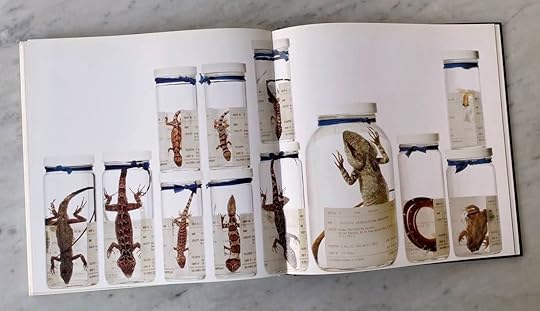
(Recently discovered lizards from Burma, the blue ribbons indicate these are all "holotype specimens," i.e., the original specimen representing a species, against which all others will be compared)


So yeah, not "ooh and ahh" beautiful like many such books, but great in its own way—especially for anyone who is a natural (and nature) collector themselves. Far too much here to go into in detail, so strongly recommend anyone interested look for this book themselves, (Amazon has "very good" copies for around $6). But just as an amuse bouche, here's a sample of some of the stuff I learned:
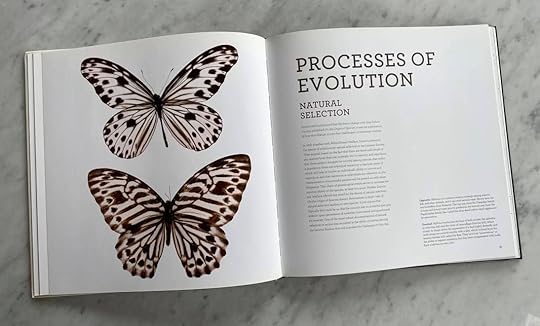
• Butterfly wings are brilliant on top and dull on the bottom, because when they land on plants and trees they fold their wings up, so that the dull undersides serve as camouflage. Meanwhile, moth wings are dull on top, as they DON'T fold their wings and so it is that top surface that hides them at rest.

• Hermaphrodites vs. gynandromorphs—the first just have the sexual organs of both sexes, while the latter have a greater diversity of both male and female characteristics (seen mainly in insects, crustaceans and butterflies).

• Vestigial vs. exapted—i.e., structures like the human appendix and snake legs that were once functional but which through evolution have totally lost their purpose or even disappeared altogether; vs. structures whose original purpose has evolved into something that now fulfills a new role, such as bird feathers (changing from a warming feature to a flight function) or penguin wings (changing from flight to underwater navigation).

• Beavers are the world's second-most “adept adapters,” manipulating their environments and creating entire new ecosystems to levels only surpassed by humans. ALSO, beavers are so well adapted to aquatic life that in the 18th century, they were classified as "fish" and could be eaten by Catholics on fasting days!

• Most insects have four wings, but beetles only have two, as the top wings have evolved into hard protective coverings to allow them to burrow—thereby exploiting a previously ignored ecological niche; ALSO, beetles alone account for 25% of all animals on earth (while all arthropods account for a full 90% of living creatures); ALSO, insects are the only truly winged animals, as everything else—birds, bats, dinosaurs—evolved wings from other limbs.

• Convergence (kind of knew this before, but better explained here)—how similar traits evolve separately in unrelated species. Examples are how birds, bats, insects, gliding mammals and pterosaurs all independently evolved flight mechanisms; while eels, snakes, earthworms and caecilians (bizarre snakelike mammals—look 'em up) have evolved into whatever the hell they are.

• Sand dollars are WAY cooler than I ever realized, knowing them only as beach relics. However, living sand dollars play a crucial role in ocean maintenance, and are just bizarre little creatures—there are various YouTube videos you can watch, most of which (like much good science, since we grownups have "more important things to think about") are aimed at children.

• And a huge shout-out here to my boy Alfred Russel Wallace, who has always been more of a footnote in the story of evolution, running a close second behind Darwin, (and we rarely focus on who came in second right?). However, as the global biosphere suffers more and more from climate change, habitat loss and invasive species, Wallace is belatedly receiving the full recognition he deserves as the father of 'biogeography," which in its relatively shorter term impacts is becoming more relevant than Darwin's really long term evolutionary changes. Indeed, while Wallace is best known for his Malay Archipelago, it's actually his The Geographical Distribution of Animals that is more important/relevant today.
ALSO, NEW VOCABULARY I LEARNED BUT WILL LET YOU LOOK UP YOURSELVES:
• Phylogenetics, clades/cladistics, biogeography, polyphyletic/paraphyletic/monophyletic, accessioning, thixotrophy, "genetic drift," "holotype specimens," "adaptive radiation," "evo devo" (i.e., evolutionary development)
And yes, as some other reviewers have noted, one star off for the super small type printed in gray—but that only brings my rating down from 10 stars to 9. HIGHLY RECOMMENDED FOR ALL THOSE PEOPLE WHO KNOW WHO THEY ARE.

* While the text here is universal, all of Middleton's wonderful photos are of samples in the massive collection found at San Francisco's California Academy of Science.
___________________________________

MY OWN PERSONAL TAXONOMY: I've long had a "nightstand reads" bookshelf for good—if long—books that can be (and are best) read slowly before bedtime, a random chapter or so at a time. However, obsessive-compulsive that I am, I realized I need another shelf for those other books—generally larger and therefore more bloody awkward—that are also best read slowly but definitely NOT in bed, which in my case means early morning with a cup of coffee in our small sunroom. Which I guess is…a warning? In that I'll be tossing some already-reviewed books onto that shelf, which means they'll probably pop up again in my overall feed since I STILL CAN'T FIGURE OUT HOW TO MAKE A SIMPLE CHANGE WITHOUT REBROADCASTING THE ENTIRE REVIEW TO THE WHOLE WORLD. So…apologies in advance.
Profile Image for Richard.
477 reviews6 followers
December 19, 2023
Evidence of Evolution with beautiful and economical text by Mary Ellen Hannibal and drop dead gorgeous photography by Susan Middleton is an oversized, coffee-table type book.
The pictures and the prose, both exhilarating and elegant, appears to me as a fingerprint, like a map of where we were and where we are.
-
I detracted a full point in my review for the terrible faint color used in producing the text of this book.
It was difficult to read, making it very easy for me to put the book down and come back to it after I calmed down.
Profile Image for Eling.
169 reviews16 followers
January 7, 2013
I'm giving this five stars for the photos (stunning! all taken from the immense collection at the CA academy of sciences) -- though if you are not into specimens in all their forms (taxidermy, jars, etc.) you might not enjoy them as much-- and three for the writing. Interesting stuff on evolution but not a lot of new material for a former student of the subject, and also slightly odd organization & random weird phrases and jargon. Pretty accessible & not too heavy if you're just peripherally interested in this area.
Profile Image for Paula.
Author 2 books253 followers
November 3, 2009
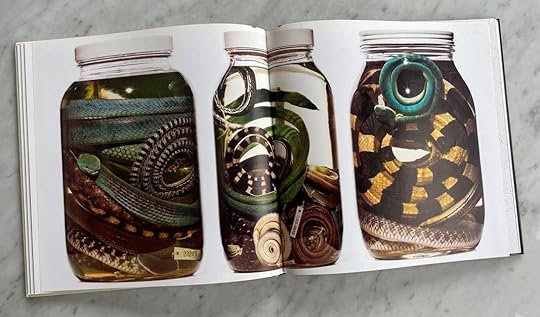
Invertebrates in jars. Study skins of Galapagos finches, tagged a century ago. Extremely freaky stick insects. What's photographer Susan Middleton got that you haven't got? Access to the collections of the California Academy of Sciences. Excellent lighting equipment. An eye for the beautiful and the unusual in natural history.

Mary Ellen Hannibal's text ain't too bad either - readable and well-organized.
Profile Image for Denise.
Author 1 book32 followers
March 15, 2012
Beautiful photography and the basics of Evolution. Makes me wish I could make it over to the CAS more often.
Displaying 1 - 6 of 6 reviews

Can't find what you're looking for?

Get help and learn more about the design.