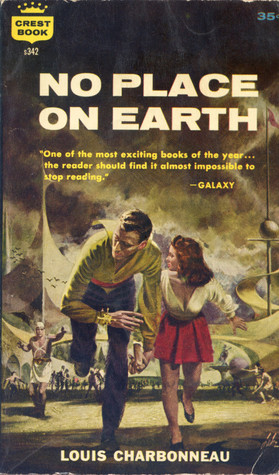
Petr Clayborne, a member of the Underground has opposed the Leader Government and is caught. In the hands of his old enemy, Captain Hartog, he is told that he has killed his wife who has also betrayed him, and shock treatment induces the recall here--of his marriage to Alda and their forbidden relations which resulted in an unauthorized pregnancy; of their attempt to escape through the Underground; of the failure of the getaway; and only finally--when Hartog is overpowered--is the true informer revealed and Petr released...Strictly for action, not speculation, this has been done before and better.--Kirkus
I’ve never read Louis Charbonneau before – in fact, I’d never even heard of him before I came across this in a second-hand bookstore. And the back cover blurb convinced me to try it, as I’m often a sucker for totalitarian dystopias (that, and it was only 95 cents). The blurb is an obvious riff on 1984 – the Great Leader, the Population Control Corps (PCC), ubiquitous surveillance, relentless propaganda, total control, etc and so on. And perhaps unsurprisingly, the actual story is not quite that.
The story is mostly told in flashback, opening with the protagonist Petr Clayborne, accused of being a member of an underground resistance, already captured and about to be subject to torturous interrogation by the cruel Captain Hartog. Only Petr remembers nothing, having dosed himself with a memory obliterator drug. Hence the electroshock therapy that can unlock those memories. As the interrogation progresses, Petr reveals more about how he went from propaganda writer to underground recruit, and how he ended up marrying Alda, the daughter of an underground leader – who may also have been a spy for the PCC (and whom Petr may have killed).
Well, Charbonneau is no Orwell, but then nobody is. The story itself is alright, building partly on the suspense of who the spy is, and the increasing revelation that Hartog is not a neutral party when it comes to Petr and Alda. That said, the novel focuses more on the action elements than the context – which is also its main weakness. Charbonneau’s 2240 Earth under the dictatorship under Malthus lacks imagination, particularly in terms of surveillance technology. On the other hand, Charbonneau has a good grasp of how people behave in such societies and tactics that authoritarian governments use to control them. So it’s an okay novel – it just could have been a much better one.
This was an interesting read. I really like this style of narrative, I've discovered, with interrogations/interviews and memories/flashbacks. It makes me super curious and drives me to keep reading. I wish there was more to it, I guess? I felt like the end was too easy, and I would've liked for the story to go just a little bit further, to have a little more resolution.
I read this book in the 60s. I really liked it at the time. But when I recently read it, I didn't care for it nearly as much. Set in the 25th century, it's a lot like the present day except for the fact that the Population Control Board (PCC) rules the dystopia with an iron hand. Oh, and that life spans have expanded enormously - not only longer lives, but longer adolescence and somewhat longer child-bearing years for women. But permission to conceive a child is delayed substantially also. Petr rebels against the PCC, for personal reasons, and joins the Underground. The happy ending is that he, his wife and his disapproved child all leave on a space ship for Venus, where Malthus's predictions about limitations on food production are disproved.
The copy we own is hardcover from the Science Fiction Book club.
I was wonderfully delighted to discover this pulp novel, as not only did I guiltily adore The Sentinel Stars, but I noticed that the premise was disturbingly similar to that of Dmitry Glukhovsky’s Future.
But I soon discovered that I wasn’t too much of a fan of No Place On Earth.
The main message is that overpopulation is a lie, and that there are absolutely enough resources for every person on Earth.
Petr and The Underground’s proof of this is that there are various edible algaes on Venus and that there is a huge possibility for experimental farms which are untouched by The Population Control Corps.
In 1958, this likely sounded scientifically accurate. The only problem is that the science is thoroughly outdated. As we know now, Venus is a gas planet, meaning there is no ground or soil for algae to possibly grow.
It isn’t just Venus. Earth is the only planet in the solar system which has food or natural soil to grow food. We could colonize the moon, and we could colonize Mars, but those planets still don’t have the basic necessities for humans to live off of.
Humans would have to find their own complicated ways of making the moon and Mars somewhat habitable, and there is still constant debate over the concept of terraforming.
Charbonneau never bothers to describe or explain the “experimental farms.” The closest thing to it that I can imagine are factory farms and farms using genetic modification.
The author’s lazy hesitation to explain what those farms would be like, is appalling. Perhaps if he were still alive, he would give us an answer.
Maybe if this was a true story, the Population Control Corps wouldn’t be sadists. They would actually be correct, to a point.
Overall, I just have too little faith in humanity and too much basic modern scientific knowledge to enjoy this book. The prose and the story itself is boring and mediocre, as well.
In the year 2240, Earth is ruled by the dictatorial Population Control Corps, which keeps the world in a state of constant famine. Petr Clayborne's father, Jack Clayborne, was a senior figure in the Underground, the only political opposition, but was executed when Petr was a child. Petr has no interest in following in his father's footsteps.
Petr is in PCC custody, and is being interrogated, with pharmaceutical help. Members of the Underground are given a false tooth with a liquid memory obliterator, instead of cyanide, if they are caught. Petr has used his fake tooth, and the PCC has supposedly developed a drug to reverse the obliterator. Captain Hartung of the PCC, a romantic rival for the affection of Petr's wife, Alda, is convinced that Petr knows the location and destination of a secret submarine which is about to slip out of the PCC's surveillance.
During the drug injections, Petr relives his life. Alda's father, who may or may not be a senior figure in the Underground, does not approve of their relationship, because of Petr's unwillingness to join the Underground. Alda and Petr are married in a bureaucratic process which bears a strong resemblance to spending a day at the DMV. They decide to have a child before they are authorized to do so, something which is very illegal. Petr eventually finds the Underground, which agrees to help them escape in the above-mentioned submarine. But, at every pickup point in New York City, the PCC is waiting. The only possible explanation is that there is a "mole" in the Underground. Does Petr reveal the sub's location to Captain Hartung? Do Alda and Petr escape via the Underground? What does the Underground know that could destroy the PCC's hold on power?
This one is pretty good. It is very "1984"-ish in that a loyal citizen slowly turns into an enemy of the state. It's a pretty "quiet" story in that there is very little violence until the end. For those who like reading dystopia stories, this is well worth reading.
I picked this mediocre, dated science fiction novel up at a resale shop because (a) it was a hardcover and (b) it was cheap. I knew nothing of the author, nothing of its contents beyond what the dust jacket said. This is typical book-buying behavior when it comes to "my" genre for light reading. As often happens, the book was pretty bad and I was disappointed. Still, the experience was over quickly.
This book was okay. I was glad to have arrived to the ending, that's for sure. The concept was interesting, though the way it was executed and how it all ultimately fell into place felt very underwhelming.