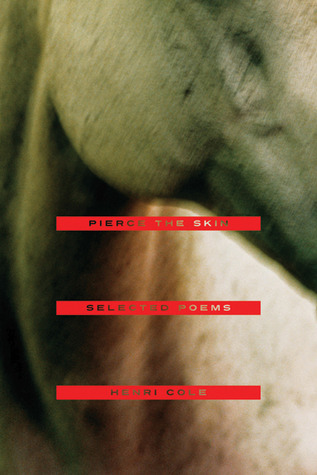
A GENEROUS SELECTION FROM ONE OF OUR GREATEST LIVING POETS
Henri Cole has been described as a "fiercely somber, yet exuberant poet" by Harold Bloom, who identifies him as the central poet of his generation. Cole's most recent poems have a daring sensitivity and imagistic beauty unlike anything on the American scene today. Whether they are exploring pleasure or pain, humor or sorrow, triumph or fear, they reach for an almost shocking intensity. Cole's fourth book, Middle Earth , awakened his audience to him as a poet now writing the poems of his career.
Pierce the Skin brings together sixty-six poems from the past twenty-five years, including work from Cole's early, closely observed, virtuosic books, long out of print, as well as his important more recent books, The Visible Man (1998), Middle Earth (2003), and Blackbird and Wolf (2007). The result is a collection reconsecrating Cole's central the desire for connection, the contingencies of selfhood and human love, the dissolution of the body, the sublime renewal found in nature, and the distance of language from experience. "I don't want words to sever me from reality," Cole says, striving in Pierce the Skin to break the barrier even between word and skin. Maureen N. McLane wrote in The New York Times Book Review that Cole is a poet of "self-overcoming, lusting, loathing and beautiful force." This book will have a permanent place with other essential poems of our moment.
Henri Cole was born in Fukuoka, Japan and raised in Virginia. He has published many collections of poetry and received numerous awards for his work, including the Jackson Poetry Prize, the Kingsley Tufts Award, the Rome Prize, the Berlin Prize, the Ambassador Book Award, the Lenore Marshall Award, and the Medal in Poetry from the American Academy of Arts and Letters. His most recent books are Orphic Paris, a memoir (New York Review Books), and Gravity and Center: Selected Sonnets, 1994-2022 (Farrar, Straus, Giroux). From 2010 to 2014, he was poetry editor of The New Republic. He teaches at Claremont McKenna College and lives in Boston.
I found a baby shark on the beach. Seagulls had eaten his eyes. His throat was bleeding. Lying on shell and sand, he looked smaller than he was. The ocean had scraped his insides clean. When I poked his stomach, darkness rose up in him, like black water. Later, I saw a boy, aroused and elated, beckoning from a dune. Like me, he was alone. Something tumbled between us— not quite emotion. I could see the pink interior flesh of his eyes. "I got lost. Where am I?" he asked, like a debt owed to death. I was pressing my face to its spear hafts. We fall, we fell, we are falling. Nothing mitigates it. The dark embryo bares its teeth and we move on.
There is no sun today, except the finch’s yellow breast, and the world seems faultless in spite of it. Across the sound, a continuous ectoplasm of gray. A ferry slits deep waters
bumping the tiny motorboats against their pier. The day ends like any day, with its hour of human change lifting the choleric heart. If living some else’s dream
makes us soft, then I am so, spilling out from the lungs like the green phlegm of spring. My friend resting on the daybed fills his heart with memory, while July’s faithful swallows
weave figure eights above him, vaulting with pointed wings and forked tails for the ripe cherries he tosses them, then ascending in a frolic of fanned umbrella-feathers to thread a far, airy steeple.
To my mind the cherries from an endless necklacelike cortex rising out of my friend’s brain, the swallows unraveling the cerebellum’s pink cord. in remission six months, his body novocained and fallow,
he trembles, threadbare, as the birds unwheel him. The early evening’s furnace casts us both in a shimmering sweat. in a wisp Gabriel might appear to us, as if to Mary, announcing a sweet miracle. But there is none.
The lilies pack in their trumpets, our nesting dove nuzzles her eggs, and chameleons color their skin with dusk. A half-life can be deepened by a whole, sending out signals of a sixth sense, as if the unabashed, youthful eye
sees clearest to the other side. A lemon slice spirals into the icy tea, a final crystal pulse of sun reappears, and a newer infinite sight takes hold of us, like the jet of color at the end of winter. Has it begun:
the strange electric vision of the dying? Give me your hand, friend. Come see the travelers arrive. Beneath the lazy, bankrupt sky, theirs is a world of joy trancing even the gulls above the silver ferry.
Interesting collection of poems. It's nice to see Cole's progression as a poet—nature imagery from The Marble Queen; intricate rhyme from The Look of Things; Japonism and the search for identity from Middle Earth; morbid, gay (and for some reason, double-spaced) poems from Blackbird and Wolf.
Two major themes recur throughout the book. First, Cole's strained relationship with his parents and his unhappy childhood. These poems are disturbingly intimate at times. Secondly, reflections on the self, often juxtaposed with observations of animals and their relatively simple lives. These poems are more distant and abstract.
This collection of poems is profoundly sad. This is coming from a pessimistic nihilist, so I'm not sure how a "normal" person could stomach these poems. It seems like Cole is always miserable, wishing he could not exist—or at least not exist as a human, and even in his love poems he laments that his life has been lonely and without love. Aside from the dreary subject matter, many of the poems in Pierce the Skin are mediocre. There are a few examples of brilliant imagery and impressive rhymes, but many of his poems blur together in a dull, grey mass.
Poems that I liked: "V-winged and Hoary," "The Mare," "Une Lettre à New York," "Tarantula," "Buddha and the Seven Tiger Cubs," "Twilight," "Poppies," "Dead Wren."
That's the last line of a poem near the middle of the book, "Coast Guard Station," which originally appeared in The Visible Man. It's lines like this that make me 100% Team Henri. He writes directly to the core of the toxic shame most gay men feel at some point in their life and work to overcome.
This is about where my engagement with this collection peaked. Even though Middle Earth, which follows TVM, is regarded as the poet's major work, I find the voice in the earlier books a little more relatable.
But the latter half of this selection is fantastic, as well as the first. I'd recommend this book to anyone, especially gay men, who have struggled to overcome shame and live authentically.
This is a good, representative account of Cole's best work during the time period. Some will, naturally, quibble with the poems selected, favoring others over those chosen, but this is a solid reaffirmation of his gifts for those familiar and a heady introduction for those not.
Truly gorgeous and not a single word wasted, but I fell asleep one of the times I was reading this and in my dream I was performing my own poetry in the style of Henri Cole and even though the poems were probably just strings of expert level SAT words when I woke up I believed myself a genius.
Not having read Henri Cole before this book, but being familiar with his name from The New Yorker, I looked forward to this, and it didn't disappoint. I say this even though I think perhaps I'm not educated enough as a reader, albeit one who reads lots of poetry, to appreciate the nuance and intention behind every one of Cole's poems. To put it another way, there was plenty here I didn't "get" or understand not only at first read, but on repeated reads. That didn't stop me from appreciating the formal background to much of this poetry (many of the poems are 14 lines long, masterful modern sonnets; Cole has a gift of incorporating formal touches into completely modern poems that feel both respectful of poetry's history and thoroughly original at the same time -- quite a feat). I also enjoy Cole's imagery, frequently surprising and often provoking multiple emotions at once.
Cole's a deep and complex poet who doesn't sound like an academic or humorless, which is another accomplishment in my book. There's plenty of mystery here, but also bare, raw feeling, humanity, playfulness, regret, and magic; this is a book for many re-reads.
The accounting student in me wants to give you the numbers, since I'm having a hard time using words alone to describe the unusual impact of this book: in total, there are 66 poems here. I dog-ear poems I find inspiring and/or intriguing, and here I marked 14 poems, or 21% of the book, for definite future consultation. That's a high percentage for me in a book of poetry by someone whose work I was previously unfamiliar with.
Some favorites: The Zoo Wheel of Knowledge Tarantula Buddha and the Seven Tiger Cubs
The last poem, Dune, speaks of bees, among many other earthy images, and ends with a tone heard throughout the book (hopefully it's not wrong for me to post this, but it resonated with me):
Is there something in earth that makes us resemble them -- rising at dawn, the sun flashing scarlet, rubbing together for warmth, going forward -- even when the world seems just a heap of broken things?
A contemporary master ofthe poetic line ("The college of cardinals wore punitive red," "I hate what I am and I hate what I am not," "in the endless dragging of chains that signifies love." Not long ago, I attended a reading by Henri Cole and repeatedly felt my breath catch in my throat at the close of each poem. Now reading these poems myself, I hear Cole's voice return to me like a fly to the same open wound stealing breath after breath after breath.
"Black bear, with pale-pink tongue at the center of his face, is turning his head, like the face of Christ from life. Shaking the apple boughs, he is stronger than I am and seems so free of passion-- no fear, no pain, no tenderness. I want to be that."