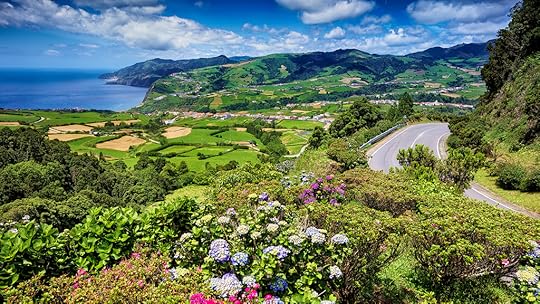
Alarmed by her father Sebastião's unexplained disappearance, Julia Castro travels from California to the family's ancestral home in the Azores to find the mid-Atlantic islands abuzz with tales of ghost ships, seductive sirens and unknown islands emerging from the sea. As she pursues the search for her father, Julia gradually succumbs to the bewitching allure of the Azores—and to Nicolau, a fellow musician—eventually discovering a place where dreams lie just beyond the horizon, shrouded in mist. Kastin’s novel has received high praise from Gregory Rabassa, translator of One Hundred Years of Solitude, who calls the book “…a romp of detective story, epic, and family quest. What a great read!”
Dramaturg, playwright and poet JoSelle Vanderhooft writes in her review that “The Undiscovered Island is a book of wonders¬ – a family saga, a chronicle of Portuguese history as it was and should have been, a scholarly text, a quixotic quest, and a beguiling mystery... I will call it a book that can stand toe-to-toe with the work of Umberto Eco, and a major work of the 21st century’s first decade.”
Darrell Kastin was born in Los Angeles, California. His maternal ancestors came from the Azores, settling in the United States at the end of World War II. He has spent considerable time on the islands over the years, using them as a setting for many of his short stories. His novel, The Undiscovered Island was published in 2009 by Tagus Press. It won the Silver Prize in the 2010 IPPY Awards. His short fiction has appeared in The Seattle Review, The Windsor Review, The Crescent Review, The Blue Mesa Review and elsewhere. he is a former used bookstore owner, and a former rare book scout. In 2007 Kastin released a CD of original songs titled Lullabies For Sinners--combination of folk and blues. 2011 he recorded a CD in Lisbon, Portugal, of Portuguese songs based on the poetry of Fernando Pessoa and Florbela Espanca, setting the poems to his music. The legendary Pedro Barroso produced the CD and used his musicians on the CD. Kastin played guitar and piano, and some background vocal, and his daughter, Shawna Lenore sang the vocals.
A short story collection titled, The Conjuror & Other Tales of the Azorean Nights was published in 2012.
Darrell Kastin currently resides in Sacramento, CA
This work of brilliance is much more than a novel. On the surface, it's partly a love story of an American-born woman who goes in search of her missing father and finds instead, love and her Portuguese ancestral roots on the Atlantic islands of the Azores. Meanwhile it's really a love story to Portuguese heritage and Portuguese history.
The book is multi-faceted in its structure. Interspersed among the pages is a mini-history of the formation of the Portuguese nation, Portugal's exploration of much of the world, and the settlement of the Azores. The author quotes extensively from The Lusíads, the Portuguese epic; Portuguese poets, especially the great Fernando Pessoa, and from many historians who wrote about Portugal, Portuguese exploration, and the Azores. There are many passages that, together, constitute a mini-genealogy of noble Portuguese founding families, intertwined with the history of Portugal. Also interspersed are philosophical writings, ostensibly those written by the missing father, a kind of crazy hermit obsessed with his native islands, his ethnic heritage, and his lineage in a déclassé family.
The book slows down a bit in the last third when it shift into magical realism as the author takes us on a long fantastic voyage, in search of the Undiscovered Island, although this sequence is also one of the most entrancing dream-like passages I can think of in literature. The search for such an island (aka the Unknown Island, the Undiscovered Island, the Enchanted Island) is a recurring theme in Portuguese literature as in Saramajo's The Tale of the Unknown Island. I mention magical realism because I also happen to be reading The Movies of My Life: A Novel by Chilean author Alberto Fuguet who is a proponent of McOndo, a movement proclaiming the end of magical realism which has become stereotypical of much Latin writing. All in all, The Undiscovered Island is a great read and I highly recommend it.
(Revised 1/17/2017) Photo of Sao Miguel Island, Azores, on Flickr
My maternal ancestors are from the Azores, the setting for this book, so it was of particular interest. To follow the meanderings of the current story interwoven to great tedious detail with the obsession of the characters for their misfortunate disconnection from the royal line of descent, took some patience. What was gained was an appreciation of the extent that poetry, music and romantic writings infuse the Azorean people. The thread of story was woven into a proof that we retain, in our blood, the essence of our ancestors; that the apple does not fall far from the tree.
I will look for those clues within myself and within my children.
I wanted so badly to love this book. As the daughter of Azoreans, I was enthralled in the history, culture, and legend interspersed throughout the novel. Unfortunately, these were the best parts, and the fiction surrounding it was overly sentimental and poorly written, in my opinion. It is clearly a well-researched and thought out book, but I found the soap opera drama unbecoming and slightly anti-thetical to the Portuguese ready acceptance of fatalism. Some of Sebastiao's musings on life are interesting philosophically, but also work because they are in HIS voice. When Julia ponders, "until we can conceive of eternity and the infinite, how can we hope to attain immortality?" (page 251), it feels wildly out of place, pointless, and pretentious. Parts of her character felt inauthentic, even in the seemingly small detail of calling her father and grandfather by their first names.
I also take some issue with the weaving of Portuguese legend in with the Gods and the Muses. In general the story seems to take several sharp left turns, including never properly addressing the opening "miracle" of the man drowned on Pico. Even as I accept the strange mythology of the book, the overly drawn out climactic "voyage" at the end is so detailed in describing Julia writing music or Antonio talking to sailors that it makes this part of the story lose steam, as well as making it harder to grasp that our astute characters aren't aware of the impossibility they are living.
The writing often tells instead of shows, and at times feels like a (non-explicit) romance novel. This kind of writing in general irks me, especially in a novel where so much mysticism and surrealism jar against mundane explanations of the characters' thoughts or cliched declarations of destiny. A few spots I marked while reading... "Julia is careful, showing an interest in history, legends and music - or so she tells herself - though she enjoys getting to know Nicolau.... Nicolau appears cautious, as though protective of her reputation, unwiling to take advantage of her possible naivite," (page 166). "There was no turning back, no alternate course, there was only destiny..." (page 236).
Of course, maybe this type of style is what you like. If you are also a Portuguese enthusiast, the review of legends, proverbs and history are redeemingly fascinating. This just was not the book for me.
I really wanted to like this book. The premise had a lot of potential. What killed it for me was too much angst, a plodding plot, and characters that never came alive for me.
Made me want to visit the Azores to look up my relatives vital records. I like how it incorporates the story of Ines de Castro and Pedro. I love that story. Very magical.