

What do you think?

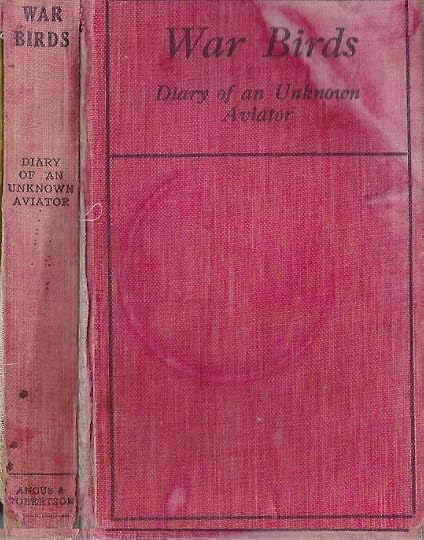
War Birds: Diary of an Unknown Aviator
Diary of a WWI American aviator known to the writer but unnamed in the book. The author served with the diarist as an aviator and apparently published the diary in order to honor an agreement he had with the deceased.
- GenresNonfiction
277 pages, Hardcover
First published January 1, 1927
Ratings & Reviews
Friends & Following
Create a free account to discover what your friends think of this book!
Community Reviews
Displaying 1 - 8 of 8 reviews

September 20, 2009
It would be great to know the identity of the diarist as he shows an insight that borders on prophetic. An example:
"After we've won this war by drowning the Hun in our own blood, in five years' time the sentimental fools at home will be taking up a collection for these same Huns that are killing us now and our fool politicians will be cooking up another good war."
The attrition rate among the aviators is ghastly, and toward the end of the book the writer clearly is suffering from what would probably now be recognized as PTSD.
"After we've won this war by drowning the Hun in our own blood, in five years' time the sentimental fools at home will be taking up a collection for these same Huns that are killing us now and our fool politicians will be cooking up another good war."
The attrition rate among the aviators is ghastly, and toward the end of the book the writer clearly is suffering from what would probably now be recognized as PTSD.

September 22, 2019
I read this book many years ago. I found it in an old book shop. It was an orange cover at the top with a picture of a WWI aircraft. The account, as I can remember, was of an unknown American pilot. I remember it was poignant and sad towards the end. I presume the writer (aviator) never survived the harsh WWI and the memoirs were then published in later years by a friend. I remember that the writer seemed to be under some stress as he gave an account of the casualty rate. I also remember a justifiable resentment at the conflict and a sense that he would not make it through the entire campaign of the air. He seemed to have an understanding of the terrible odds stacked against him and many like himself. You are actually touching a condemned man's inner being. There is an inevitable sadness about this biographical account. You are reading a condemned man's inner thoughts and it was rather sad in many parts because you know what is going to happen and the anonymous writer knows too. His thoughts are up close and very personal and immensely sad from the readers perspective. This is worth reading. Even if you can only do it once, I would advise reading sad memoir.
November 3, 2014
This book is based on a diary by John MacGavock Grider, who was a friend of Elliot White Springs, who edited and published it after WWI.It is considered probably the finest and most realistic picture of aviators in that war. It was considered quite controversial at the time it was published, because of the highly unflattering comparison of the US Army with the British army air service.As he said,"we owe the British a lot and have a lot to get even with our own army for." Also, he portrayed the American flyers, including himself, as quite a bunch of womanizers and drinkers, rather than the "All-American boys" they were generally presented as. And his cynicism about the "nobility" of the war shows clearly. While certainly not as shocking to us as it was to the more naive and idealistic people of the 1920's, it still packs a punch and conveys a grim picture of the true horrors of war.

November 27, 2025
Review from here.
This is a diary kept by an 'unknown aviator' about their experiences in WWI flying over France.
The author is generally known to be John McGavock Grider, a US pilot who joined the RFC, went through training in England and flew in France.
Young men died frequently during training, especially if flying Sopwith Camels, and in great numbers at the front. The casual death strikes you.
The diary was edited and published after the war, because of a commitment that another flyer made to the author. (That man is referred to as Elliott Springs in the book.)
I rate this very highly among the first-person accounts I have read. Up with The last enemy and Fall of fortresses. Grider writes in direct, unselfconscious prose. Hemingway might have read it and been inspired. He elides where it comes to sex, but tells everything else pretty straight. The last section, during which he describes the traumatic stress he is under and his fragmented state of mind, is deeply moving, as the young men continue to die around him.
Find it here. And on Gutenberg, and other places on the web -- it is long out of copyright.
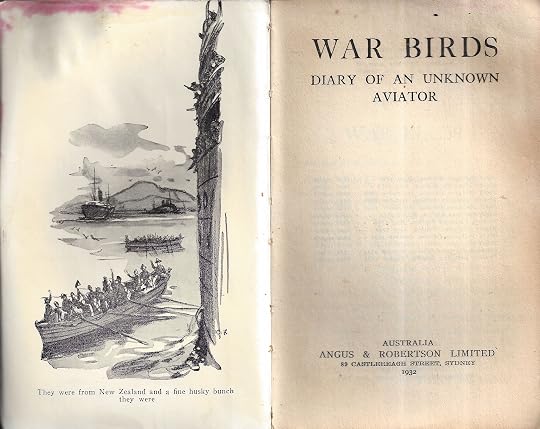
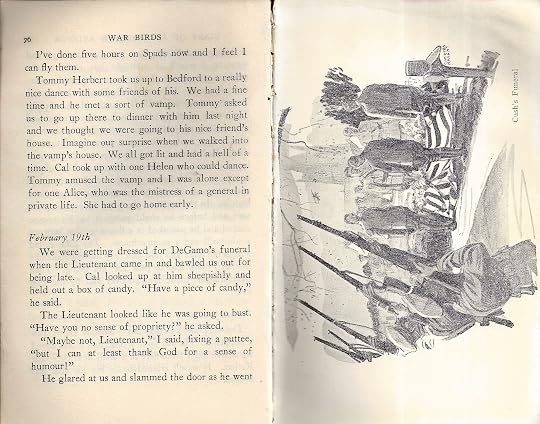
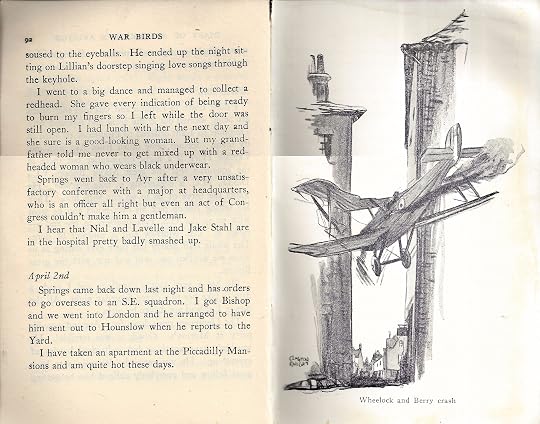
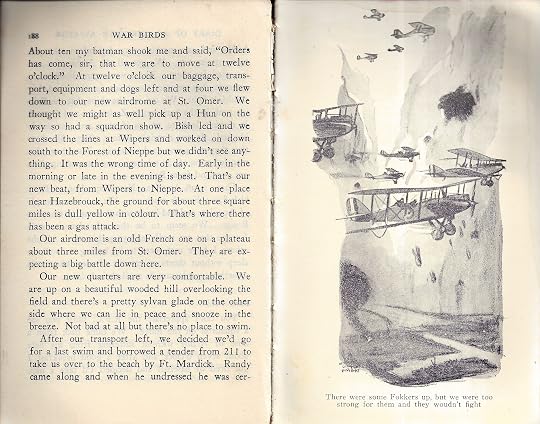
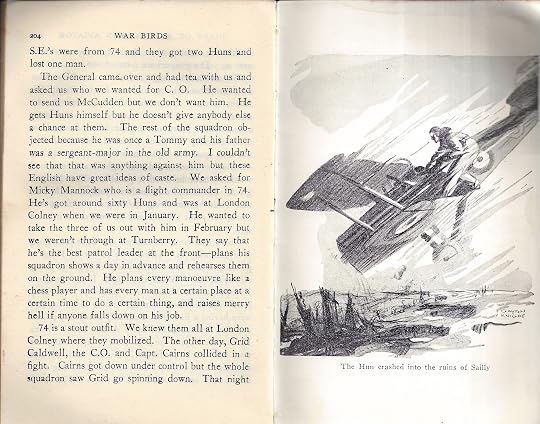
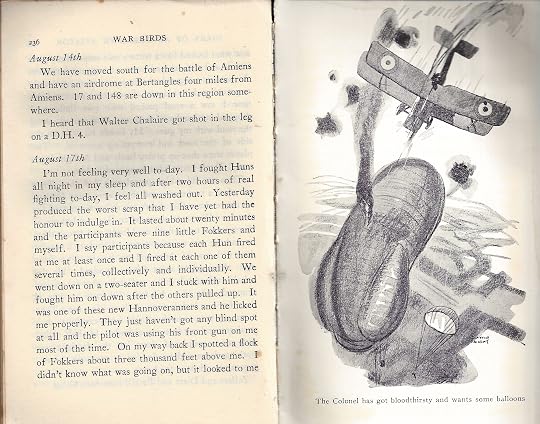
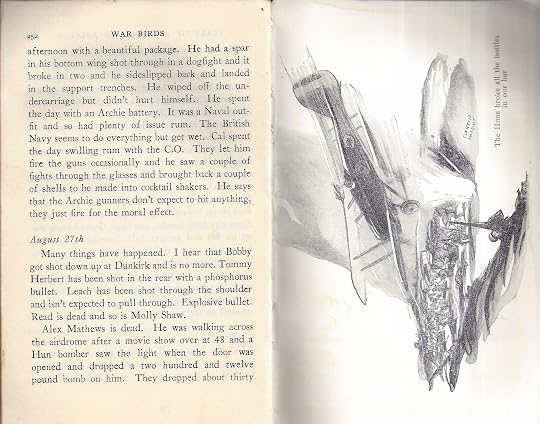
I cannot do it justice in a review. Here are some quotes, in order going through the book. Note the change in tone. Below the quotes are some illustrations -- by Clayton Knight, who flew with the author.
This is a diary kept by an 'unknown aviator' about their experiences in WWI flying over France.
The author is generally known to be John McGavock Grider, a US pilot who joined the RFC, went through training in England and flew in France.
Young men died frequently during training, especially if flying Sopwith Camels, and in great numbers at the front. The casual death strikes you.
The diary was edited and published after the war, because of a commitment that another flyer made to the author. (That man is referred to as Elliott Springs in the book.)
I rate this very highly among the first-person accounts I have read. Up with The last enemy and Fall of fortresses. Grider writes in direct, unselfconscious prose. Hemingway might have read it and been inspired. He elides where it comes to sex, but tells everything else pretty straight. The last section, during which he describes the traumatic stress he is under and his fragmented state of mind, is deeply moving, as the young men continue to die around him.
Find it here. And on Gutenberg, and other places on the web -- it is long out of copyright.
I cannot do it justice in a review. Here are some quotes, in order going through the book. Note the change in tone. Below the quotes are some illustrations -- by Clayton Knight, who flew with the author.
[on the boat to England] We can gamble at bridge and drink all we want as long as we don't get drunk. Now isn't that a fine distinction! I don't know how to play bridge and I like to get drunk.
This is Sunday. I don't know the date but I am sober so it must be Sunday.
But there are a few roughnecks in every outfit that will cause trouble and get the whole bunch in wrong. I've got my eye on one of that sort and the first break he makes is going to be his last. I can't put him in the guardhouse, but I can put him in the hospital.
He's one man that ought to have his face shoved down his throat.
An order from the adjutant general can't make a pilot out of a quartermaster.
... he made all the instructors go up in Camels and do the same thing. It was a wonderful exhibition and then he made us a little speech and told us there was nothing to worry about, to go to it. Several of the boys were so encouraged that they took off in Camels and tried to do the same things. Only one was killed.
I guess majors are like children around eight and ten. They are just passing through an ugly age.
Lily the widow came around again. It was a false alarm about the baby and she acts as if she might be consoled very easily. However, none of us wanted the job.
If these boys can fly two-bladers [planes] like they can fly fourposters, there'll sure be a shortage of Huns before long.
I think there are only five airmen living that have the V.C. The first thing you have to do to get it is get killed.
I've got to make a name for myself, even if they have to prefix "late" to it.
There's hardly a spot on his body that isn't cut or shot. He ought to be in a museum. His back and chest look like he was tattooed by one of those futurist artists.
... the whole squadron saw Grid go spinning down. That night they had a wake and all got drunk and turned it into a celebration. About midnight Grid walked in. They thought they were seeing a ghost as he was all bloody and his clothes were torn to pieces. He had set his tail stabilizer and got out of his seat and crawled out on the wing and got the plane out of the spin. His aileron control was jammed and part of his wing tip was gone but he balanced it down and landed it this side of the trenches by reaching in and pulling the stick back before he hit. [That is, he climbed out on the wing and manually adjusted and held the aileron to control the plane; see illustrations below.]
His teeth were all right, they were just on the outside of his face.
I'm getting so bored at being shot at that I don't bother to dodge any more ... I used to be scared to death of Archie [anti-aircraft fire] and gunfire from the ground. Now it almost fails to excite even my curiosity.
I was over at a Nine squadron the other day and saw Clayton Knight. He showed me some sketches he had made of planes and fights. They were very good. That boy will be an artist some day if he lives through it.
I don't know which will get me first, a bullet or the nervous strain.
[in case I die] Springs asked me to leave it [this diary] to him, but he's on Camels and it wouldn't be safe with him. Cal will look after it as long as he is here. It will never do to let the people at home find out the truth about this war. They've been fed on bunk until they'd never believe anything that didn't sound like a monk's story of the Crusades.
The French are willing to let us have their share of the war cheap.
It's only a question of time until we all get it. I'm all shot to pieces. I only hope I can stick it. I don't want to quit. My nerves are all gone and I can't stop. I've lived beyond my time already.
Few men live to know what real fear is. It's something that grows on you, day by day, that eats into your constitution and undermines your sanity.
I've lost all interest in life beyond the next patrol.
Oh, for a parachute!
I've even lot my taste for liquor.
It takes a brave man to even experience real fear. A coward couldn't last long enough at the job to get to that stage. What price salvation now?
This war won't prove anything.
Then I go out to test out my engine and guns and walk around and have a drink and try to write a little and try not to think. And I move my arms and legs around and think that perhaps to-morrow I won't be able to.
He always flies with a bottle of milk of magnesia in one pocket and a flask of gin in the other. If one doesn't help him he tries the other.
... every time two pilots meet it is only to swap news of who's [been] killed.
[when it comes to luck] A stocking to tie over my nose and a Columbian half dollar and that last sixpence and a piece of my first crash seem to take care of me all right, though I am not superstitious.

June 29, 2022
Beginning on September 20, 1917 and ending approximately August 27, 1918 (exact date not known because last entry is not dated), the unknown aviator diarist is actually thought to be John MacGavock Grider of Arkansa. Along with flying buddies Elliot White Springs of South Carolina and Lawrence Callahan of Kentucky, MacGavock captured the musings of his trans-Atlantic journey to the UK to become a pilot with the Royal Air Force during WWI. It contains mindless chatter regarding off-duty life, the party scene around Thetford and London where these young men hung out while not flying, but most importantly, descriptions of aerial combat with the German 'Huns'. As one might guess and understand, MacGavock's diary romanticizes what it was like to fly against the enemy early on in his account with imaginative language, yet as the months and war grind on, his tone takes on a more fatalistic edge. Fellow pilots are dying all around him by the dozens either resulting from aircraft mechanical issues, the over stressing of the aircraft during maneuvers, sheer stupidity, and contact with the enemy. These losses clearly have a cumulative effect on MacGavock's psyche near the end of the diary and before his own death, which he fatalistically senses is near at hand. Most telling of these entries is as follows: "But we've lost a lot of good men. It's only a question of time until we all get it. I'm all shot to pieces. I only hope I can stick it. I don't want to quit. My nerves are all gone and I can't stop. I've lived beyond my time already." The rest of this day's entries describes the numb feelings of just going through the motions and not caring anymore, yet he doesn't fly carelessly to hasten his own end. The diary was published as a result of an agreement with his surviving friends in 1926 to enormous popularity, and although it starts out slow, the pace and illustrative narrative in the latter half will most certainly draw in any aviation lover.

September 11, 2020
I’m not usually one for autobiographies or diaries, but I stumbled across this book and, being on a WWI kick, decided to read it on a whim. For those, like me, who tend to find diaries a bit of a slow or boring read, this book is far from that. Though 80% of it is written before the pilot even reached the front, his witty and poignant writing style and plethora of honestly hyyyysterical stories make up for what it lacks in war excitement. I mean, the guy had me laughing! Some of the mental images of the things him and his buddies would do were a riot. And it’s also a truly fascinating first-hand account of how war affected the psyche of WWI aviators. Though the book begins funny and lighthearted, by the end, you can see in his writing how haggard he becomes, how mentally rattled and scarred his daily experiences have left him. The end of the book is truly sad, and when I closed it, I wished more than anything to know who he was. I’m thankful he shared his story with the world through his diary, and I only wish he and his friends could be better honored for their sacrifice by knowing who the brave author was.

July 9, 2020
Referenced in First to Fly. Intrigued. Good read. Springs wrote some novels about WW1 and the flyboys. Haven't been able to track them down.

July 16, 2014
Read this book many ago after having it recommended by an uncle who had been in the RAAF in WW2... Will have to track it down agin as I remember it being very good.
Displaying 1 - 8 of 8 reviews