The Train That Had Wings presents modern life in Kerala in terms of a shared but tragically compromised humanity. Mukundan dares to look beneath the routines and facades of everyday life in order to probe depth of sin, greed, and hypocrisy but also to rediscover what brings joy and hope.
Sixteen short story translations and a critical introduction, offering examples of Mukundan's realistic, existentialist, psychedelic, and parabolic stories, show his range and talent for the very short story. If Hawthorne wrote “twice told tales,” Mukundan writes half-told tales, stories that jump in the middle, stomp around for just a minute, and leap away almost before the reader can settle in. Half-told, but a powerful and infectious half.
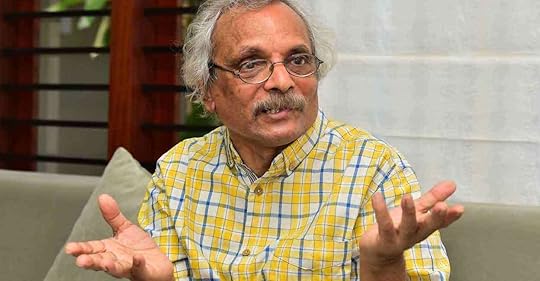
M. Mukundan(Malayalam: എം. മുകുന്ദൻ) is one of the pioneers of modernity in Malayalam literature. He was born on 10 September 1942 at Mayyazhi in Mahe, a one-time French territory in Kerala. He served as the president of Kerala Sahitya Akademi from October 2006 until March 2010. Mukundan is known in Kerala as 'Mayyazhiyude Kathakaaran' (The story-teller of Mayyazhi). His native village of Mayyazhi figures in his early works: 'Mayyazhippuzhayude Theerangalil', 'Daivathinte Vikrithikal', 'Appam Chudunna Kunkiyamma' and 'Lesli Achante Kadangal'. His first literary work was a short story published in 1961. Mukundan has so far published 12 novels and ten collections of short stories. Mukundan's latest four novels 'Adithyanum Radhayum Mattu Chilarum', 'Oru Dalit Yuvathiyude Kadanakatha','Kesavante Vilapangal' and 'Nritham ' carries a change in structure and approach. 'Oru Dalit Yuvathiyude Kadanakatha' reveals how Vasundhara, an actress has been insulted in the course of acting due to some unexpected situations. It proclaims the postmodern message that martyrs are created not only through ideologies, but through art also. 'Kesavante Vilapangal' one of his most recent works tells the story of a writer Kesavan who writes a novel on a child named Appukkuttan who grows under the influence of E. M. S. Namboodiripad. 'Daivathinte Vikrithikal' bagged the Kendra Sahithya Academy award and NV Prize. 'Ee Lokam Athiloru Manushyan' bagged the Kerala Sahitya Academy award. Daivathinte Vikrithikal has been translated into English and published By Penguin Books India. In 2008, Mukundan's magnum opus Mayyazhi Puzhayude Theerangalil fetched him the award for the best novel published in the last 25 years. Three of his novels were made into feature films in Malayalam . Mukundan wrote the script and one of them bagged a state film award. Mukundan's latest novel is "Pravasam" (sojourn in non-native land) and tells the story of a Malayali whose journeys carry him around the world. The French government conferred on him the title of Chevalier des Arts et des Lettres in 1998 for his contribution to literature.
16 short (6-8 pages each) stories translated from Malayalam by a South Indian 20th century author. Quite a treat for me to get a tiny glimpse of Malayalam literature. The stories deal almost exclusively with existential issues - loneliness, detachment, the tyranny of the social order and expectations. There are a few surreal ones, there's a lot of the absurd into most stories - some are only quasi-realistic, others are downright fantastical, like dreams or imaginings. The style is brief, telegraphic almost, but the stories pack a punch. Nothing is held back, there are scenes of cruelty and scenes of high intimacy depicted with an unflinching stare. There's indictment of social ills, too, but this is also detached and unemotional.
Many of the stories don't have a resolution in the traditional (Western?) sense, which makes the reading exciting, as you can't really predict the twists or endings in general. And there is, of course, the connection with India's immense literary and philosophical history, even if it's very subtle, woven into stories with a resoundingly cosmopolitan sound.
The introduction by the translator very usefully contextualises the stories and Mukundan's oeuvre for new readers.
And my favourite quote:
Their existentialism is bullshit. No whitey has ever said anything that wasn't already said in the Gita.
A very mixed bag of short stories in terms of type of story and quality. We are warned by the subtitle of the “Preface: Why I Like Mukundan…and Hate Him Too.”
The long introduction (which attempts to ‘explain’ almost every story) tells us that the author’s two dominant themes are “…anomie, a person’s sense of lost purpose, identity or value and a rigid sense of captivity, or being stuck in burdensome, tedious, or morally bankrupt social roles or situations.”
All of the stories are fairly short – 16 in less than 150 pages. Many are a mixture of fantasy, fable, science fiction and surrealism. Or maybe they are all one or another, just hard to categorize, lol. A few examples of the stories follow.
Radha, Just Radha, we are told is his most famous story. A young woman meets her boyfriend at a bus stop. She had visited with him the previous evening. He doesn’t know who she is. Angry and confused about what game he is playing she flees home and finds
In Tea, a mother and working-age son struggle with a domineering father who is getting dementia.
Breast Milk is the story of a 4-year-old boy who still consumes only breast milk. A new baby has arrived and he has to stop – but can’t.
The title story, The Train That Had Wings, is a very modern story. It starts out with a couple on their honeymoon in Madras comparing the horrible conditions of homeless beggars with the horrible conditions back in their home in Delhi. They meet up with a friend of the groom and his wife. The friend is a surrealist painter, and the story moves on moves on to pot, LSD and possible wife-swapping.
In I, the Scavenger, a man is thrilled to get a job cleaning out toilets. “I have become a scavenger. I have become a human being.” Enough said.
The Seventh Flower is a traditional fable about a woman meeting a demon in the forest who gives her a locket.
I particularly didn’t like a couple of stories that were written just to shock us with a tragic ending. I won’t reveal any plots but let me make up an example of a story I could write. I’ll write about a wonderful happy family and my last sentence of the story is “And that night their house collapsed and they were all killed!” No foreshadowing; no one hearing creaks in the night, no preliminaries about shoddy construction. Nada. What would be the literary value of that story?
Just a random passage: “His life was a roadside temple for whores…The greatest tragedy of his life was the fact that he hadn’t been born in the belly of a prostitute; instead he had to pop out of the womb of a mother of impeccable character and reputable family.”
The author (b. 1942) is a well-known writer in Kerala. He writes in his native language of Malayalam. He’s best known in the English world for his novel Delhi, but most of his work has not been translated into English.
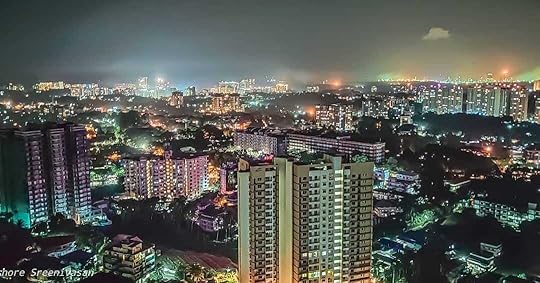
Top photo, Kochi (formerly Cochin), the largest city in the author’s home state of Kerala from skyscrapercity.com
Map from Wikipedia showing the location of Kerala on the southwest Indian coast (formerly called the Malabar Coast). Of the states of India, Kerala is one with much economic development, high income, high level of literacy and low birth rates.