

What do you think?

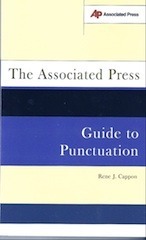
The Associated Press Guide To Punctuation
In the no-nonsense, authoritative tradition of the best-selling AP Stylebook , the top editors at the AP have written the definitive guide to punctuation.
More people write for the Associated Press than for any other news service, and more writers take their style and word-usage cues from this world-famous institution than from any other journalism source. From the when and how of the ampersand to the rules for dashes, slashes, and brackets; from the correct moment for the overused exclamation point to the rules of engagement for the semicolon, The AP Guide to Punctuation is an invaluable and easy-to-use guide to the most important aspect of clear and persuasive writing.
More people write for the Associated Press than for any other news service, and more writers take their style and word-usage cues from this world-famous institution than from any other journalism source. From the when and how of the ampersand to the rules for dashes, slashes, and brackets; from the correct moment for the overused exclamation point to the rules of engagement for the semicolon, The AP Guide to Punctuation is an invaluable and easy-to-use guide to the most important aspect of clear and persuasive writing.
105 pages, Paperback
First published January 1, 2003
Ratings & Reviews
Friends & Following
Create a free account to discover what your friends think of this book!
Community Reviews
Displaying 1 - 12 of 12 reviews

October 23, 2018
Well there was some light reading on the bus! Every so often, I need to know where a comma goes when I'm writing. I think I break a lot of rules; however, I am trying. Yes, I read grammar books for fun.
This book is short and sweet. You can tell it was written in 2003. Many of the example sentences talk about Al-Qaida, terrorism, Bush, and Enron. That was a bit bizarre but it was, after all, put out by the AP.
This book is short and sweet. You can tell it was written in 2003. Many of the example sentences talk about Al-Qaida, terrorism, Bush, and Enron. That was a bit bizarre but it was, after all, put out by the AP.

February 10, 2018
I acquired this book because an instructor in an online course I am taking, Keys to Effective Editing, recommended it. She was undoubtedly trained as a journalist. First, I note with some of the other reviewers that this is just the Associated Press's version of what constitutes good punctuation. That is, it is what journalists are taught to use. It would almost be better to read punctuation guides from other types of writers—novelists, memoirists, biographers—and then compare them all in one comprehensive book review.
My copy was printed in 2003 and the author died in 2007, and so cannot defend himself.
I did find a couple of points on punctuation that I have been puzzled with, and the book was helpful in guiding me as to what to do in those cases. One instance of this—it has always appeared wrong to me that phrases such as 'teachers college', 'writers group' and 'childrens book' should have the apostrophe dispensed with. But according to Cappon, it can be so because they are “primary descriptive phrases.” Another one he says can do without the apostrophe is 'Presidents Day.'
I realize that if one is writing something to be submitted to a paying publisher, as opposed to a self-publishing firm, he has to abide by the rules of that publisher. But here in 2018 journalists and journalism have lost much credibility. There was already a lot of sloppiness in newspaper articles, not to mention the fact they can be cliche-ridden. Now so much is being reported as news in the mainstream, traditional news media that we find out is false after all. Punctuation, it can be argued, is cosmetic to a point and not as vital as getting accurate information on the world to the public. But if the profession, journalism, has lost credibility on the one point, how much longer will it be until it loses the same with the other?
I guess I take the subject matter seriously for I found the author to be too whimsical in his writing. He's no E.B. White, whose humor I can appreciate. Also, Cappon seemed keen on giving illustrations in his sentences for mere shock value. Pornography was a subject three times, divorce twice and swinging once. Milder, less controversial topics would have served the purpose better, in my estimation.
Ironically, the author cites a number of instances in which the decision on punctuation can be left up to the writer. What entities, one wonders, would concur with this sentiment? No doubt many publishers would have preferences with these very points.
I know that the brevity of the book was intentional, but I found myself wanting to learn more about punctuation in our history, when commas were more widely used, and when the word 'today' was rendered 'to-day.'
My copy was printed in 2003 and the author died in 2007, and so cannot defend himself.
I did find a couple of points on punctuation that I have been puzzled with, and the book was helpful in guiding me as to what to do in those cases. One instance of this—it has always appeared wrong to me that phrases such as 'teachers college', 'writers group' and 'childrens book' should have the apostrophe dispensed with. But according to Cappon, it can be so because they are “primary descriptive phrases.” Another one he says can do without the apostrophe is 'Presidents Day.'
I realize that if one is writing something to be submitted to a paying publisher, as opposed to a self-publishing firm, he has to abide by the rules of that publisher. But here in 2018 journalists and journalism have lost much credibility. There was already a lot of sloppiness in newspaper articles, not to mention the fact they can be cliche-ridden. Now so much is being reported as news in the mainstream, traditional news media that we find out is false after all. Punctuation, it can be argued, is cosmetic to a point and not as vital as getting accurate information on the world to the public. But if the profession, journalism, has lost credibility on the one point, how much longer will it be until it loses the same with the other?
I guess I take the subject matter seriously for I found the author to be too whimsical in his writing. He's no E.B. White, whose humor I can appreciate. Also, Cappon seemed keen on giving illustrations in his sentences for mere shock value. Pornography was a subject three times, divorce twice and swinging once. Milder, less controversial topics would have served the purpose better, in my estimation.
Ironically, the author cites a number of instances in which the decision on punctuation can be left up to the writer. What entities, one wonders, would concur with this sentiment? No doubt many publishers would have preferences with these very points.
I know that the brevity of the book was intentional, but I found myself wanting to learn more about punctuation in our history, when commas were more widely used, and when the word 'today' was rendered 'to-day.'
December 2, 2007
Blah. What a boring read - especially right after "Eats, Shoots and Leaves." I just wanted to see what American punctuation was all about, and I got this - this horror of a reference book. I was upset for at least twenty minutes because the poor woman can't clearly define her examples, not to mention cite special cases. In particular, my confusion was this:
"Names ending with 'S' get an apostrophe after the 'S': James' novel, Jesus' teachings.
"When a possessive ending in an 'S' sound directly proceeds an object beginning with an 'S' sound, an apostrophe is given after the 'S': hostess' supper; hostess's cupcakes."
Hostess can have an apostrophe-S? Really? You never mentioned that any word ending in 'S' should have an apostrophe, plus an extra 'S'... oh, I see. Is it that *only names* ending in 'S' shouldn't have an extra 'S'? Well, then, that makes sense. Lucky, that I should infer that from your text. No need to cite explicit usage in this guide for the ASSOCIATE PRESS.
No wonder we're all illiterate.
"Names ending with 'S' get an apostrophe after the 'S': James' novel, Jesus' teachings.
"When a possessive ending in an 'S' sound directly proceeds an object beginning with an 'S' sound, an apostrophe is given after the 'S': hostess' supper; hostess's cupcakes."
Hostess can have an apostrophe-S? Really? You never mentioned that any word ending in 'S' should have an apostrophe, plus an extra 'S'... oh, I see. Is it that *only names* ending in 'S' shouldn't have an extra 'S'? Well, then, that makes sense. Lucky, that I should infer that from your text. No need to cite explicit usage in this guide for the ASSOCIATE PRESS.
No wonder we're all illiterate.
Read
June 13, 2012No.
August 28, 2017
Everyone should read this book. Everyone! It’s helpful and entertainingly written — my punctuation is much, much better after I read this book, and I’ve often reread sections of it for entertainment. I sometimes happily recite sections of it to myself, and other people, too, if they’ll listen. I do genuinely find punctuation interesting and fun, but I think other people’s punctuation would benefit greatly from this book, without its being too torturous to read. (But I don’t know this for sure, because, annoyingly, I haven’t managed to convince anyone else to read it yet.) There are some unfortunate typos, but the guidelines are good, though some of the examples didn’t make that much sense to me. Try not to be too confused by the typos in the elipses. But, anyway, this is definitely one of my favorite books ever, and I really, really, really suggest that you read it. (It’s only 97 pages long, and some of the pages are blank. Just 97 pages. That’s all I ask.)
Also, the AP stylebook has a section on punctuation, which offers a slightly different view and more guidelines on this subject (though it’s not as entertainingly written as the puctuation guide).
Also, the AP stylebook has a section on punctuation, which offers a slightly different view and more guidelines on this subject (though it’s not as entertainingly written as the puctuation guide).
February 3, 2020
Always helpful
It was a good read but bought mostly as a reference book. Not too different from the MLA guide.
Highly recommended for non academic writing and especially for bloggers.
It was a good read but bought mostly as a reference book. Not too different from the MLA guide.
Highly recommended for non academic writing and especially for bloggers.

January 4, 2018
Chatter than I was expecting. Nice reference
July 25, 2011
I decided to review the Associated Press Guide to Punctuation (2003) by Rene Cappon to determine if it would be a helpful resource for college students. I selected this book for review because it focuses specifically on the use of punctuation. Proper use of punctuation is an important component of writing. Because many college courses are writing intensive and demand a higher level of writing skill than expected in high school, mastering strong writing skills, including proper punctuation use, is required for college survival. Punctuation usage rules are tricky; therefore, having a guide to refer to is useful for all students.
This book is based on the Associated Press Stylebook. Stylebooks are books that serve as guides for the writing in a particular academic field, organization or other group. The Associated Press is a newsgathering organization. Their stylebook guides the writing of many other news organizations throughout the Untied States.
Upon review of Associated Press Guide to Punctuation, I found his book to offer simple and straightforward rules on how to use punctuation based on the Associated Press Stylebook. I believe it would be very helpful for anyone uncertain of when or how to use a particular punctuation mark or who needs a quick, simple solution. However, the straightforward solutions offered by this book can be a drawback as well for some college students because punctuation usage rules are not universal. Punctuation rules vary among types of writing. This book does not, nor was it intended to, cover all of the types of writing expected throughout college classrooms.
The use of the serial comma is an example of how this book may provide rules that conflict with other reference guides. Serial commas separate items in a series, such as in the following sentence: He invited Mary, Rachel, Janet and Samantha to the party. Commas separate the items in this series. Should a comma have followed the name Janet prior to the word "and"? Writing styles vary on the topic. However, on page 40, of this book the author states, "No coma goes before the final conjunction." (The conjunction in the example sentence is the word 'and.') There is no mention of writing styles that would use a comma before the word 'and' in the example sentence. This is because the intent of this guide is to give specific instructions based on only the Associated Press Stylebook. However, a student in a psychology class (especially an upper-level class) is likely required to follow the stylebook produced by the American Psychological Association. This stylebook states that a comma should follow the conjunction in a series.
Despite the drawback of only explaining the Associated Press's take on punctuation, I believe this book offers many benefits to college students. It is small, lightweight, and easy to read. It could easily be carried in a book bag for handy punctuation reference when studying. Students who have declared a major should use the stylebook of their academic field. However, this book can make a nice supplement as it covers punctuation points not covered in many stylebooks. It could also be helpful for a student who has not yet committed to a particular academic field.
See review at http://www.bellaonline.com/articles/a...
This book is based on the Associated Press Stylebook. Stylebooks are books that serve as guides for the writing in a particular academic field, organization or other group. The Associated Press is a newsgathering organization. Their stylebook guides the writing of many other news organizations throughout the Untied States.
Upon review of Associated Press Guide to Punctuation, I found his book to offer simple and straightforward rules on how to use punctuation based on the Associated Press Stylebook. I believe it would be very helpful for anyone uncertain of when or how to use a particular punctuation mark or who needs a quick, simple solution. However, the straightforward solutions offered by this book can be a drawback as well for some college students because punctuation usage rules are not universal. Punctuation rules vary among types of writing. This book does not, nor was it intended to, cover all of the types of writing expected throughout college classrooms.
The use of the serial comma is an example of how this book may provide rules that conflict with other reference guides. Serial commas separate items in a series, such as in the following sentence: He invited Mary, Rachel, Janet and Samantha to the party. Commas separate the items in this series. Should a comma have followed the name Janet prior to the word "and"? Writing styles vary on the topic. However, on page 40, of this book the author states, "No coma goes before the final conjunction." (The conjunction in the example sentence is the word 'and.') There is no mention of writing styles that would use a comma before the word 'and' in the example sentence. This is because the intent of this guide is to give specific instructions based on only the Associated Press Stylebook. However, a student in a psychology class (especially an upper-level class) is likely required to follow the stylebook produced by the American Psychological Association. This stylebook states that a comma should follow the conjunction in a series.
Despite the drawback of only explaining the Associated Press's take on punctuation, I believe this book offers many benefits to college students. It is small, lightweight, and easy to read. It could easily be carried in a book bag for handy punctuation reference when studying. Students who have declared a major should use the stylebook of their academic field. However, this book can make a nice supplement as it covers punctuation points not covered in many stylebooks. It could also be helpful for a student who has not yet committed to a particular academic field.
See review at http://www.bellaonline.com/articles/a...

June 24, 2009
I didn't love this book because some of my punctuation conventions are different from those described in the book. The author does offer the caveat that there are few hard-and-fast rules with regard to punctuation, that mostly there are "conventions." Specifically discussed are the AP's conventions.
Well, I have my own conventions. These are the result of what my elementary school teachers taught me and my own preferences in reading. I'm consistent in my own writing, which the author says is the point. Unless, of course, you're submitting a work for publication (e.g., a journal in the field of psychology) which I'm not.
Well, I have my own conventions. These are the result of what my elementary school teachers taught me and my own preferences in reading. I'm consistent in my own writing, which the author says is the point. Unless, of course, you're submitting a work for publication (e.g., a journal in the field of psychology) which I'm not.

November 17, 2013
This book is awesome! What a great companion to the AP Style Manual.
Read
October 30, 2015I think this book is the best material for beginners in newswriting.

January 13, 2018
Excellent resource for grammarians and advocates of AP style.
Displaying 1 - 12 of 12 reviews