What do you think?
Rate this book


96 pages, Paperback
First published January 1, 1973
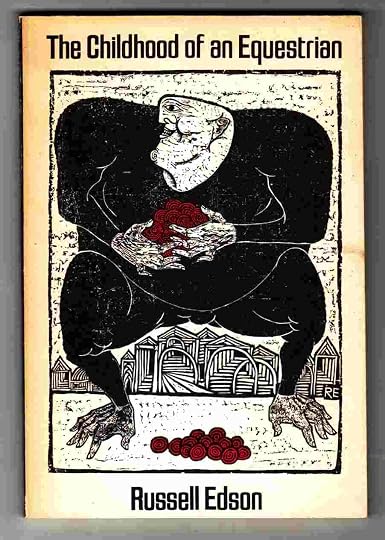
There was a woman name Martha George
who had discovered one day that he chest
was a radio. She turned it on with her left
nipple. A voice came out from between her
breasts: We now present the adventures of
 Martha George. As you remember
 in our last episode Martha had been
 fiddling with her breasts - We find
 her now fiddling with her breasts.
 She turns her left nipple. She's a-
 fraid it might come off. But instead,
 a voice comes out from between
 her breasts: We now present the
 further adventures of
 Martha George . . .
- "The Further Adventures of Martha George", for Robert Bly (pg. 48)
BLVR: I agree with your distinction between short story and story—that the word story, minus the short, can include more eccentric forms. I read that you’d choose to call Russell Edson’s prose poems (which he originally called “fables”) “stories.”
LD: I was simply reacting against Edson’s designation of his pieces as “poems,” which I have seen on the covers of his collections (more often than “prose poems” or “fables”). I might call them “fables,” except that this term usually implies a moral or precept, and I think his pieces are wonderfully free of morals. They are stories, for me, because they are full of narrative. The weight of emphasis in them is on the narrative, I think, not on the language. When the emphasis shifts onto the language, then maybe they enter the realm of poem.
BLVR: Do you find “story” to be a potentially larger category than “poem”?
LD: Yes, I suppose I do find the category “story” to be more elastic. But of course part of the problem is that we have only a limited number of familiar categories and into one or another of these we try to fit the work of writers such as Edson, Kafka, Peter Altenberg, Robert Walser, Jim Heynen, Henri Michaux, Léon-Paul Fargue, Peter Cherches, Francis Ponge, Geoff Bouvier, Martha Ronk, Phyllis Koestenbaum, Diane Williams....
BLVR: Flash fiction, sudden fiction, short shorts, very shorts, prose poems, proems—do you think the solution to sorting the chaos is to create more categories?
LD: Where a need is felt for another category, I think it will be created and accepted, although that may take time. There is some acceptance of the terms flash fiction, sudden fiction, etc. But I think people may still be expecting a kind of miniature short story when they begin reading a piece of flash fiction, rather than the less usual offering that it might be—meditation, logic game, extended wordplay, diatribe—for which there is no good general name. Robert Walser was described by one critic (rather diminishingly, I think) as a “feuilletonist.” He sometimes referred to his work simply as “short prose pieces.”
When we set sail I had no idea that the sails would bloat with wind like pregnant women.
I brought this to the attention of the Captain.
He adjusted my offended modesty by saying that the sails were married, and that by no means would he allow prostitutes to bear us forth.
An immediate applause broke from my hands.
- "A Journey by Water" (pg. 60)
Cuando despertó, el dinosaurio todavía estaba allí.
("When he awoke, the dinosaur was still there.")
- "El Dinosaurio (The Dinosaur)" (Obras completas (y otros cuentos), pg. 71)Unfortunately, I don't know enough about Augusto Monterroso to compare him and Edson in any way other than the length of their prose.
A small girl had been given a pony because the anniversary of her entrance into this state had come round again.
Take your pony behind the house and mount him; we do not with to see you make a mockery of modest as your little gown blows up to reveal those lace undergarments, which are worn to keep your excretory openings in decorous hiding, said the mother.
The small girl led the pony around the back of the house and proceeded to mount the small horse.
Do not get on my back, I don't want you there, said the pony.
When the small girl returned to her parents and advised them of the pony's attitude they replied, get away from us.
Father said, you are only trying to create a situation when we shall be forced to view your underclothes.
No no, it is the pony who refuses to cooperate, cried the little girl.
We do not want you to be here anymore, said her mother.
Indeed, said father, I would rather the pony to this child.
The little girl began to cry.
Yes, said mother, I believe the pony will be our new child.
In which case today shall be the pony's birthday, said father.
And our daughter who is no longer our daughter shall be a gift to the pony, said mother.
The little girl was crying.
You will give the pony your pretty dress and lace loincloth, said mother, and we shall no worry about your modesty because you are now an animal which is to be given to our new daughter on her birthday.
And so they dressed the pony in their little daughter's clothes.
They said to the pony, take this animal behind the house and mount it, for we have no wish to be advised as to what it is you wear on your excretory area.
Soon the pony came around the house riding the naked little girl. She was crying.
- "The Birthday Party" (pg. 12)
Some of us had been threatening our friend Colby for a long time, because of the way he had been behaving. And now he'd gone too far, so we decided to hang him. Colby argued that just because he had gone too far (he did not deny that he had gone too far) did not mean that he should be subjected to hanging. Going too far, he said, was something everybody did sometimes. We didn't pay much attention to this argument. We asked him what sort of music he would like played at the hanging. He said he'd think about it but it would take him a while to decide. I pointed out that we'd have to know soon, because Howard, who is a conductor, would have to hire and rehearse the musicians and he couldn't begin until he knew what the music was going to be. Colby said he'd always been fond of Ives's Fourth Symphony. Howard said that this was a "delaying tactic" and that everybody knew that the Ives was almost impossible to perform and would involve weeks of rehearsal, and that the size of the orchestra and chorus would put us way over the music budget. "Be reasonable," he said to Colby. Colby said he'd try to think of something a little less exacting.
Hugh was worried about the wording of the invitations. What if one of them fell into the hands of the authorities? Hanging Colby was doubtless against the law, and if the authorities learned in advance what the plan was they would very likely come in and try to mess everything up. I said that although hanging Colby was almost certainly against the law, we had a perfect moral right to do so because he was our friend, belonged to us in various important senses, and he had after all gone too far. We agreed that the invitations would be worded in such a way that the person invited could not know for sure what he was being invited to. We decided to refer to the event as "An Event Involving Mr. Colby Williams." A handsome script was selected from a catalogue and we picked a cream-colored paper. Magnus said he'd see to having the invitations printed, and wondered whether we should serve drinks. Colby said he thought drinks would be nice but was worried about the expense. We told him kindly that the expense didn't matter, that we were after all his dear friends and if a group of his dear friends couldn't get together and do the thing with a little bit of eclat, why, what was the world coming to? Colbv asked if he would be able to have drinks, too, before the event. We said,"Certainly."
[...]
- "Some of us had been threatening our friend Colby" (Forty Stories, pg. 167)Whereas Barthelme takes the simple and makes it abstract, Edson takes the abstract and makes it simple. In this way Barthelme is the antithesis of Edson.
An equestrian fell from his horse.
A nursemaid moving through the wood espied the equestrian in his corrupted position and cried, what child has fallen from his rockinghorse?
Merely a new technique for dismounting, said the prone equestrian.
The child is wounded more by fear than hurt, said the nursemaid.
The child dismounts and is at rest. But being interfered with grows irritable, cried the equestrian.
The child that falls from his rockinghorse refusing to remount fathers the man with no woman taken in his arms, said the nursemaid, for women are as horses, and it is the rockinghorse that teaches the man the way of love.
I am a man fallen from a horse in the privacy of a wood, save for a strange nursemaid who espied my corruption, taking me for a child, who fallen from a rockinghorse lies down in fear refusing to father the man, who mounts the woman with the rhythm given in the day of his childhood on the imitation horse, when he was in the imitation of the man who incubates in his childhood, said the equestrian.
Let me help you to your manhood, said the nursemaid.
I am already, by the metaphor, the don of the child, if the child father the man, which is involuted nonsense. And take your hands off me, cried the equestrian.
I lift up the child which is wounded more by fear than hurt, said the nursemaid.
You life up a child which has rotted into its manhood, cried the equestrian.
I lift up as I lift all the fall and are made children by their falling, said the nursemaid.
Go away from me because you are annoying me, screamed the equestrian as he beat the fleeing white shape that seemed like a soft moon entrapped in the branches of the forest.
- "The Childhood of an Equestrian" (pg. 18)
Five minutes to eleven?...
A horse was devouring the roots of a tree that the guardians of the city of Paris had come to chop down. A little girl about ten years old was watching them do so when a lady, a sexagenarian at the very least, came up to her and said:
"Aren't you ashamed, you naughty little girl, letting this poor animal poison itself?"
The child laughed and replied:
"I think it's funny. What can we do, it's not always cherry season."
And from the pocket of a man passing by on his way to work, she plucked a bottle of red wine, which she emptied at one go.
Immediately after that, she was the one in the hole gnawing at the roots of the tree, while the horse took off at full gallop and knocked over all the statues proliferating in Paris.
They were displeased and addressed the first passerby to come along, ordering them yo pursue the animal and bring it back to them; some of them demanded a tooth, some a hoof, some a rib or a hair from its tail.
After it had galloped a long time and outdistanced all its pursuers, the horse reached the bois de Vincennes where, roaming about, it saw the execution post. A squad of soldiers was there, at attention. A carriage arrived and Bolo Pasha got out. What do you think happened?... That Bolo Pasha climbed on the horse and slipped away at full tilt?...
Not at all!...
Bolo Pasha knelt down, and holding the horse's tail, said:
"Our Father who art in heaven, etc...."
Just as he uttered the last syllable of the prayer, the horse's stomach opened and its intestines slipped out.
Bolo Pasha cut the part of the intestines still attached to the animal and took their place. The stomach immediately healed up and the animal's breast was soon covered in wisteria. The horse whinnied and said:
"Rights of man and citizen!
"'All citizens are born free and equal in rights.'"
Then it whinnied a second time and went to sit atop an ancient oak tree that grew taller for the occasion, then blurred and vanished without being noticed.
Meanwhile, immediate after the horse's departure, the intestines had taken the form of Bolo Pasha, who cried out:
"Sentries, take care... I bless you."
And he died, struck by twelve bullets.
- "Within the Scope of Our Morals" (The Leg of Lamb, pg. 46-47)Whereas Péret's piece gallops along to outdistance its pursuers (its pursuers being the conventions imposed by the literary institution), gallops without knowing where it is going, but happy to arrive anywhere other than the place from which it departed (again, it departed from the literary institution), Edson's piece exhibits none of the urgency (however short his pieces may be). The resulting piece (like all or most of Edson's pieces) exhibit a deliberation that is contrary to Péret's piece; moreover, it is contrary to the definition of Surrealism put forth by Péret and the other signatories of the First Surrealist Manifesto:SURREALISM, noun, masc., Pure psychic automatism by which it is intended to express, either verbally or in writing, the true function of thought. Thought dictated in the absence of all control exerted by reason, and outside all aesthetic or moral preoccupations.