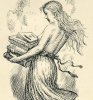
Relying most heavily on music and metaphor, syntax and diction, Two Rooms explores the conflicting claims of life and art, world and word, cultural heritage and cultural affinities, through the sacral, erotic, and creative imagination. By the light of these dark lyrics, Constance Merritt searches for a path, a sign, a respite―perhaps love or death or God or insight, perhaps radical transformation or a simple good night's sleep. In these poems, by turns passionate, sinuous, playful and grave, a deep and abiding trust in "the plain sense of things" and intractable longing for the "lush, desire-transfigured world" meet and wrestle to a dynamic draw.
Born in Pine Bluff, Arkansas in 1966, and educated at the Arkansas School for the Blind in Little Rock, Constance Merritt is the author of three collections of poems: A Protocol for Touch (University of North Texas Press, 2000), winner of the Vassar Miller Prize in Poetry and a finalist for the William Carlos Williams Book Award, Blessings and Inclemencies (Louisiana State University Press, 2007), and Two Rooms (forthcoming from the Louisiana State University Press in 2009). In 2001 Merritt received a grant from the Rona Jaffe Writers' Foundation and a fellowship from the Radcliffe Institute for Advanced Study at Harvard University. From 2003 to 2005 Merritt served as the Margaret Banister Writer-in-Residence at Sweet Briar College. Currently, she lives in Louisville, Kentucky with her beloved and their two beautiful cats.
I've been reading and rereading Two Rooms by Constance Merritt, published by Louisiana State University Press.
This is Louisville, Kentucky resident, Merritt's third book of poetry, and I'm not quite sure what to say about it. The "two rooms" are the body and the soul. The poems are stark, but beautiful, powerful, and above all else, passionate.
Merritt (I want to call her Constance because I feel I know her after reading the poems) is a wonderful lyric poet, with true depth of imagination and a beautiful gift for metaphor that she's so obviously honed to perfection.
For me, "Coda" shows the book's intensity:
A part of it says:
the soul's a great mosaic Shattered in the atmosphere at birth, And life the search, the slow and tedious, Never-ending work of gathering.
In another poem she writes:
Sing it again, chorus of angels. Lower your golden ropes that I might climb Into this day and each day after.
Wow! I thought that was just gorgeous! I loved it. I do love it.
The final poem in the book, "Sieve," is a quiet one, but so beautiful:
Light in autumn that stand of trees in leaf blossom bare, flare Of bone that woman's wing, beneath brief moment fingers splayed your out- stretched palm
These are definitely special poems - to read, to reread, and to treasure.
I actually ended up winning this one in the goodreads giveaway, which was a wonderful surprise. I've not read much poetry in English, but was really intrigued by the description the author/publisher gave. I tend not to read poetry books from beginning to end, but instead dip in and out (which also really suits my lifestyle at the moment). So far, I'm loving the quality of the writing and the evocative sensuality of the work. Good stuff!
I feel terrible because I've done a terrible thing. I won this book so that I could review it, and I'm only now getting around to it. It was terrible of me to just... not review it the way I did. I want to officially apologize to the author. I think my main problem was that poetry isn't nearly as much my thing as prose is, but that's no excuse.
The poems in this book are beautiful, and they really make a person think ((trust me, I thought about them a lot, trying to decide their meanings)). I don't really have anything negative to say. I believe anyone who loves poetry may very well enjoy these.