

What do you think?

Amsterdam: The Rough Guide
From its humble origins as a city crowded around a dam of the Amstel river, Amsterdam has grown up to be one of Europe's most beautiful and well-loved cities. The Rough Guide to Amsterdam is an indispensible tool in discovering the works of Rembrandt and Van Gogh at the Rijksmuseum, navigating your way through the winding streets that follow the flow of the city's canals, and seeking out the hottest nightspots in the Leidseplatz. This guide includes everything you need to know to eat, drink, and sleep in this most intriguing and captivating of cities.
288 pages, Paperback
First published June 1, 1988
About the author
Martin Dunford
68 books1 followerMartin Dunford is one of the founders of the international travel guide series Rough Guides and is the author of more than 10 guidebooks.
Ratings & Reviews
Friends & Following
Create a free account to discover what your friends think of this book!
Community Reviews
Displaying 1 - 7 of 7 reviews

July 21, 2015
May be it is because I am a reader that I enjoy travel guidebooks. I approach a new city or new country like a text that needs to be deciphered. Walking through the streets and looking at the buildings I always feel a need to know about their history. Reading about the place then has become for me necessary.
The Rough Guides have long been my favourites. They fit in the bag and provide a good balance between practicalities and context.
With the internet and globalization, however, the section on practicalities becomes less and less useful, but I still value the way they present the context. Organized in neighbourhoods, they divide the city in chapters, each one with its own drama but contributing to the overall plot.
Unfortunately, the latest edition for Amsterdam is somewhat old, 2010, but this matters more to the practicalities. For example, it does not indicate that for visiting the Ann Frank Huis one needs at least two months notice. Nonetheless, I still managed to get interesting hints about somewhat hidden places, like one of the oldest cafés, t’Smalle, in the Jordaan, where we had a lovely lunch on a narrow balcony perching over the lovely Egelantiersgracht. It was a tasting house for the gin distillery next door. To our surprise it was almost empty. Or the existence of a Pianola museum, which awoke memories of my Proust reading days. This peculiar museum had somewhat reduced visiting times, but we did manage to get a peek.
Like other editions of Rough Guides, this one included an excellent chapter on Books on Amsterdam and by Amsterdammers. I have often found excellent references in such chapters.. Almost as good as GR.
The book also helped me in working out a couple of day excursions, to beautiful Edam and to Frans Hals’ Haarlem. The guide also pointed me towards the possibility of visiting the Corrie Ten Boomhuis, which compensated not been able to visit the Ann Frank museum.
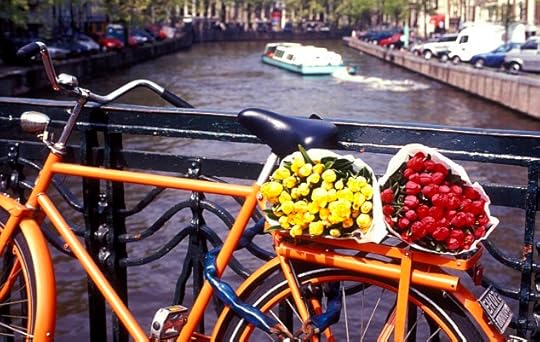
What this book did not warn me, though, was of the extreme danger of the bicycles…
If you want to know what I mean have a look at this..
https://www.youtube.com/watch?v=fQdwl...

September 3, 2016
My first visit to Amsterdam was boring (thank you Fodors). I went to the tourist traps (Anne Frank Hause, Sex Museum, Medieval torture museum), toured the red light district, giggled at smoke shops...
However, during my second visit I was in possession of a more enlightened guide (as well as staying with my Dutch friends). Yes, there IS a condomerie, and you should visit it! You should also party at the Ministry of Sound, move to a houseboat, and spend New Year's in an inappropriately themed warehouse party. 48 hours later, you must CRAWL into a cab (otherwise you haven't had the full experience). Later, you'll find the cute roads that have signs of children crossed out, and enjoy not being around children while your pupils return to a normal size. Shopping is critical (see the guide), but wear nice panties because the salespeople will strip and forcibly re-clothe you.
As a professional, this is all I can say. However, read the book, use the maps, and remember that the bikes always have the right of way. Also, the medieval torture museum is always worth another visit, as all the "implements" are authentic.
However, during my second visit I was in possession of a more enlightened guide (as well as staying with my Dutch friends). Yes, there IS a condomerie, and you should visit it! You should also party at the Ministry of Sound, move to a houseboat, and spend New Year's in an inappropriately themed warehouse party. 48 hours later, you must CRAWL into a cab (otherwise you haven't had the full experience). Later, you'll find the cute roads that have signs of children crossed out, and enjoy not being around children while your pupils return to a normal size. Shopping is critical (see the guide), but wear nice panties because the salespeople will strip and forcibly re-clothe you.
As a professional, this is all I can say. However, read the book, use the maps, and remember that the bikes always have the right of way. Also, the medieval torture museum is always worth another visit, as all the "implements" are authentic.

January 17, 2025
This is a very good and comprehensive guide book of Amsterdam. I plan a visit to Amsterdam soon and I found useful information for my trip in this guidebook. Rough Guides are my favourite guide books.
December 10, 2025
The city of Amsterdam, concerned about overcrowding of the city due to tourism, would be well advised to recommend this book to anyone planning to travel to this fascinating and beautiful city. It would be enough to discourage anyone who hasn’t visited.
Condescending, inaccurate, and dismissive, the authors should be banned from travel. No must sees here? Are you kidding?
I don’t know who the authors are or where they live but they should stay there and be relegated to writing reviews of Poundland.
Condescending, inaccurate, and dismissive, the authors should be banned from travel. No must sees here? Are you kidding?
I don’t know who the authors are or where they live but they should stay there and be relegated to writing reviews of Poundland.
October 20, 2015
desperately needs updating
while the outlay is fine, three things make me regret my purchase :
1. the maps are awful on Kindle, Kindle iOS etc.
2. the text layout is awful on Kindle iOS
3. much of the information is out of date ( ticket price from schiphol to centraal is NOT 6,30€ but more like 8€, and the chip card has been mandatory for all least 6 years now )
while many people flock to the city center and the canal rings, there is so much more to see, in up and coming new neighborhoods like Oud-oost ... a good guide should be better informed
while the outlay is fine, three things make me regret my purchase :
1. the maps are awful on Kindle, Kindle iOS etc.
2. the text layout is awful on Kindle iOS
3. much of the information is out of date ( ticket price from schiphol to centraal is NOT 6,30€ but more like 8€, and the chip card has been mandatory for all least 6 years now )
while many people flock to the city center and the canal rings, there is so much more to see, in up and coming new neighborhoods like Oud-oost ... a good guide should be better informed

February 18, 2013
Jak zachwalałam zawsze praktyczne przewodniki Pascala, to ten nie przypadł mi do gustu. Po pierwsze jest z 1998 r., kiedy był jeszcze kawałek czasu do wstąpienia Polski do Unii Europejskiej i strefy Schengen. Poza tym od 1998 roku Pascal udoskonalił układ. W tym wydaniu układ leżał i nawet jeśli kwiczał, bo bardzo słabo.

January 19, 2009
Is it too much to tell us what mode of transport we may choose to take to a sight? It's a mainstay in guidebooks these days.
Displaying 1 - 7 of 7 reviews