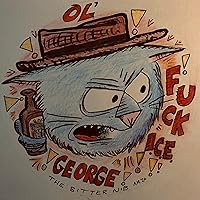
George Herriman was an American cartoonist celebrated for creating the groundbreaking comic strip Krazy Kat, a work widely regarded as one of the most inventive, poetic, and influential achievements in the history of comics. Raised in a culturally diverse environment and navigating complex racial identities throughout his life, Herriman developed a singular artistic voice that combined humor, surrealism, philosophical reflection, and emotional nuance. He began his career as a newspaper illustrator and political cartoonist before transitioning fully into comic strips, producing several short-lived features and experiments that helped him refine his sense of rhythm, timing, and visual storytelling. Krazy Kat, which emerged from an earlier strip called The Dingbat Family, became his defining work and ran for decades in newspapers across the United States. The strip centered on a triangular relationship among three main characters: Krazy, a blissfully optimistic and androgynous cat; Ignatz Mouse, who continually expressed his contempt or affection by throwing bricks; and Offisa Pupp, a dutiful dog who sought to protect Krazy and maintain order. What might have been a simple gag became, in Herriman’s hands, a lyrical exploration of love, longing, misunderstanding, and the complexities of emotional connection, articulated through shifting perspectives, inventive language, and a dreamlike visual landscape inspired by the American Southwest. Herriman developed a distinctive style that blended loose, expressive brushwork with carefully considered composition, often altering backgrounds from panel to panel to evoke mood rather than physical continuity. His dialogue employed dialects, puns, poetic phrasing, and playful linguistic invention, creating a voice for Krazy Kat that felt both musical and deeply human. The strip attracted a passionate following among intellectuals, writers, and artists, including figures such as Gilbert Seldes, E.E. Cummings, Willem de Kooning, and many others who recognized its sophistication and emotional resonance. However, Krazy Kat never achieved the widespread commercial popularity of contemporaries like Popeye or Li’l Abner and often relied on the support of influential newspaper magnate William Randolph Hearst, who admired Herriman’s work and insisted it remain in publication despite fluctuating readership. Herriman also produced the comic strip Baron Bean, as well as numerous illustrations, editorial drawings, and commercial work throughout his career, but it was Krazy Kat that defined his legacy and shaped the development of visual narrative art. The strip influenced generations of cartoonists and graphic storytellers, contributing to a lineage that includes artists working in newspaper strips, comic books, underground comix, graphic novels, animation, and contemporary experimental media. Herriman maintained a private, quiet personal life, working diligently and steadily, drawing inspiration from the landscapes of California, Arizona, and New Mexico, which he visited frequently and often featured in his art as stylized mesas, desert plateaus, and open skies. His deep engagement with the American Southwest brought texture, symbolism, and environmental presence to Krazy Kat, making setting an integral emotional and thematic component rather than a mere backdrop. Although widely honored posthumously, his work was recognized during his lifetime by peers and critics who understood the originality of his vision. Today, he is acknowledged as one of the key figures who expanded the expressive potential of the comic strip form, demonstrating that sequential art could convey subtle emotional states, philosophical ideas, and complex storytelling with elegance and humor. Herriman’s legacy endures in the ongoing study, republication, and celebration of Krazy Kat, which continues to be admired for its innovation, sensitivity, and unique artistic spirit.
Krazy Kat lives up to its reputation as one of the all-time greats. I’ve purchased a few collections over the years, though there have been many more on which I’ve had to pass for one reason or another.
On the one hand, I regret that I don't reread them more frequently. But on the other, I get the joy of rediscovering over and over again the wonderful world that George Herriman created.
I had a fun moment in the course of reading this particular book. It was the Sunday strip for July 29, 1916. Basically, Krazy is being pursued by Ignatz, and Officer Pupp gets knocked down in the scuffle. Walter Cephus Austridge bends down, and calmly proclaims, “Phlebotomy has been performed upon his nose.” I was tickled by the phrasing. “Phlebotomy” is not a word I hear in casual conversation, and it was a delight to encounter it in this context.
Herriman’s expressive line and jazz inflected prose make for a magical combination. Krazy Kat is always highly recommended!
Krazy Kat is a legendary comic strip that demonstrates George Herriman's mastery of the form with sheer simplicity. The premise of the strip is simple - Krazy nurses an obsession with a mouse name Ignatz, who in turn is short-tempered and shows abject contempt for Krazy. Ignatz schemes to keep Krazy at arm's length, but Krazy's drive from the unrequited love keeps the story going. Amidst the silly hijinks and love triangles, the design of the strip is where Herriman's innovation really shines. Not nearly as repetitive as similarly simplistic strips, Krazy Kat excels in the unique layouts, creative bursts of action and quaint dialogue. Even with a modern lens, it's easy to see just how spectacular Herriman's eye for design and composition really was.
This first volume has "Krazy" moving in the best of "ways". What I mean is that he is constantly running with all four feet in the air and frequently is in the tail->straight->up position. He's also more "animated" and seen from more "angles". I adore those "stances" and "movements" which are comparatively rare going forward. There is also more of a loose "plot" to them where the "brick" isn't such the king as will follow. He even gets "poetic" more often in this one.
First appearance of the oooooold smoke tree: December 24th 1916.
This softcover collection of Herriman's Krazy Kat is the first volume in the series. Herriman's work is amazing on so many levels. While there is plenty of action via brick throwing, there is a great love triangle between Krazy Kat, Ignatz the mouse and Offica Pup.
This early strip from the pages of American newspapers is one of the finest examples of the art form. Herriman broke new ground when he created these little dramas.
The highlight of this collection of course is the fantastic artwork Herriman brought to the strip. These stories look nothing like modern comic strips and that is a good thing. Pick up this book and learn what the comic strip has lost over the years as an art form.
This is a great textbook example of what comics can and should be for modern cartoonist.