

What do you think?

Birds in Your Backyard: A Bird Lover's Guide to Creating a Garden Sanctuary
Turn your backyard into a blissful bird sanctuary-create an appealing habitat to attract birds and watch them thrive.
This indispensable guide for bird enthusiasts is a comprehensive and richly illustrated volume-with over 600 full-color photos. Together with a little careful planning and planting you can turn your yard into a bird and butterfly oasis. It's several books in one:
* An A-to-Z landscaping guide to identify over 75 flowers and plants
* A field guide includes over 170 varieties of birds and butterflies with key
information on: how to identify them by their markings, how they behave, and which feeder foods they like the best
* A bird-watching guide to understand the basics of bird-watching and what equipment might be needed to observe or photograph birds
Plus, a how-to guide filled with step-by-step instructions for easy-to-build projects. Learn how-to:
* Plant your garden with bird-friendly trees, plants, hedges, ground cover, seed- producing flowers, and fruit-bearing shrubs and vines
* Build and mount your own birdhouses, boxes, perches, and shelters
* Identify the best plants for creating nesting sites; grow bird seed; and add a birdbath or pond
Let Birds in Your Backyard reveal its secrets for creating an irresistible garden and welcoming landscape alive with birds and butterflies.
This indispensable guide for bird enthusiasts is a comprehensive and richly illustrated volume-with over 600 full-color photos. Together with a little careful planning and planting you can turn your yard into a bird and butterfly oasis. It's several books in one:
* An A-to-Z landscaping guide to identify over 75 flowers and plants
* A field guide includes over 170 varieties of birds and butterflies with key
information on: how to identify them by their markings, how they behave, and which feeder foods they like the best
* A bird-watching guide to understand the basics of bird-watching and what equipment might be needed to observe or photograph birds
Plus, a how-to guide filled with step-by-step instructions for easy-to-build projects. Learn how-to:
* Plant your garden with bird-friendly trees, plants, hedges, ground cover, seed- producing flowers, and fruit-bearing shrubs and vines
* Build and mount your own birdhouses, boxes, perches, and shelters
* Identify the best plants for creating nesting sites; grow bird seed; and add a birdbath or pond
Let Birds in Your Backyard reveal its secrets for creating an irresistible garden and welcoming landscape alive with birds and butterflies.
272 pages, Paperback
First published October 21, 2004
Ratings & Reviews
Friends & Following
Create a free account to discover what your friends think of this book!
Community Reviews
Displaying 1 - 13 of 13 reviews

November 24, 2011
Excellent book of information. The photo illistrations are so beautiful and the ideas and projects are explained in simple terms with show step by step instructions.
In the Contents you get.
1. Rewards of Backyard Birds - a well round of information discusing helping nature, benefiting the birds, helping the gardner, habitats in Home gardens, woodland and shrub habitats, waterside and river habitats, flower and nectar habitats, prairie, meadow, and grassland habitats, Ecosystems and habitats, Masterworks of adaptation, specialization, and back yard habitats.
2. Creating Bird Gardens in Home Landscapes - explains how to choose the right place for your plants and features with the appropriate feeders/houses along with perches and different types of shelters. Talks about providing protection from predators and different types of water features.
3. Bird Gardens at Home - Shows several types of functional birdhouses and feeders. Also it illistrates with photos and instructions on how to build/construct not one but 22 different types of bird houses. And, it even illistrates with instructions and photos how to construct bird baths, water fountains, and ponds.
I was really impressed with the different ideas, they look really simple to do.
4. Plantscapes to attract birds - shows different photos of plants that can provide birds with food and plants to draw butterflies too. Also plants that provide support for nesting material. And it discuses feeder care to keep from spreading diease. Planting arrangements and different types of fertilizers are touched on a little.
5. Feed and Seed - Gives examples of natural and artificial bird feed. illistrates how easy it is to grow your own birdseed. Cleaning and keeping feeders clean and overcoming feeder pest and problems are discussed as well.
6. Bird Watching - Observing and Recognizing birds - their size, color, body shape, flight manner, bill, tail, and manners are all discussed. their territory and mating rituals, nesting and shelter, and migration are touched upon by recognizing their range, song, and species. Recommendations for different types of equipment to use when birdwatching.
7. Field Guide to Back Yard Birds - pgs 163 through 229 illistrates photos of the different types of birds found in back yards all over the country. Absolutely beautiful photos and interesting information.
For example: Greater Roadrunner - Length: 20" - 24" (50-60 cm)
What to Look for: large size, long tail; rough chest; patch of red and pale blue behind eye; runs rapidly but seldom flies.
Habitat: deserts, semi-arid areas with scattered brush and trees.
The roadrunner is really a large ground-dwelling cuckoo, although it neither looks nor behaves like a cuckoo. This long-tailed, long legged bird is very agile and fast on its feet; one was clocked at 15 miles (24 km) an hour. the roadrunner is known to feed on snakes-poisonous or otherwise-and lizards. It also eats scorpions, spiders, grasshoppers, crickets, small mammals, birds' eggs, and even small birds that it catches in flight by leapig into the air and snatching them with its bill.
the roadrunner is not a quiet bird. It crows and chuckles. It rolls its mandibles together, producing a clacking sound. And mostly it coos like a dove-a most unusual cuckoo altogether.
8. Plants that attract Birds - pg 230 to 259 illistrates with photos and discription of plants/shrubs.
Ends with Index.
Excellent Book - a keeper!
In the Contents you get.
1. Rewards of Backyard Birds - a well round of information discusing helping nature, benefiting the birds, helping the gardner, habitats in Home gardens, woodland and shrub habitats, waterside and river habitats, flower and nectar habitats, prairie, meadow, and grassland habitats, Ecosystems and habitats, Masterworks of adaptation, specialization, and back yard habitats.
2. Creating Bird Gardens in Home Landscapes - explains how to choose the right place for your plants and features with the appropriate feeders/houses along with perches and different types of shelters. Talks about providing protection from predators and different types of water features.
3. Bird Gardens at Home - Shows several types of functional birdhouses and feeders. Also it illistrates with photos and instructions on how to build/construct not one but 22 different types of bird houses. And, it even illistrates with instructions and photos how to construct bird baths, water fountains, and ponds.
I was really impressed with the different ideas, they look really simple to do.
4. Plantscapes to attract birds - shows different photos of plants that can provide birds with food and plants to draw butterflies too. Also plants that provide support for nesting material. And it discuses feeder care to keep from spreading diease. Planting arrangements and different types of fertilizers are touched on a little.
5. Feed and Seed - Gives examples of natural and artificial bird feed. illistrates how easy it is to grow your own birdseed. Cleaning and keeping feeders clean and overcoming feeder pest and problems are discussed as well.
6. Bird Watching - Observing and Recognizing birds - their size, color, body shape, flight manner, bill, tail, and manners are all discussed. their territory and mating rituals, nesting and shelter, and migration are touched upon by recognizing their range, song, and species. Recommendations for different types of equipment to use when birdwatching.
7. Field Guide to Back Yard Birds - pgs 163 through 229 illistrates photos of the different types of birds found in back yards all over the country. Absolutely beautiful photos and interesting information.
For example: Greater Roadrunner - Length: 20" - 24" (50-60 cm)
What to Look for: large size, long tail; rough chest; patch of red and pale blue behind eye; runs rapidly but seldom flies.
Habitat: deserts, semi-arid areas with scattered brush and trees.
The roadrunner is really a large ground-dwelling cuckoo, although it neither looks nor behaves like a cuckoo. This long-tailed, long legged bird is very agile and fast on its feet; one was clocked at 15 miles (24 km) an hour. the roadrunner is known to feed on snakes-poisonous or otherwise-and lizards. It also eats scorpions, spiders, grasshoppers, crickets, small mammals, birds' eggs, and even small birds that it catches in flight by leapig into the air and snatching them with its bill.
the roadrunner is not a quiet bird. It crows and chuckles. It rolls its mandibles together, producing a clacking sound. And mostly it coos like a dove-a most unusual cuckoo altogether.
8. Plants that attract Birds - pg 230 to 259 illistrates with photos and discription of plants/shrubs.
Ends with Index.
Excellent Book - a keeper!

October 4, 2017
An Awesome book!
November 30, 2011
I just got this in the mail and after viewing it I realized it was very similar to the Birds in your back yard book I purchased a week ago, the only difference is the book cover and the years it was published. The pages are identical, not one page or word different.
RECOMMENDATION: Buy books like this from Amazon and buy them used because most of the time they are bran new like this one is. Do not purchase this book from "Shop at Home"
Here is my review:
Excellent book of information. The photo illistrations are so beautiful and the ideas and projects are explained in simple terms with show step by step instructions.
In the Contents you get.
1. Rewards of Backyard Birds - a well round of information discusing helping nature, benefiting the birds, helping the gardner, habitats in Home gardens, woodland and shrub habitats, waterside and river habitats, flower and nectar habitats, prairie, meadow, and grassland habitats, Ecosystems and habitats, Masterworks of adaptation, specialization, and back yard habitats.
2. Creating Bird Gardens in Home Landscapes - explains how to choose the right place for your plants and features with the appropriate feeders/houses along with perches and different types of shelters. Talks about providing protection from predators and different types of water features.
3. Bird Gardens at Home - Shows several types of functional birdhouses and feeders. Also it illistrates with photos and instructions on how to build/construct not one but 22 different types of bird houses. And, it even illistrates with instructions and photos how to construct bird baths, water fountains, and ponds.
I was really impressed with the different ideas, they look really simple to do.
4. Plantscapes to attract birds - shows different photos of plants that can provide birds with food and plants to draw butterflies too. Also plants that provide support for nesting material. And it discuses feeder care to keep from spreading diease. Planting arrangements and different types of fertilizers are touched on a little.
5. Feed and Seed - Gives examples of natural and artificial bird feed. illistrates how easy it is to grow your own birdseed. Cleaning and keeping feeders clean and overcoming feeder pest and problems are discussed as well.
6. Bird Watching - Observing and Recognizing birds - their size, color, body shape, flight manner, bill, tail, and manners are all discussed. their territory and mating rituals, nesting and shelter, and migration are touched upon by recognizing their range, song, and species. Recommendations for different types of equipment to use when birdwatching.
7. Field Guide to Back Yard Birds - pgs 163 through 229 illistrates photos of the different types of birds found in back yards all over the country. Absolutely beautiful photos and interesting information.
For example: Greater Roadrunner - Length: 20" - 24" (50-60 cm)
What to Look for: large size, long tail; rough chest; patch of red and pale blue behind eye; runs rapidly but seldom flies.
Habitat: deserts, semi-arid areas with scattered brush and trees.
The roadrunner is really a large ground-dwelling cuckoo, although it neither looks nor behaves like a cuckoo. This long-tailed, long legged bird is very agile and fast on its feet; one was clocked at 15 miles (24 km) an hour. the roadrunner is known to feed on snakes-poisonous or otherwise-and lizards. It also eats scorpions, spiders, grasshoppers, crickets, small mammals, birds' eggs, and even small birds that it catches in flight by leapig into the air and snatching them with its bill.
the roadrunner is not a quiet bird. It crows and chuckles. It rolls its mandibles together, producing a clacking sound. And mostly it coos like a dove-a most unusual cuckoo altogether.
8. Plants that attract Birds - pg 230 to 259 illistrates with photos and discription of plants/shrubs.
Ends with Index.
Excellent Book - a keeper!
RECOMMENDATION: Buy books like this from Amazon and buy them used because most of the time they are bran new like this one is. Do not purchase this book from "Shop at Home"
Here is my review:
Excellent book of information. The photo illistrations are so beautiful and the ideas and projects are explained in simple terms with show step by step instructions.
In the Contents you get.
1. Rewards of Backyard Birds - a well round of information discusing helping nature, benefiting the birds, helping the gardner, habitats in Home gardens, woodland and shrub habitats, waterside and river habitats, flower and nectar habitats, prairie, meadow, and grassland habitats, Ecosystems and habitats, Masterworks of adaptation, specialization, and back yard habitats.
2. Creating Bird Gardens in Home Landscapes - explains how to choose the right place for your plants and features with the appropriate feeders/houses along with perches and different types of shelters. Talks about providing protection from predators and different types of water features.
3. Bird Gardens at Home - Shows several types of functional birdhouses and feeders. Also it illistrates with photos and instructions on how to build/construct not one but 22 different types of bird houses. And, it even illistrates with instructions and photos how to construct bird baths, water fountains, and ponds.
I was really impressed with the different ideas, they look really simple to do.
4. Plantscapes to attract birds - shows different photos of plants that can provide birds with food and plants to draw butterflies too. Also plants that provide support for nesting material. And it discuses feeder care to keep from spreading diease. Planting arrangements and different types of fertilizers are touched on a little.
5. Feed and Seed - Gives examples of natural and artificial bird feed. illistrates how easy it is to grow your own birdseed. Cleaning and keeping feeders clean and overcoming feeder pest and problems are discussed as well.
6. Bird Watching - Observing and Recognizing birds - their size, color, body shape, flight manner, bill, tail, and manners are all discussed. their territory and mating rituals, nesting and shelter, and migration are touched upon by recognizing their range, song, and species. Recommendations for different types of equipment to use when birdwatching.
7. Field Guide to Back Yard Birds - pgs 163 through 229 illistrates photos of the different types of birds found in back yards all over the country. Absolutely beautiful photos and interesting information.
For example: Greater Roadrunner - Length: 20" - 24" (50-60 cm)
What to Look for: large size, long tail; rough chest; patch of red and pale blue behind eye; runs rapidly but seldom flies.
Habitat: deserts, semi-arid areas with scattered brush and trees.
The roadrunner is really a large ground-dwelling cuckoo, although it neither looks nor behaves like a cuckoo. This long-tailed, long legged bird is very agile and fast on its feet; one was clocked at 15 miles (24 km) an hour. the roadrunner is known to feed on snakes-poisonous or otherwise-and lizards. It also eats scorpions, spiders, grasshoppers, crickets, small mammals, birds' eggs, and even small birds that it catches in flight by leapig into the air and snatching them with its bill.
the roadrunner is not a quiet bird. It crows and chuckles. It rolls its mandibles together, producing a clacking sound. And mostly it coos like a dove-a most unusual cuckoo altogether.
8. Plants that attract Birds - pg 230 to 259 illistrates with photos and discription of plants/shrubs.
Ends with Index.
Excellent Book - a keeper!

September 30, 2014
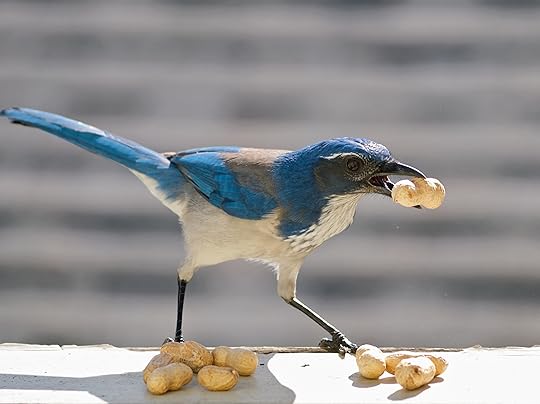
A few days ago, I watched "Sky" the Scrub Jay steal a peanut I had left for "Hoffa" the Squirrel. "Sky" flew all over the front and back yards, trying to find a safe spot to stow his find. Finally, the Jay landed next to the pond and moved several pebbles out of the way so a hole could be dug. Into the hole went the peanut, and I thought that was that. But "Sky" wasn't satisfied until he/she located a white stone and placed it carefully over the hole. Then, the bird moved all the pebbles back, so the Squirrel would never find the lost treasure.
I quickly went out to find that peanut. It should have been easy. 'X' marked the spot with a white stone. I lifted the stone and dug and dug and dug...but I couldn't find that darn peanut. Did one of the smartest birds on the planet play a magic trick on me? Yes. That's what I get for creating an environment for birds (trees, water, food, shelter, white stones) that makes them become master burglars.
This book helped me develop a garden sanctuary for the birdies. Now there are several hummer feeders, a dozen seed dispensers, plenty of water outlets, and a squirrel vs. bird plot that can look like West Side Story at times. Within this book is a bunch of helpful info, even for folks who do not have green thumbs. There's even a how-to section on cleaning feeders and creating hiding places for birds who are afraid of hawks (the Tudors of the bird family). Really, this volume is a terrific place to start if you want to begin your own world of bird adventures.
Book Season = Spring (fallen angels)
I quickly went out to find that peanut. It should have been easy. 'X' marked the spot with a white stone. I lifted the stone and dug and dug and dug...but I couldn't find that darn peanut. Did one of the smartest birds on the planet play a magic trick on me? Yes. That's what I get for creating an environment for birds (trees, water, food, shelter, white stones) that makes them become master burglars.
This book helped me develop a garden sanctuary for the birdies. Now there are several hummer feeders, a dozen seed dispensers, plenty of water outlets, and a squirrel vs. bird plot that can look like West Side Story at times. Within this book is a bunch of helpful info, even for folks who do not have green thumbs. There's even a how-to section on cleaning feeders and creating hiding places for birds who are afraid of hawks (the Tudors of the bird family). Really, this volume is a terrific place to start if you want to begin your own world of bird adventures.
Book Season = Spring (fallen angels)

August 25, 2009
Did you ever gasp in delight as a brightly colored bird flutters by, then spend the rest of the afternoon wondering what kind of bird you saw? Birds In Your Backyard features some of the most common types of birds in North America with photographs, colored prints, explanations of habitat, range, and food sources to help even the most inexperienced bird watcher. Great as a gift or as a part of your permanent library.

February 3, 2013
I'm a birder, and one day aspire to planting the perfect bird and butterfly garden in my backyard. This book provided a lot of inspiration and info on how to attract not only birds to your yard, but butterflies as well. The pictures in this book are pleasing, the how to's inspiring, and the overall layout very well done. I was pleasantly surprised as I was reading the section showing how to make different kinds of birdhouses and bird feeders. I've never thought to myself, "Ya know, I oughta make a birdhouse" until I read this book. There is also a lovely how to on creating your own bird bath, and I thought these projects were a nice addition to the book. In the back of the book is an illustrated guide to some of the most common birds in North America, so if you are a beginning birder this will help you get started with identifying some of the birds you may see. Obviously, your location will determine what species will be gracing your backyard, and you're probably going to want to get an additional bird guide (maybe National Geographic or Sibley). I live in Wisconsin, so I don't expect to see a road runners out back any time soon, and even though there are bobolinks and red wing black birds in these parts they sure won't be coming into this part of town any time soon. There is also a section on butterfly identification that I felt was a great bonus in a bird oriented book. The final section takes you through flowering plants, ground covers, trees, and shrubs to plant to attract birds (and butterflies) to your space, and earlier on in the book there are a lot of landscaping tips that are also pretty useful. All in all I am very happy that I checked this book out at the library, and may even purchase it as a coffee table book to leave out in the future.

March 16, 2009
We enjoy watching our backyard birds. This book is a great beginners' guide to backyard bird watching. The boys enjoyed all the pictures showing all the different types of common backyard birds. This would be a great resource for our home library, but until then...we'll have to keep checking the book out from the library.
April 29, 2014
This book has a permanent home on my enclosed porch, beside a pair of binoculars. I refer to it many times each season to identify a bird, or to refresh my memory on a particular bird's feeding, mating, eating or nesting habits. It is very easy to read, and well organized. Large clear, full color photography makes it easy to use.

December 4, 2008
If you ever wanted to create a garden to attract birds and butterfly's, this book will be of great assistance. It identifies many flowers, shrubs, etc and what type of bird they attract. It also shows how to build feeders. It lists many commom birds and butterflys with great photos of each.

April 7, 2014
A highly informative book for beginner gardeners with a yen to attract birds and butterflies. Ideas for yards of all types in varying climates. The second half Is a basic field guide to species of birds, butterflies, flowers, and trees.
October 1, 2016
Everything you need to know to attract birds to your backyard. Great ideas about plants, feeders, commercial bird food and types of bird houses. Pictures and information of the most common birds that frequent our backyards, here in the US.

Read
July 27, 2011Excellent reference.
July 18, 2016
Beautiful book endorsed by Birds & Blooms magazine. Easy to read & very informative, with alot of really great photos! I would recommend it to any birder.
Displaying 1 - 13 of 13 reviews