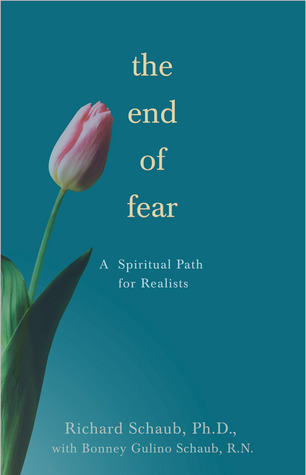
Why are we afraid? Why do we dwell on worst-case scenarios, lie awake in anxiety’s grip, and react to minor mishaps as though they threaten our very survival? Chances are you don’t envision the world’s or your own catastrophic end on a daily basis; however, we are all routinely altered by fear€”from simply feeling nervous about a new experience to repeatedly rethinking a critical comment. In The End of Fear, Richard and Bonney Schaub explore the origin of fear down to its root and posit that it grows out of our innate love of life. They teach that fear is so influential because deep down we know that our life is unpredictable and that we are all vulne
I keep on my computer a vast quote file, & recently found a quote there from this book from years ago. I was so struck by it that I requested this from the library to read again! I had utterly forgotten about this wise little tome.
It's a quick and engaging read. For decades I read SO much self-help, but lately find myself mostly averse; however the authors' style kept me easily rapt and curious as to what was next, with many stories of themselves (GoodReads here does not mention the other author, his wife) and clients dealing with fear and the transformations out of it.
The book is sprinkled with many wonderful quotes by Ralph Waldo Emerson, Rumi, Kabir and others which are pertinent, helpful, and beautiful, too.
I wasn't super fond of the main exercise of seeing everyone as impermanent. I think, maybe one "had to be there" in their workshops or as a client--here it just sounds depressing and hard to master.
Still, I found a wonderful, helpful framework for my fear from this little book. It is both biological and spiritual in its simplicity.
My favorite aspect of this book are the vivid but brief descriptions of transcendent, connected-to-the-All states that can be had with this way of inner work. It was such a nice reminder that such moments can not only be had, but be life-changing.
This book seems to say that the root of all fear is the fear of death. It quotes the Buddhist observation of, "the truth of impermanence." As a result of this truth, our feelings of vulnerability surface and must be faced. Vulnerability must be allowed to exist. It must become tolerable. In confronting the reality that we are vulnerable, not only ourselves, but all the world around us, supposedly we can make peace. We can become one with everything. Somehow. Apparently this is the goal? Maybe I'm misunderstanding.
He does talk about how our fears come from the way we think about things. We can continue in patterns of thought that can explode our fears and make them unmanageable.
I like when he talks about the decision we must make between holding onto our delusions and facing reality and vulnerability. He asks, "Do you want to get through life in a a dream of avoidance? Or do you want to be alive to life as it is?" I really like that question.
"Thanking" our fears for existing is apparently a helpful way to manage them. The author says:
"Turning toward your fears with affection is a way to acknowledge and appreciate your survival instinct for working overtime to protect you. When you feel anxiety, worry, or fear, you must first ask if there is an actual physical threat. If there is, you'll act on those warning signals to avoid the danger. In most situations though, there will be no actual threat. Then you can turn to your fears and thank them affectionately for what they are trying to do for you."
I guess that's a way to process the thoughts, to question them, and to put them back into a realistic perspective where you can actually do something.
He paints a reassuring picture of death. Apparently, based on all accounts, actual death isn't so bad. I listened to a talk recently that fearing death is actually helpful because it helps us value our lives.
He has some interesting things to say about beliefs. I can't find the quote, but it's basically that if beliefs are helpful and get the desired results, he doesn't see a problem with them. I'm inclined to agree.
I found this interesting:
"Skeptics like David do, in fact, have strong beliefs: they believe in the religion of their own minds. A skeptic puts all his trust in his own thinking to come up with the truth about life. He will know it is the real truth because it will have passed the test of his own scathing doubts and challenges. He trusts that his mental process is rational and objective, in contrast to the wishy-washy, self-deluded thinking of others; of course, he is often deluded in this himself, since his own values and emotional needs invariably influence his thinking. He wants only the truth, and that is admirable; the problem is that his version of the truth is limited to what his mind is capable of comprehending. And his truth is no more immune than other systems of belief-- faith in material things, trust in a benevolent God-- to collapsing under the weight of real life."
This reminds me of people I know who say they only believe in science.
I listened to a talk recently that mentions the necessity to look above and beyond rational thought. Truths are spiritual. We can't get to many of them by rational thought alone.
I'm thankful for the truths I know that are above and beyond my rational mind. I'm also grateful for this book for reminding me of some truths I already learned from other sources.
I might recommend this book. It's short. It's easy to read. I like how it influenced my thoughts.