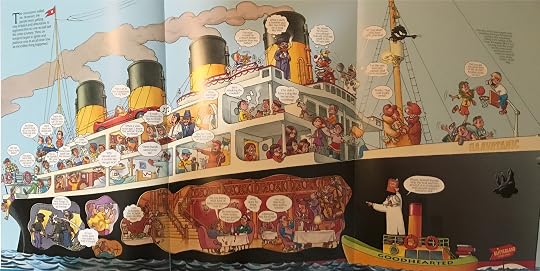
It's the amazing, unsinkable, exclusive Gaavatanic, and it's sailing with a deck full of middos-impaired passengers--straight for disaster! But wait! Rabbi Lev Tov is onboard, and he patiently leads the wayward vacationers towards the good middos (character traits) they so sorely need. This outstanding book, the first of its kind, utilizes fabulous full-color illustrations, humorous dialogue, and the vast wisdom of a renowned educator, to teach humility, sensitivity and character refinement to children and adults alike. A superb educational tool for every home and school. Based on the classic, 'Ways of the Tzaddikim'.
This was one of my FAVORITE books as a kid. I remember going to the library at my school and just devouring the art in this book. There are only so many Orthodox kids' books out there, and this is easily one of the best-- best illustrated, most good-hearted, and most entertaining to all ages.
I was so excited to read this again now that my family purchased the series for ourselves, and it lived up to my expectations. I'm not sure I ever read every page in such detail, and there are so many wonderful jokes and visual gags when you look closely. I felt immediately transported back to childhood, and spent a day just falling back into the world of the books. And now I'm here to review it, of course, in loving detail.
I need a paragraph to talk about the illustrations. They're SO beautiful. Beautiful, and detailed-- and really exciting to explore, especially back when I was a child. It's rare to see a children's book with this much care taken, especially when every character on the page has such unique expressions and importance. I've nearly finished the series, and the art is so consistently impressive and carefully wrought.
The narrative is both simplistic and fun to follow-- a group of conceited Jews, dissatisfied with their lives, set off to the mysterious Glitterland on the great ship Gaavatanic, where they're promised they'll finally have all the pleasures of this world. Each character has unique faults and strengths, allowing for an easy fable about how to improve oneself and avoid the temptation of the yetzer hara.
Generally, I quite liked the way the story was told. This book reminds me of some of my favorite aspects of Judaism-- the idea that nobody is truly 'bad', and that you can always improve yourself, no matter how you feel or what you've done. Not only
that, but it takes the necessary leap of focusing entirely on Jewish characters, making it clear that the 'bad guys' aren't always some external non-Jewish Evil Force. This is a book about how anyone, including Jews, including extremely pious Jews, can go wrong, and how it's possible for any of these people to come back from their mistakes. In addition to that, the front of the book clearly instructs the parental reader never to label their child as "bad" or to make them feel "guilty, inadequate, or sinful."
Overall, the book's take on morality is clearly quite nuanced, with pages dedicated to how specifically Jewish practices can be misused-- for example, making others feel bad with your oversized etrog (which, okay, I pointed to and said "HE'S compensating for something" about while sitting with another adult sibling.) The book emphasizes prayer should never be a way to make others feel bad, and that all worship is about your relationship with Hashem. This book was making me want to start praying again-- and not out of guilt! Out of love and optimism! This children's book made me, a Jewish adult, want to be even MORE Jewish!
The structure of the book gives us some wide shots of the characters on board the ship, and then focuses on each individual to show us how they express bad middos (qualities, traits) and how they could accomplish their goals positively, and/or improve. It's similar in style to the old Goofus and Gallant cartoons, though much more text-heavy, and I agree that this could pose an issue in terms of readability or entertainment for young kids. In my case, I was satisfied by the clever little jabs the authors came up with for the characters. There's something delightfully campy (yes, I'm invoking camp while talking about an Orthodox Jewish book for children) in the sassy, nasty retorts of the different conflicting personalities, and the scenarios were very creatively thought of.
I'll say this-- as an LGBT Jew, yes, this is certainly centered around extremely normative ideas of Orthodox Judaism. It's mostly white (or white-passing) Jews, and it's set in the mold of cis/heterosexual family norms. That said, when it comes to Orthodox literature, I don't take a major issue with this, because, like I said, it's the norms... and one doesn't really expect Orthodox literature, especially for kids, to take particularly progressive stances on these things. So this isn't some kind of leftist breakthrough for Orthodox lit, but then, I didn't expect it to be; so that doesn't factor into my rating. (You may well disagree.)
A reviewer here mentioned that men were generally the default characters, and in nearly every scenario the book was positioned as speaking to/about men. In Orthodox Judaism in particular, the roles for men and women are VASTLY different, and though the book positions itself as though it's talking to everyone, most characters and most examples are men.
Like I said above, this seems like a failing of Orthodox Judaism moreso than the book. While many characters could've been female, all religious positions of power (cantor, rabbi, member of minyan, teacher of Torah study for boys, children in these classes) needed to be male by virtue of the trappings of Orthodoxy. So when the majority are male and the female characters are mostly there to discuss dressing modestly, I'm not surprised. But again, that's my pessimism re: Orthodoxy and the inherent rules, and I would understand different ratings.
Something I did consider more strongly was my desire to see some more reaching out to Jewish kids who might feel drawn to outside culture. There's a sense here that all outside fashion is bad, and all outside music is bad, and that's simply not sustainable. Some people like the sound of rap. Some people like EDM. Some people like different, niche fashion styles. I don't think it's fair to say that essentially everything outside of Jewish culture is bad, and though the book isn't that explicit, it certainly comes off that way-- there really isn't much space for non-conformity, and there's no in-between given for, say, a child who likes a non-Jewish pop star.
Is there no alternative except to only listen to Jewish music (this being what the book suggests)? That doesn't seem tenable. I suppose this would encourage people to completely monitor their children's media intake, but again, I don't think that's possible nor reasonable in this world. Again, I say this as an LGBT person, so obviously none of this worked on me. And I would understand someone saying that THEY expect this of Orthodoxy! I just think Orthodoxy can be well balanced with non-Jewish pop stars. But oh well.
In addition to that, there were places where the suggestions for managing conflict were a little passive-aggressive, and, as much as it pains me to say it, there were a few typos (which did not cause any comprehension errors for me.) Little things which I refused to knock more than half a star for.
And, again, despite that one star I'm removing for all of my complaints, it really impresses me how overall well-done this book is. Like I said, it was one of my favorites as a child, and I'm incredibly excited to have it in my home and available to read again. The pages are immensely rewarding to explore time and time again, and there just aren't enough beautifully illustrated worlds to explore in Jewish literature. For the problems I have with this book, maybe it isn't this book's job to handle every problem in Orthodox Judaism or Orthodox Jewish literature. There's so much out there to explore, and as a foundation, this book does a fantastic job at proving that you CAN write a children's book entirely oriented around Orthodox Jewish characters learning a moral lesson, and you can make it readable and entertaining and compelling to not just children but leftie adults.
I'm very happy with this book! I'd recommend it to just about all the Jews I know, age notwithstanding. And I'm very excited to read and review the rest of the series.
The book serves it's purpose - to teach kids (and grown ups..) the meaning of being modest and focusing on good values and not on materialism and self andorsment. I read only this part of the series, I really liked the idea behind it, you can really feel the book comes from a good home, and I took from it some lessons myself. two thing I didn't like in the book - although it is well writen and pictured (the drawings are very detatiled and thought of), after a short introduction the whole book is pretty much in the same structure - an example for a situation with bad charachter + explanation + the same situation with a good character and good values. it is quite repetitive and I would recommend reading the book not as one unit but as a reference you can come back to when you want to find an example of how to change the bad character. the second issue was the very lacking representation of women or girls. out of the many many men in the drawings, storyline and examples, women were very very few and concentrated on clothing. made me ask how a girl who reads this would feel? and what kind of example does the book give her? I wish I would see a religous book that was also addressing them in a respected manner.
An absolute must have for any household that takes pride in the proper choices that their children make. This is an amazing work that simplifies very difficult material in the style of Rashi (can be taught to the spectrum of all students from 3 years old - College level).