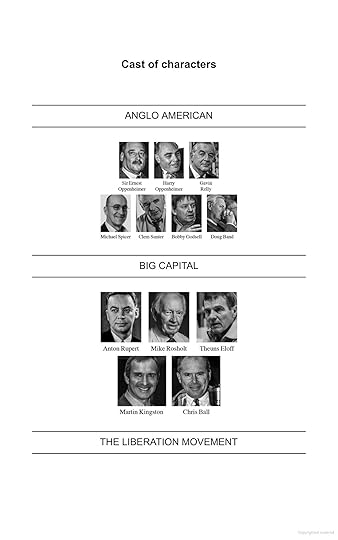
In September 1985 a group of white South African business leaders travelled to a game lodge in Zambia to meet with the exiled ANC leadership under Oliver Tambo and Thabo Mbeki. The group wanted to establish for themselves who and what the ANC was, and they were led by Gavin Relly, executive chairperson of Anglo American. The Zambian visit set in motion a coordinated and well-resourced plan by big business to influence political change in South Africa. After the ANC was unbanned, their goal was to ensure the party did not turn the country into a last outpost of socialism. In The ANC Billionaires top-selling author Pieter du Toit investigates whether secret deals were struck between capital and the liberation movement to ensure the status quo remains in terms of economic policy. He also shows how the ANC was completely unprepared to navigate the intersection between business and politics. The book draws on first-hand accounts by major role players about the contentious relationship between capital and the ANC before, during and after the country’s transition to democracy. It also sheds light on the millionaires and billionaires who have benefited from their relationship to the party, and with business.
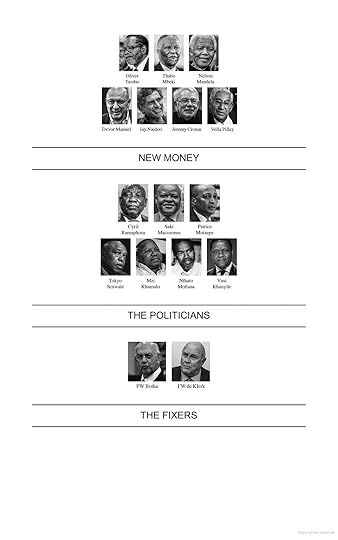
After 1994, a cadre of politically connected businessmen, such as Tokyo Sexwale, Cyril Ramaphosa, Saki Macozoma and Patrice Motsepe, emerged who had access to preferential empowerment deals brokered by companies like Anglo American – all became very wealthy.
The one thing these individuals have in common is the ANC - the party of government and patronage.
4*5: good introduction to the topic Writing style/sentence structure: 4.5*(easy to follow, not wordy, to the point) Layout/Guide: 4.5*(provides a handy Timeline & Cast of Characters) Exploration on topic: 5*(clear on what occurred providing variances of opinions without strong bias. Leaving he reader to conclude/form an opinion)
Cast of Characters
Introduction: quick overview of the principal characters and organisations. Big Capital wanting to take care of its interests by bribing the ANC leaders. Because once they became owners of capital they will have more interest in preserving the status quo.
Part I: Turbulence (1985-1990)
Chapter 1. The long road to Lusaka Meeting in Nambia between ANC leaders & Big Capital (business leaders) led by Gavin Pelly
2. South Africa burning Rent increases leading to protests & a mayor being burnt alive which leads to the Apartheid regime dispatching the army in brutal reprisals
Michael Spicer working under Clem Sunter for Anglo American created scenarios for the future South Africa in what was called the "low road and high road". The former being nationalised industries and socialist policies. The latter being market friendly liberal capitalism
3. Not crossing the Rubicon Bothe's speech doubling down on apartheid policies and refusing to "submit" to international pressure, despite agreeing to wide ranging reforms 2 weeks earlier.
This lead to sanctions imposed globally and international businesses rapid selling off their assets for cheap to SA companies like Anglo American owned by the Oppenheimer family.
4. Marxist-Leninists and fears about the ANC Big capital hoping to convince ANC leaders to adopt free market capitalism, low taxes and zero socialism. This was during the background of the collapse of the USSR, which supported & trained the ANC leaders.
Big Capital starts planning the future The Consultative Business Movement (CMB) was formally established in August 1988, a year after De Klerk replaced Botha as head of state, during the "Broederstroom Encounter" which was attended by 40 white business leaders and 40 black (liberation) leaders from the MDM. At the time it was the only business-led initiative established after "direct consultation with largely black leadership of mass-based organisations."
The CMB had arranged meetings with the Mass Democratic Movement (MDM), (which was a loose alliance of the United Democratic Front (UDF) & Confederation of South African Trade Unions (Cosatu) to create dialogue between white businessman and black leaders. Initially the CBM agitated for a democratic dispensation, as in they weren't interested in getting involved with the apartheid/liberation struggle, and due to the existing mistrust between Afrikaans and the English-speaking whites, there was some reluctance by the English-speaking businessmen e.g. Mike Rosholt (one-time leader of the CMB) of being "perceived as a political enemy of a government dominated by Afrikaans-speaking whites who are just starting to overcome an almost hereditary mistrust of the English-speaking business establishment."
But it also believed 'as Spicer said of business in general, in "enlightened self-interest." "We have to convince the corporate leadership in South Africa that the role of business was to stay in business. They therefore had to become involved. And there was going to be something of a market economy, said Eloff'.
'Big Business - which included Anglo, Old Mutual, Sanlam, the banks and others the Van Zyl Slabbert-Kogl consultancy assisted, were "confused...and scared looking for solutions to enable them to remain in the country."' They knew that they had to do something politically but didn't also want to act against the government. But also were hoping to shape the policies of the ANC (basically play both sides, hedging their bets to protect their interests).
Reform accelerates The biggest change to ANC policy, according to Michael Spicer was the collapse of the Soviet Union, '"In 1989 the Berlin Wall goes down, socialism is fundamentally discredited and then the Soviet Union breaks up. And that, by the way, is significant, as we know, for movement on the Namibian and other fronts, because the sort of dreaded communist ogre, according to lots of old NP stalwarts, disappeared. But from a global economic point of view, it meant capitalism and globalisation and technology and human progress were absolutely dominant."'
It was unfortunate for black South Africans that there wasn't a USSR when they finally received their freedoms, they could have demanded for some redistribution of wealth, instead of crony capitalism. Even the UK, a capitalist country experienced a huge specialist/redistribution of wealth from WWI to WWII including the formation of the NHS, nationalisation of key industries, which decreased inequality.
Part II: Contestation (1990-1996)
Return from exile When the ANC leaders returned from exile, they were introduced to a modern global economy very different to the places that they had been exiled e.g. Dar Es Salaam (Tanzania). Many of the leaders returned homeless, and concerned about their safety due to revenge attacks from "rightwing whites" who were angry after the Hein Grosskopf bomb that targeted whites) and thus became indebted to Big Capital who assisted with housing & security.
Capitalists and comrades Big Capital & the liberation movement began to form a closer relationship with Michael Spicer even visiting Soweto (the first business leader to do so), however, '"I think we seriously misread people like Michael Spicer and what their agenda was. Obviously, they were genuinely committed to democracy of a kind; I would say low-intensity democracy," said Jeremy Cronin. "Big Capital in South Africa didn't trust a future ANC government, and they were desperate to get their bottled-p investments out of the country as quickly as possible; because they were uncertain about the future," he said.' The Workers Hammer, 'accused Mandela of "backing off" at the Carlton conference, accusing Anglo of 'co-opting' trade unions, 'orchestrating' Mandela's speech and trying to 'mould the shape' of the country. "In our attempts to try and negotiate with the ANC about what would be the post-apartheid economic framework, we were often told that we should leave that to a democratic government," said Jay Naidoo leader of the Cosatu (trade union collective).
Brenthurst and meeting Oppenheimer in Jan 1992, Mandela went to The World Economic Forum in Davos. His speech, which was initially scripted by a socialist London-based organisation (under the leadership of Vella Pillay) that touched upon wealth redistribution via nationalisation per the Freedom Charter , was completely changed by Big Capital as well as the influence of China and Vietnam, that had moved to market economies. Big Capital assisted the ANC leaders massively, even paying Winnie Mandela's considerable debt. Hollywood stars such as Whoop Goldberg. Furthermore, some big capitalist's employed black professionals to high positions e.g. Norwich Life in 1990 appointed Mamphela Ramphele, not due to any legal obligation.
Living in the real world
Ready to govern
The left loses its lustre
Betrayal and the end of RDP
Part III: Harvest (1996 to present day)
The origin story of ANC billionaires
The new Randlord: Cyril Ramaphosa
Empowering the ANC: Vusi Khanyile
From Robben Island to the baordroom: Saki Macozoma
The suitcase Man: Patrice Motsepe
Conclusion
My opinion / conclusion Having recently travelled to South Africa (which is where I spotted the book, this is my 2nd copy as i lost the first during transit), I feel as though history will not be on the side of Big Capitalist. South Africa is a violent place with huge levels of inequality. The “whites” (as they call them) reminisce how safe it used to be (before the end of Apartheid). And these people I had spoken to weren’t racists, just frightened of being murdered in their own home, raped or kidnapped. Events which unfortunately seemed commonplace even when I was there in March 2023. The opinion I formed, is that that Big Capital e.g. Anglo American sought to influence the ANC leadership by bribing them and cynically creating a black elite to maintain the status quo of cheap labour and neoliberal market capitalism. Because, as Big Capitalist had reasoned, if you included these black politicians into the hierarchy of the Status Quo, they wouldn’t want to change said Status Quo
A very interesting read and from a Zambian point of view I couldn't be more proud of the role we played in the liberation struggle of not only South Africa but the SADC region.
From a distance big business salvaged the country from plunging into the abyss by taking the initiative to start talking to ANC leaders who had been exiled in Zambia, however closer introspection suggests that it only saved its self interest. The transition from Apartheid to Democracy should have helped the black masses however only the elite with connections to the ANC were the major beneficiaries. The Black elite had to be well milked and empowered in order to silence talks about Nationalization and expropriation without compensation. Probably with the exception of Patrice Motsepe who argued that ''the freedom charter does not discourage private enterprise''. And His comrades would call him the black capitalist. And he would point out that nationalized state mines had failed in South America and elsewhere in Africa However his connection to the ANC can never be disregarded.
Pieter du Toit delivers a well-researched and meticulously chronicled account of the relationship between South African big business and the ANC, particularly focusing on the period surrounding the transition to democracy. Du Toit delves into the motivations and strategies of both sides, shedding light on the clandestine dealings that shaped the economic landscape of the post-apartheid era.
Du Toit's exploration of the ANC's unpreparedness in navigating the complexities of business and politics is particularly insightful, providing valuable context for understanding the subsequent rise of politically connected businessmen.
However, while the book excels in tracing the broader historical trajectory, it leaves the reader wanting a more in-depth analysis of the individual billionaires who emerged from this unique confluence of power. Figures like Tokyo Sexwale, Cyril Ramaphosa, Saki Macozoma, and Patrice Motsepe are undeniably central to the story, yet their personal journeys, motivations, and the intricacies of their wealth accumulation are given relatively superficial treatment.
Despite this shortcoming, this book remains a valuable contribution to the understanding of South Africa's political and economic landscape. It is a must-read for anyone interested in the complex interplay between power, politics, and wealth in the post-apartheid era.
On the whole, it is an OK book, nothing spectacular but not terrible either.
The history lessons at the beginning were not necessary but you can understand why the author had those many chapters focusing on the ANC and its interaction with businesses operating during apartheid. I really enjoyed the chapters that talk about the gentlemen on the cover, nothing new but enjoyable nonetheless.
What Pieter is good at is taking what is there in the public space and package it into a readable product.
This entire review has been hidden because of spoilers.
It would be unfair to give any less than 3 stars to be fair to the author but this is not my area of expertise. I was given the book but I found it hard going not knowing all the players involved and the intricacies of the country. To someone that knows the history of South Africa more intimately I’m sure this would be a good book, but it’s not for the faint hearted.
It was educational and enlightening. It’s also all facts and chronology, and no story - quite unlike The Stellenbosch Mafia. It turns out this book was hurriedly written to ride the crest of the Stellenbosch Mafia wave.
As a regular visitor to South Africa I found this a really interesting account of how big business helped a select group of ANC politicians get mega rich while the masses were left behind.