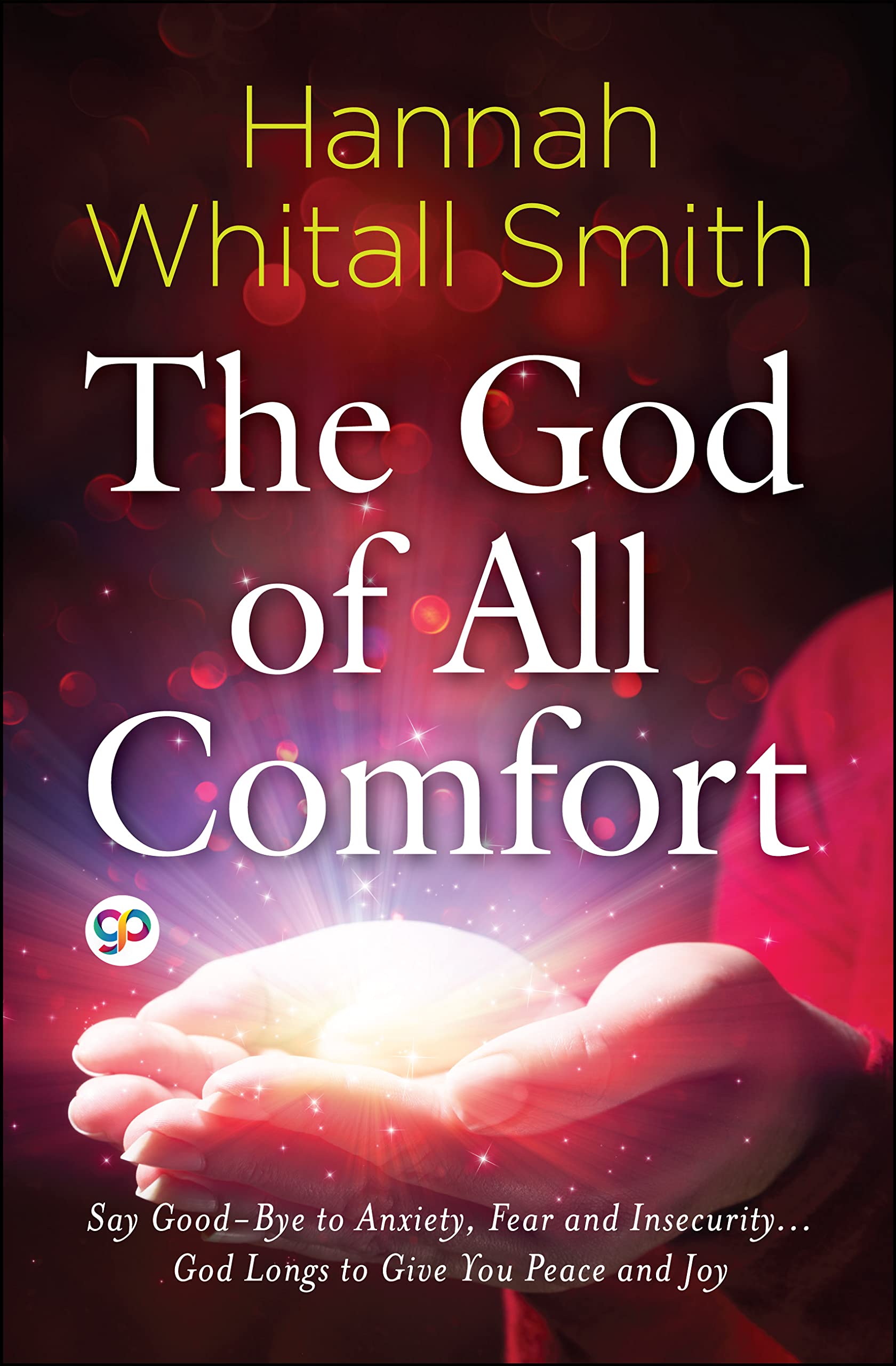
I found this book somewhat surprising.
I went into it with a healthy dose of skepticism. I knew that Hannah Whitall Smith was part of the holiness movement, that she's considered a mystic by some, a spicy theologian by others, and all around not that fashionable right now.
I left the book understanding why she might be considered a mystic and a bit spicy, but thought that overall there were more good points to the book than there were bad points. I also think that she is a bit more fashionable than people realize. There's been a bit of a movement recently in evangelical circles in the United States, the "But God" movement. I am fully aware that this phrase is biblical, and that the Bible is the ultimate source of the phrase, but it's recently become popular, and I'm uncertain if people know that it was popular once before...in Hannah Whitall Smith. Granted, hers was a bit wordier "But still there is God", however, the sentiment is largely the same. Therefore it seems possible that Smith has come back into vogue, or that, much like the cycle of heresy where things once dealt with crop back up again, the cycle of theological discovery has turned once more and we have again remembered the truth of the statement 'But God'. I just found it amusing that some of the people who I have heard use the phrase 'but God' are the same people who decry Mrs. Smith. I'm guessing that it's because they haven't actually read her.
Although I say that I got more enlightenment out of this book than heresy, there were definitely places that caused much brow arching as I read. Part of that is simply because of the time frame in which it was written. 19th century authors had very few qualms about addressing their audiences directly, and they also had zero problems with creating vague stories in order to make a point and ascribing reality to them. I got very tired of the "I once knew a believer who" stories that were patently created out of Mrs. Smith's mind. The stories were inevitably trite, shallow, and entirely too pat by half, so anyone with a halfway bent toward skepticism would find them irritating and feel as though their intelligence was being insulted...at least that's how I felt when I read them...maybe that says more me than it does about the stories.
But it wasn't just the quaintness of the writing style. There were occasions where Mrs. Smith went off the deep end. It was in such an odd way though. On page 17 of the book she said that "We must refuse to believe anything concerning God that is not revealed to us in Christ. All other revelations are partial and therefore not wholly true." If you take her words as they are, then you come away with the conclusion that general revelation is faulty, that creation can tell us only partial truths about God, and that the old testament, and indeed most of the new testament, where Christ is not present, are also presenting partial truths about God and are not to be trusted. That's what she says, but that's not how she acts, or writes. She is constantly quoting scripture in this book, and it's scripture from all over the place, not just the words of Christ. So, clearly she doesn't actually believe what she wrote, or she wouldn't use old testament scripture to prove a point that she is making about who God is.
It did make me think though. I remember sitting in Bible class and being taught that Christ was the only 200% human, that he was 100% God and 100% human. It's a basic point of theology that opposes gnosticism. But reading the book made me think about the concept of incarnation to a greater degree and understand how very much of a separation it was for Christ and God. Christ is 100% God, even in his incarnate form. But God is not 100% Christ. It's a simple thing to say, it's part of the catechism of faith. But it's profound and has a lot of implications. God cannot die. Christ did. God cannot be tempted. Christ was. God is not limited except by the limits he places on himself, Christ was limited as we are limited. God doesn't hunger or thirst. Christ did. If Christ longed for his father and the power and the majesty that he left behind to be clothed in flesh, did God long for his son and all the experiences that being clothed in flesh entailed?
I don't know the answer to that question. I had never thought of it before reading this book.
There are places in the book where Mrs. Smith outright contradicts herself, there are places where her arguments are...well...juvenile. But there are also places where she seems to have her finger on the pulse of humanity.
One such place was on page 38 when she said "It is pure and simple unbelief that is at the bottom of all our lack of comfort, and absolutely nothing else. God comforts us on every side, but we simply do not believe his words of comfort."
I have to admit, she got me there.
I know that there is a distinct problem in the church of taking verses outside of their context, taking a promise intended for Israel and applying it towards modern evangelicals, for instance. But it also seems to me that fear of this misapplication is causing some people, me for instance, to go too far in the opposite direction and think that therefore none of the promises could possibly apply to us.
Another place that I feel she is on to something is on page 122 when she talks about how "the eyes of most of us are continually turned inward, and our gaze is filled on our own interior states and feelings to such an extent that self, and not Christ, has come at last to fill the whole horizon." As long as we are looking at our self, even if from the positive intention of examining ourselves for sin, then that is taking away from our ability to look unto Christ, and it makes us miserable. I thought this was an interesting point to make, especially because I just finished Bad Therapy by Abigail Shrier last week and the two books agree that too much concentration on ourselves is morbidly unhealthy, in our physical and mental lives, and in our spiritual lives as well.
I thought the book was very interesting because there was such tension between the mental and the sentimental. She and C.S. Lewis made some of the same points, that feelings of exaltation are transitory and shouldn't be allowed to determine the success of the Christian walk, but then she went in a completely different direction where the will becomes the all-powerful tool to bring about faith. That faith and belief are choices. That affirmation, vocal, constant affirmation of truths is enough to bring about faith. That doesn't seem all that mystical to me, but it's also clearly not all that intellectual either.
I don't really know what I think about it. I didn't really enjoy the process of reading it, but it did make me think. I didn't agree with everything, but I thought there were some very good points, if only because it made me confront my own aspects of unbelief.