

What do you think?
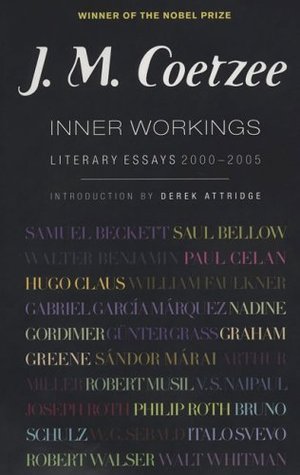
Inner Workings: Literary Essays 2000-2005
A new collection of essays and literary criticism from the respected Nobel Prize-winning author of Stranger Shores is comprised of twenty recently written pieces that examine the work of such twentieth-century writers as Samuel Beckett, Günter Grass, and Gabriel García Márquez.
320 pages, Hardcover
First published January 1, 2007
About the author
J.M. Coetzee
192 books5,520 followersJ. M. Coetzee is a South African writer, essayist, and translator, widely regarded as one of the most influential authors of contemporary literature. His works, often characterized by their austere prose and profound moral and philosophical depth, explore themes of colonialism, identity, power, and human suffering. Born and raised in South Africa, he later became an Australian citizen and has lived in Adelaide since 2002.
Coetzee’s breakthrough novel, Waiting for the Barbarians (1980), established him as a major literary voice, while Life & Times of Michael K (1983) won him the first of his two Booker Prizes. His best-known work, Disgrace (1999), a stark and unsettling examination of post-apartheid South Africa, secured his second Booker Prize, making him the first author to win the award twice. His other notable novels include Foe, Age of Iron, The Master of Petersburg, Elizabeth Costello, and The Childhood of Jesus, many of which incorporate allegorical and metafictional elements.
Beyond fiction, Coetzee has written numerous essays and literary critiques, contributing significantly to discussions on literature, ethics, and history. His autobiographical trilogy—Boyhood, Youth, and Summertime—blends memoir with fiction, offering a fragmented yet insightful reflection on his own life. His literary achievements were recognized with the Nobel Prize in Literature in 2003.
A deeply private individual, Coetzee avoids public life and rarely gives interviews, preferring to let his work speak for itself.
Coetzee’s breakthrough novel, Waiting for the Barbarians (1980), established him as a major literary voice, while Life & Times of Michael K (1983) won him the first of his two Booker Prizes. His best-known work, Disgrace (1999), a stark and unsettling examination of post-apartheid South Africa, secured his second Booker Prize, making him the first author to win the award twice. His other notable novels include Foe, Age of Iron, The Master of Petersburg, Elizabeth Costello, and The Childhood of Jesus, many of which incorporate allegorical and metafictional elements.
Beyond fiction, Coetzee has written numerous essays and literary critiques, contributing significantly to discussions on literature, ethics, and history. His autobiographical trilogy—Boyhood, Youth, and Summertime—blends memoir with fiction, offering a fragmented yet insightful reflection on his own life. His literary achievements were recognized with the Nobel Prize in Literature in 2003.
A deeply private individual, Coetzee avoids public life and rarely gives interviews, preferring to let his work speak for itself.
Ratings & Reviews
Friends & Following
Create a free account to discover what your friends think of this book!
Community Reviews
Displaying 1 - 30 of 44 reviews

January 24, 2021
Big fan of a couple of Coetzee's novels and this was my first time trying his nonfiction, of which I was left both absorbed and rather bored. Some essays were hard work, not helped by the fact he writes about certain books I haven't read - like Roth's The Plot Against America, and Sebald's After Nature, but there is no doubt the guy writes terrifically well outside his fiction. Highlights for me were on Graham Greene's Brighton Rock (love the novel), Gabriel García Márquez, Bruno Schulz, and the poet Paul Celan, but I yawned somewhat when it came to William Faulkner, V.S. Naipaul, and Walt Whitman (nothing against them, just not interested). Will stick to Coetzee's novels from now on.

December 1, 2015
So impressed with the literary essays of Coetzee. I had no idea he was this brilliant and well-read. Plus this book had in it some of my favorite writers including Robert Walser and Max Sebald. Reading this book has now led me to writers I knew little about including Italo Svevo and Gabriel Garcia Marquez.

January 9, 2009
I wasn't familiar with all of the writers discussed here by Coetzee (Bruno Schulz? Sandor Marai? Hugo Claus?), but I did enjoy his essays on Musil, Grass, and Joseph Roth. Almost half of the essays consider authors who wrote in German; among the writers in English discussed are Whitman, Faulkner, Beckett, Graham Greene, Bellow, Roth and Arthur Miller. Essays on Nadine Gordimer, Gabriel Garcia Marquez and V.S. Naipaul round out the book.
At times Coetzee's erudition approaches that of Borges, giving the sensation that one is reading tablets handed down from Olympus; occasionally, his inner pedant breaks free. But what is surprising about most of these essays is their relative freedom from pedantry. Most are accessible (well, maybe not the essay on Walter Benjamin) and even if you can't expect to follow all of Coetzee's literary cross-referencing, you will learn something from these essays.
I particularly liked his commentary on the quality of translation of various works; in particular, the essay on Paul Celan and his translators was the high point for me. Among other things I learned was that Celan had an affair, and a subsequent lengthy correspondence, with Ingeborg Bachmann. (A lot of depressed writers in "middle Europe" in the mid-20th century: Celan eventually killed himself, after years of depression, and Bachmann was found dead in her bed after "a suspicious hotel fire").
At times Coetzee's erudition approaches that of Borges, giving the sensation that one is reading tablets handed down from Olympus; occasionally, his inner pedant breaks free. But what is surprising about most of these essays is their relative freedom from pedantry. Most are accessible (well, maybe not the essay on Walter Benjamin) and even if you can't expect to follow all of Coetzee's literary cross-referencing, you will learn something from these essays.
I particularly liked his commentary on the quality of translation of various works; in particular, the essay on Paul Celan and his translators was the high point for me. Among other things I learned was that Celan had an affair, and a subsequent lengthy correspondence, with Ingeborg Bachmann. (A lot of depressed writers in "middle Europe" in the mid-20th century: Celan eventually killed himself, after years of depression, and Bachmann was found dead in her bed after "a suspicious hotel fire").
August 14, 2025
3.75? 4?
My vision of Coetzee's character had stayed frozen in the idea he presents of himself as a young man in "Youth": somewhat spineless, coy, melancholic, slightly self-absorbed in a subtle vapor of defeat.
He emerges as someone very different here: his prose is brilliant, firm, severe, unapologetic, self-assured. I thoroughly enjoyed reading his keen insights into this array of writers, whose identities prove that Coetzee, even if born into a post-colonial state and having tussled with this legacy in his own fiction, remains by and large an inhabitant —if perhaps somewhat uncomfortably— of the European intellectual province.
I appreciated the rigour with which he approaches his subjects and his sparse but honest admissions of admiration. His take on Walter Benjamin's lines on thinking is refreshingly dominated sooner by scepticism than by nonchalant adoration, as was the case among my philosophy professors, without failing to acknowledge the power of his prose's weight of presence, beauty of form and content.
If I had to point out a negative aspect of the book, it would be that after a few essays one starts to feel a sense of familiarity, of an underlying shared recipe, crystallised even in unusual words and turns of phrase that Coetzee uses repeatedly ('appurtenances', 'in thrall to', 'pathos', 'intelligentsia'), that take away from the vitality of his critical reception expressed not minorly in the style of his texts.
My vision of Coetzee's character had stayed frozen in the idea he presents of himself as a young man in "Youth": somewhat spineless, coy, melancholic, slightly self-absorbed in a subtle vapor of defeat.
He emerges as someone very different here: his prose is brilliant, firm, severe, unapologetic, self-assured. I thoroughly enjoyed reading his keen insights into this array of writers, whose identities prove that Coetzee, even if born into a post-colonial state and having tussled with this legacy in his own fiction, remains by and large an inhabitant —if perhaps somewhat uncomfortably— of the European intellectual province.
I appreciated the rigour with which he approaches his subjects and his sparse but honest admissions of admiration. His take on Walter Benjamin's lines on thinking is refreshingly dominated sooner by scepticism than by nonchalant adoration, as was the case among my philosophy professors, without failing to acknowledge the power of his prose's weight of presence, beauty of form and content.
If I had to point out a negative aspect of the book, it would be that after a few essays one starts to feel a sense of familiarity, of an underlying shared recipe, crystallised even in unusual words and turns of phrase that Coetzee uses repeatedly ('appurtenances', 'in thrall to', 'pathos', 'intelligentsia'), that take away from the vitality of his critical reception expressed not minorly in the style of his texts.

March 21, 2025
As both academic and celebrated novelist, Coetzee’s reviews are almost always first-class. I’ve also loved getting a sense of what appears to be a chunk of his personal canon. And now I’m already on to another of his books of literary essays, Stranger Shores.

October 8, 2008
Coetzee has recently emerged as one of the leading figures in contemporary fiction. His style is dark, obscure, and undeniably Kafkaesque. If you'd like to learn who his other literary influences are, this volume is an excellent help.
Coetzee is highly preoccupied with modernist German literature. There are some excellent reviews in here on Walter Benjamin, Paul Celan, Gunter Grass, and Robert Musil. He also weighs in on American heavy-weights like William Faulkner and Saul Bellow.
The bulk of the content in here is predominantly biographical. I particularly enjoyed his discussion of Faulkner's peculiarly hermetic life, as well as his elaboration on the common view of Benjamin's final days in Europe.
Coetzee is highly preoccupied with modernist German literature. There are some excellent reviews in here on Walter Benjamin, Paul Celan, Gunter Grass, and Robert Musil. He also weighs in on American heavy-weights like William Faulkner and Saul Bellow.
The bulk of the content in here is predominantly biographical. I particularly enjoyed his discussion of Faulkner's peculiarly hermetic life, as well as his elaboration on the common view of Benjamin's final days in Europe.

January 27, 2021
Leitura 02/2021
.
Mecanismos internos [2007]
Orig. Inner workings - Literary Essays 2000-2005
J. M. Coetzee (South Africa, 1940-)
Cia das Letras, 2011, 360 p.
_____________________________
“A função do escritor é agir de tal maneira que ninguém possa ignorar o mundo, nem dizer que não tem culpa do que está acontecendo” (Posição Kindle 4109/81%).
.
Quando “Desonra”, em novembro de 2016, tinha me prometido ler outras cousas do escritor sul-africano J. M. Coetzee. De lá para cá, juntei alguns romances seus, mas a minha teimosa preguiça e a ainda mais insolente e caótica maneira como vou dirimindo minha infindável lista de livros a ler, o projeto foi ficando esquecido. Aí de mim!
.
Então pego para ler o “Mecanismos internos”, uma coletânea de ensaios literários que Coetzee produziu entre os anos 2000 a 2005. Nela, estão reunidos 21 textos seus sobre vários autores e suas “manobras” criativas. Sempre que posso, gosto de buscar livros assim, que narram o processo criativo do escritor, que buscam desvendar o que há por trás de cada romance produzido.
.
No livro de Coetzee, apesar de os textos terem uma franqueza clara e simples, penso que seu teor vai agradar muito mais a especialistas do que um leitor comum. Mas é claro que é possível navegar neles sem muita dificuldade, principalmente por abordarem escritores que povoam minha estante e a memória de meu kindle, como Sándor Márai, Garcia Márquez e Philip Roth, a cujos ensaios mais gostei. Contudo, o livro é recheado de vários outros excelentes escritores e Coetzee mostra um bom estofo ao tratar com a devida atenção de algumas das obras mais importantes da literatura contemporânea, tais como os romances de Robert Musil, Robert Walser, Bruno Schulz, Beckett, Sebald, Bellow e Naipaul. Um tudo de tudo reunido num bom e honesto livro de ensaios.
.
Mecanismos internos [2007]
Orig. Inner workings - Literary Essays 2000-2005
J. M. Coetzee (South Africa, 1940-)
Cia das Letras, 2011, 360 p.
_____________________________
“A função do escritor é agir de tal maneira que ninguém possa ignorar o mundo, nem dizer que não tem culpa do que está acontecendo” (Posição Kindle 4109/81%).
.
Quando “Desonra”, em novembro de 2016, tinha me prometido ler outras cousas do escritor sul-africano J. M. Coetzee. De lá para cá, juntei alguns romances seus, mas a minha teimosa preguiça e a ainda mais insolente e caótica maneira como vou dirimindo minha infindável lista de livros a ler, o projeto foi ficando esquecido. Aí de mim!
.
Então pego para ler o “Mecanismos internos”, uma coletânea de ensaios literários que Coetzee produziu entre os anos 2000 a 2005. Nela, estão reunidos 21 textos seus sobre vários autores e suas “manobras” criativas. Sempre que posso, gosto de buscar livros assim, que narram o processo criativo do escritor, que buscam desvendar o que há por trás de cada romance produzido.
.
No livro de Coetzee, apesar de os textos terem uma franqueza clara e simples, penso que seu teor vai agradar muito mais a especialistas do que um leitor comum. Mas é claro que é possível navegar neles sem muita dificuldade, principalmente por abordarem escritores que povoam minha estante e a memória de meu kindle, como Sándor Márai, Garcia Márquez e Philip Roth, a cujos ensaios mais gostei. Contudo, o livro é recheado de vários outros excelentes escritores e Coetzee mostra um bom estofo ao tratar com a devida atenção de algumas das obras mais importantes da literatura contemporânea, tais como os romances de Robert Musil, Robert Walser, Bruno Schulz, Beckett, Sebald, Bellow e Naipaul. Um tudo de tudo reunido num bom e honesto livro de ensaios.

October 12, 2023
Essays on Italo Svevo, Robert Walser, Robert Musil, Walter Benjamin, Bruno Schulz, Joseph Roth, Sandor Marai, Paul Celan, Günter Grass, W.G. Sebald, Hugo Claus, Graham Green, Samuel Beckett, Walt Whitman, Saul Bellow, Arthur Miller, Philip Roth, Nadine Gordimer, Gabriel Garcia Màrquez, and V.S. Naipaul.
The formula is the same: the plot summary of a book, a biographical sketch of the writer combined with some reflection on (all but for one exception) his impact in the kingdom of (European) letters, commentary on a bad translation (Coetzee seems to wear his knowledge lightly - noting here a bad translation choice of an Italian simile, there a more suitable word for the imagery depicted in the original Hungarian or German), a discussion of the writer's artistic merits - good prose stylist? easy wit? acceptable marriage of belletrism and storytelling? etc.
But the richness nonetheless slowly unfurls: it is clear this is a man discussing his peers, and so we are spared the causticity or the fawning of a reviewer who does not understand what goes into writing books - or good ones, at least. Respect is circumscribed but nonetheless given, and when criticism is levied, it is often noted as disagreement on validly contestable points. The effect becomes that one can see that Coetzee is a charitable reader, firm but fair. If there is anything remarkable in this volume, it is not any single piece of insight but rather the impression Coetzee leaves you with at the end, a mark not just of his breadth but also his acuity. To quote Naipaul: "Aloof everywhere, unsurprised, immensely knowing."
The formula is the same: the plot summary of a book, a biographical sketch of the writer combined with some reflection on (all but for one exception) his impact in the kingdom of (European) letters, commentary on a bad translation (Coetzee seems to wear his knowledge lightly - noting here a bad translation choice of an Italian simile, there a more suitable word for the imagery depicted in the original Hungarian or German), a discussion of the writer's artistic merits - good prose stylist? easy wit? acceptable marriage of belletrism and storytelling? etc.
But the richness nonetheless slowly unfurls: it is clear this is a man discussing his peers, and so we are spared the causticity or the fawning of a reviewer who does not understand what goes into writing books - or good ones, at least. Respect is circumscribed but nonetheless given, and when criticism is levied, it is often noted as disagreement on validly contestable points. The effect becomes that one can see that Coetzee is a charitable reader, firm but fair. If there is anything remarkable in this volume, it is not any single piece of insight but rather the impression Coetzee leaves you with at the end, a mark not just of his breadth but also his acuity. To quote Naipaul: "Aloof everywhere, unsurprised, immensely knowing."

July 30, 2022
This is the second collection of essays I've read by JM Coetzee. It includes pieces on over twenty writers, some of whom --such as Philip Roth and Graham Greene--I was very familiar with, and others --Italo Svevo and Hugo Claus--of which I knew nothing. Regardless of the level of familiarity, all the essays are written intelligently and can be appreciated for their insights into specific works and their general understanding of literature. This is the type of criticism that is no longer found in most English departments, which have become insufferably burdened by theory. Coetzee worked as a professor for many years. I'm sure his students were enriched by his knowledge, just as I was by reading this book.

April 18, 2021
this book is written under three sections of world literature: 1) european, 2) american, and 3) rest of the world. in these three sections, i didn't like american literature section. those essays were so unnecessarily long, and sometimes, convoluted that i partly lost my interest. yet, i loved reading this book in which coetzee's genius literary mind shines in his writing and thoughts. in one of the most important arguments, he raised a strong and valid point for the ethics of translation and translated literature. this has never discussed that much in the discussions of literature.

September 26, 2017
Raccolta di una ventina di saggi su nomi noti della letteratura europea e americana.
Nonostante le tematiche non sempre immediate lo stile è scorrevole, e i riferimenti alle opere, di cui è presentato sempre un breve riassunto, sono chiari e precisi. Ho avuto l'impressione di un reale intento comunicativo da parte dell'autore, cosa non sempre scontata nelle opere di critica letteraria..
Nonostante le tematiche non sempre immediate lo stile è scorrevole, e i riferimenti alle opere, di cui è presentato sempre un breve riassunto, sono chiari e precisi. Ho avuto l'impressione di un reale intento comunicativo da parte dell'autore, cosa non sempre scontata nelle opere di critica letteraria..


January 14, 2020
Some of the essays are interesting but overall I felt bored reading the book.

June 8, 2021
Eu gosto do Coetzee.

Want to Read
August 22, 2024Bought in Barcelona, Spain
August 2024
August 2024

October 5, 2024
Bem interessante alguns ensaios de autores bem conhecidos como Gabriel G. Marques.
November 16, 2025
Estupendos ensayos de un gran premio nobel.muy recomendado

bits-and-pieces
February 11, 2021Containing appreciations of some of my favourite early 20th century writers: Svevo, Musil and Joseph (not Philip) Roth.

June 28, 2015
"Inner Workings" is J.M. Coetzee's second collection of literary essays (my review of the outstanding first set, "Stranger Shores", can be found here ), written between 2000 and 2005. Coetzee again covers a wide spectrum of authors, ranging from some very well known to me, like Gabriel Garcia Márquez, William Faulkner, or Günter Grass, to ones whose names - due to my ignorance about world literature - I can barely recognize, for example Walter Benjamin or Hugo Claus. Like in my review of the previous collection, I am just scribbling some random thoughts about selected essays, ones that resonated with me stronger. Let me say it up front, though: all 21 essays are superb and greatly recommended.
In the essay "Günter Grass and the Wilhelm Gustloff" Coetzee points out that Grass was among the first "to attack the consensus of silence about the complicity of ordinary Germans in Nazi rule". This is a very important point: one who reads about European history may be tempted to think that in 1930-1940s there was a strange nation living between the borders of France and Poland, the nation of Nazis. The sad truth is that this purported Naziland was called Germany, and its inhabitants were ordinary Germans. Not for the first time Coetzee suggests that ordinary people, people like you and me, can be led to commit unspeakable atrocities.
Günter Grass's "Tin Drum" was the first European work of magic realism, which provides a neat segue to the absolutely fascinating essay entitled "Gabriel Garcia Márquez, Memories of My Melancholy Whores", where Coetzee quotes Márquez' definition of magic realism: it is "a matter of telling hard-to-believe stories with a straight face, a trick he learned from his grandmother in Cartagena." To me, the highest point of this essay, and of the entire collection, is the juxtaposition of Cervantes' Dom Quixote and Garcia Marquez' Florentino Ariza: a nameless young factory girl is transformed into the virgin Delgadina by "the same process of idealisation by which the peasant girl of Toboso is transformed into the [Quixote's] Lady Dulcinea." While there are several other startling insights in this incomparable essay, not only am I unqualified to discuss them here, but first and foremost I lack the courage.
The essay on Walt Whitman shows a rare side of Coetzee - his sense of humor, constrained and acerbic yet very funny. Having defined the phrenological terms of "amativeness" (basically meaning "sexual ardor") and "adhesiveness" (meaning "attachment, friendship, comradeship"), notions that were very important for Whitman in his life, erotic or otherwise, Coetzee writes "'the nature of [Whitman's] physical relationship' with young men can refer to only one thing: what Whitman and the young men in question did with their organs of amativeness when they were alone together." In a fascinating aside Coetzee mentions the major change of paradigm of heterosexual versus homosexual that occurred some time after 1880: while in mid 1800s men could kiss in public and could hold hands in purely asexual way, the same actions signified altogether different relationship in the 20th century.
My review is, as usual, getting way too long, so here's an itemization of some other tasty morsels from "Inner Workings":
-> Walter Benjamin's Arcade Project", in Coetzee's words "a great ruin of twentieth-century literature", with its principle of "montage", which may be thought of as a very early version of the hypertext concept.
-> William Faulkner catching a glimpse of but not approaching James Joyce in a Parisian café.
-> Disturbing passages about capturing wild horses in Nevada, during filming a movie, in the essay "Arthur Miller, The Misfits".
-> The mathematical metaphor of rational vs. irrational numbers as applied to human behavior in the essay "Robert Musil, The Confusions of Young Törless"; only Coetzee, who has a degree in mathematics could pull this one off.
-> Bruno Schulz (the author of Cinnamon Shops) being too late with his planned escape from Drohobycz to Warsaw in 1942.
-> In-depth examinations of the art and craft of translation (Coetzee is an accomplished professional translator himself): about conveying the meaning, the rhythm, the tone, the mood, and the beauty of the original in a translation.
Four and a quarter stars.
In the essay "Günter Grass and the Wilhelm Gustloff" Coetzee points out that Grass was among the first "to attack the consensus of silence about the complicity of ordinary Germans in Nazi rule". This is a very important point: one who reads about European history may be tempted to think that in 1930-1940s there was a strange nation living between the borders of France and Poland, the nation of Nazis. The sad truth is that this purported Naziland was called Germany, and its inhabitants were ordinary Germans. Not for the first time Coetzee suggests that ordinary people, people like you and me, can be led to commit unspeakable atrocities.
Günter Grass's "Tin Drum" was the first European work of magic realism, which provides a neat segue to the absolutely fascinating essay entitled "Gabriel Garcia Márquez, Memories of My Melancholy Whores", where Coetzee quotes Márquez' definition of magic realism: it is "a matter of telling hard-to-believe stories with a straight face, a trick he learned from his grandmother in Cartagena." To me, the highest point of this essay, and of the entire collection, is the juxtaposition of Cervantes' Dom Quixote and Garcia Marquez' Florentino Ariza: a nameless young factory girl is transformed into the virgin Delgadina by "the same process of idealisation by which the peasant girl of Toboso is transformed into the [Quixote's] Lady Dulcinea." While there are several other startling insights in this incomparable essay, not only am I unqualified to discuss them here, but first and foremost I lack the courage.
The essay on Walt Whitman shows a rare side of Coetzee - his sense of humor, constrained and acerbic yet very funny. Having defined the phrenological terms of "amativeness" (basically meaning "sexual ardor") and "adhesiveness" (meaning "attachment, friendship, comradeship"), notions that were very important for Whitman in his life, erotic or otherwise, Coetzee writes "'the nature of [Whitman's] physical relationship' with young men can refer to only one thing: what Whitman and the young men in question did with their organs of amativeness when they were alone together." In a fascinating aside Coetzee mentions the major change of paradigm of heterosexual versus homosexual that occurred some time after 1880: while in mid 1800s men could kiss in public and could hold hands in purely asexual way, the same actions signified altogether different relationship in the 20th century.
My review is, as usual, getting way too long, so here's an itemization of some other tasty morsels from "Inner Workings":
-> Walter Benjamin's Arcade Project", in Coetzee's words "a great ruin of twentieth-century literature", with its principle of "montage", which may be thought of as a very early version of the hypertext concept.
-> William Faulkner catching a glimpse of but not approaching James Joyce in a Parisian café.
-> Disturbing passages about capturing wild horses in Nevada, during filming a movie, in the essay "Arthur Miller, The Misfits".
-> The mathematical metaphor of rational vs. irrational numbers as applied to human behavior in the essay "Robert Musil, The Confusions of Young Törless"; only Coetzee, who has a degree in mathematics could pull this one off.
-> Bruno Schulz (the author of Cinnamon Shops) being too late with his planned escape from Drohobycz to Warsaw in 1942.
-> In-depth examinations of the art and craft of translation (Coetzee is an accomplished professional translator himself): about conveying the meaning, the rhythm, the tone, the mood, and the beauty of the original in a translation.
Four and a quarter stars.

January 27, 2012
With the pieces in Inner Workings (Coetzee’s second volume of literary essays after Stranger Shores), he examines the work of a wide range of writers, past and contemporary, ranging from Europe to the Americas. As was the style and scope of Stranger Shores, the critiques and discussions in this collection are accessible, but challenging at times in their erudition. Coetzee showcases his inquisitive mind for analysis and interpretation throughout these pieces. He raises questions that reveal his surefooted understanding of the lives of writers and an intense interaction with their works. He writes with flawless command of subjects, whether it is psychology, history, or some other field or discipline pertinent to his study. He is masterful at describing and summarizing texts, but also brilliant at uncovering deeper meanings. The sum total of each essay is fascinating in its discussion of literary figures and their works. As a former Nobel recipient, Coetzee views literature as more than stories. For him, it is the creative process of shaping reality by exposing and illuminating truths. In this way, he exalts the art of literature as a system that functions to identify, investigate, and ultimately change reality. These essays show how this process of change links inseparably with a writer’s experiences.

March 17, 2010
Reread:
Enjoyed learning about Walser. Was disgusted that Faulkner lied about his military service, though Larry Browm obfuscated his own bad conduct (not that I have room to talk) until his later interviews, when he had read enough of Faulkner to realize that Faulkner is totally full of shit in terms of military fiction.
In Faulker's 'Collected Stories,' I wanted to vomit at the onset of each military story. Pardon me, contemporary military story - his Civil War fiction is entertaining and nostalgic for the dead language of the Old South it holds, something mainstream America has beaten out of contemporary generations of southerners to varying degrees. I digress, slightly.
I don't think Coetzee has much respect for Faulkner. But he is too couth or breathing to outright eviscerate him, though the underlying contempt Coetzee seems to have for the Mississippian surfaces in many none too subtle jibes. Maybe I'm being sensitive because I'm a Mississippian. Maybe Faulkner is totally deserving of the criticism.
At any rate, I enjoyed these essays thoroughly, though it sucked to be reminded that Marquez went all Lolita there a couple of times. Whatever, it's fiction.
Enjoyed learning about Walser. Was disgusted that Faulkner lied about his military service, though Larry Browm obfuscated his own bad conduct (not that I have room to talk) until his later interviews, when he had read enough of Faulkner to realize that Faulkner is totally full of shit in terms of military fiction.
In Faulker's 'Collected Stories,' I wanted to vomit at the onset of each military story. Pardon me, contemporary military story - his Civil War fiction is entertaining and nostalgic for the dead language of the Old South it holds, something mainstream America has beaten out of contemporary generations of southerners to varying degrees. I digress, slightly.
I don't think Coetzee has much respect for Faulkner. But he is too couth or breathing to outright eviscerate him, though the underlying contempt Coetzee seems to have for the Mississippian surfaces in many none too subtle jibes. Maybe I'm being sensitive because I'm a Mississippian. Maybe Faulkner is totally deserving of the criticism.
At any rate, I enjoyed these essays thoroughly, though it sucked to be reminded that Marquez went all Lolita there a couple of times. Whatever, it's fiction.

November 10, 2013
It's interesting how modern many of the themes seem to be in the writings Coetzee reviews, even though some were writing more than a hundred years ago. It's so easy to read Coetzee's non-fiction! His mind is so sharp and his writing so clear, it makes me want to read all the books he reviews.
Fascinating that so many are rooted in Eastern Europe, particularly in and just after the Austro-Hungarian Empire and its collapse at the beginning of the 20th century. While the stories are mostly about personal passions, the backdrop is an empire that had managed to encompass lots of diversity and was then breaking up into it ethnic components - a process we saw continuing in the rest of the 20th century.
It has echoes for today's world, and the competing tensions of embracing diversity and dividing ourselves up into ethnically homogenous states.
Coetzee writes in a way that gives a good name to literary criticism. Far less obscure and tortured than a lot of his own early fiction, full of wit and insight, a feast of intellectual delight.
Fascinating that so many are rooted in Eastern Europe, particularly in and just after the Austro-Hungarian Empire and its collapse at the beginning of the 20th century. While the stories are mostly about personal passions, the backdrop is an empire that had managed to encompass lots of diversity and was then breaking up into it ethnic components - a process we saw continuing in the rest of the 20th century.
It has echoes for today's world, and the competing tensions of embracing diversity and dividing ourselves up into ethnically homogenous states.
Coetzee writes in a way that gives a good name to literary criticism. Far less obscure and tortured than a lot of his own early fiction, full of wit and insight, a feast of intellectual delight.
February 14, 2014
'Inner Workings' is a collection of essays written by J.M.Coetzee,
between 2000-2005. In this book he ponders overs works of some of the
great authors in the past and present century. The set of authors
whose work Coetzee reviews are mostly from Europe and America (barring
Marquez, Naipaul and Gordimer).
His musings on these authors and their writings are beautifully
written. As is usual with Coetzee his writing is succinct, lucid, and
almost poetic. For his reviews Coetzee makes well use of his extensive
erudition and traces links between the author's work and their earlier
works, autobiographical elements from author's life, any influences
that would have inspired the author. This provides a broader context
to the work he is writing about generating a strong interest in
reader's mind to go and read (re-read) the works that have been
reviewed .
between 2000-2005. In this book he ponders overs works of some of the
great authors in the past and present century. The set of authors
whose work Coetzee reviews are mostly from Europe and America (barring
Marquez, Naipaul and Gordimer).
His musings on these authors and their writings are beautifully
written. As is usual with Coetzee his writing is succinct, lucid, and
almost poetic. For his reviews Coetzee makes well use of his extensive
erudition and traces links between the author's work and their earlier
works, autobiographical elements from author's life, any influences
that would have inspired the author. This provides a broader context
to the work he is writing about generating a strong interest in
reader's mind to go and read (re-read) the works that have been
reviewed .

September 1, 2008
Though at times formulaic (each essay begins with biography and then segues into criticism) and sometimes more descriptive than analytical, this collection of literary essays is ultimately a wonder. Coetzee--unsurprisingly--repeatedly wields his immense literary acumen and boundless linguistic knowledge, thus, making for engaging, insightful, and provocative essays throughout. Perhaps what is most remarkable about this wide-raging collection is his selection of authors and texts, which highlights some lesser exposed novelists from the first half of the 20th century, all of whom wholly deserve Coetzee's exposure, praise, and thoughts. Here's hoping for a revival of the likes of Italo Svevo, Bruno Schulz, and Robert Walser!

May 31, 2014
This book is primarily a collection of essays that were originally published in the New York Review of Books, but it also includes some book introductions. Most worthwhile are the essays on less well-known authors like Hugo Claus, Bruno Schulz, and Robert Walser. Although Walser like Marai has become better known over the past decade. Some of my personal favorites like Robert Musil, Samuel Beckett, and Joseph Roth are included. English language writers are well represented from Whitman through Gordimer. Specific works by Arthur Miller and Philip Roth are discussed along with Gabriel Garcia Marquez and V. S. Naipaul. Coetzee is a well read author who writes intelligent, interesting essays. This collection is one worth exploring.

October 24, 2007
This book is valuable for two reasons: the writing about the individual authors, and seeing Coetzee's perspective on these authors. Unfortunately, each essay is usually only valuable for one of the reasons. But that's a minor complaint considering how much better Coetzee writes about these authors than almost every other living critic. He knows the languages that many of the works are translated from, and that helps him illuminate things that would be lost on the rest of us.
MUCH better than his other collections of essays.
MUCH better than his other collections of essays.

August 6, 2011
With the exception of 'Disgrace', I like Coetzee's literary essays better than his fiction. The essays on Italo Svevo and Bruno Schulz were my favorites here (Schulz's striving to "mature into childhood" is now deeply etched into my brain.)
Here's a review that does the book more justice than I ever could: http://www.independent.co.uk/arts-ent...
Here's a review that does the book more justice than I ever could: http://www.independent.co.uk/arts-ent...

August 14, 2008
I think I wanted more out of this book. I read a few sections, but, as sometimes with criticism, I want to read the stuff itself. I guess I think if I read article essays, I may know what to read and what to stay away from.
He's a good writer, but I guess I want the whole chocolate, not just a little nibble .
He's a good writer, but I guess I want the whole chocolate, not just a little nibble .

February 9, 2014
More literary biographies than criticism, but biographical trivia feeds the engine of fantasy, so: pretty fun.
(side note: coetzee seems to be a man who reads through ouevres and gets the ideas and links them together (in not necessarily all taht rigorous of a way), which is maybe related to how he began his academic training in mathematics)
(side note: coetzee seems to be a man who reads through ouevres and gets the ideas and links them together (in not necessarily all taht rigorous of a way), which is maybe related to how he began his academic training in mathematics)

March 21, 2008
Considered essays, so thorough that one has to wonder are there any books on whatever author/subject that Coetzee has not read and synthesized. I do feel like I learn tremendously from his essays. This collection, which covers authors I'm less familiar with, is ever a surprise.
Displaying 1 - 30 of 44 reviews