Jump to ratings and reviews
Rate this book

The Edith Wharton Collection

Rate this book
Discover three classic novels by the literary genius Edith Wharton.

Inside this bundle, you’ll find three stories which established Edith Wharton as a literary legend.

Originally written over a hundred years ago, these stories have stood the test of time to resonate in the hearts of people to this very day. Reflecting the life of the upper-class aristocrats and socialites, The House of Mirth and The Age of Innocence offer tragic tales, while Ethan Frome tells a story in a small wintery town of Massachusetts.

With complex characters, tragic endings, and a timeless quality which explores the social customs of the upper class, these books are perfect for anyone interested in the literary genre.

Buy now to discover Edith Wharton’s classic works today!
Public Domain (P)2020 Montgomery Providence Publishing

Audible Audio

First published January 1, 1920

56 people are currently reading
107 people want to read

About the author

Edith Wharton

1,512 books5,374 followers
Edith Wharton emerged as one of America’s most insightful novelists, deftly exposing the tensions between societal expectation and personal desire through her vivid portrayals of upper-class life. Drawing from her deep familiarity with New York’s privileged “aristocracy,” she offered readers a keenly observed and piercingly honest vision of Gilded Age society.

Her work reached a milestone when she became the first woman to receive the Pulitzer Prize for Fiction, awarded for The Age of Innocence. This novel highlights the constraining rituals of 1870s New York society and remains a defining portrait of elegance laced with regret.

Wharton’s literary achievements span a wide canvas. The House of Mirth presents a tragic, vividly drawn character study of Lily Bart, navigating social expectations and the perils of genteel poverty in 1890s New York. In Ethan Frome, she explores rural hardship and emotional repression, contrasting sharply with her urban social dramas.

Her novella collection Old New York revisits the moral terrain of upper-class society, spanning decades and combining character studies with social commentary. Through these stories, she inevitably points back to themes and settings familiar from The Age of Innocence. Continuing her exploration of class and desire, The Glimpses of the Moon addresses marriage and social mobility in early 20th-century America. And in Summer, Wharton challenges societal norms with its rural setting and themes of sexual awakening and social inequality.

Beyond fiction, Wharton contributed compelling nonfiction and travel writing. The Decoration of Houses reflects her eye for design and architecture; Fighting France: From Dunkerque to Belfort presents a compelling account of her wartime observations. As editor of The Book of the Homeless, she curated a moving, international collaboration in support of war refugees.

Wharton’s influence extended beyond writing. She designed her own country estate, The Mount, a testament to her architectural sensibility and aesthetic vision. The Mount now stands as an educational museum celebrating her legacy.

Throughout her career, Wharton maintained friendships and artistic exchanges with luminaries such as Henry James, Sinclair Lewis, Jean Cocteau, André Gide, and Theodore Roosevelt—reflecting her status as a respected and connected cultural figure.
Her literary legacy also includes multiple Nobel Prize nominations, underscoring her international recognition. She was nominated for the Nobel Prize in Literature more than once.

In sum, Edith Wharton remains celebrated for her unflinching, elegant prose, her psychological acuity, and her capacity to illuminate the unspoken constraints of society—from the glittering ballrooms of New York to quieter, more remote settings. Her wide-ranging work—novels, novellas, short stories, poetry, travel writing, essays—offers cultural insight, enduring emotional depth, and a piercing critique of the customs she both inhabited and dissected.

Ratings & Reviews

What do you think?
Rate this book

Friends & Following

Create a free account to discover what your friends think of this book!

Community Reviews

5 stars
36 (51%)
4 stars
20 (28%)
3 stars
10 (14%)
2 stars
3 (4%)
1 star
1 (1%)
Displaying 1 - 5 of 5 reviews
Profile Image for Realini Ionescu.
4,235 reviews24 followers
September 1, 2025
The Age of Innocence, based on the classic by Edith Wharton, directed by Martin Scorsese, with Daniel Day-Lewis
10 out of 10

- This will be a look at The Age of Innocence, as adapted for the big screen and Through a Glass…Brightly
- This note will be trying to consider the Signature Strengths of the characters and what we can learn from them, in terms of Positive Psychology

- The Age of Innocence is a resplendent story of love, fidelity and betrayal, perseverance, dedication and more
- It is surprising thought to find that the film, with an impressive acclaim form critics, did not win more than one Oscar

- Besides, it was not even nominated for Best Motion, Leading Roles, Director, which it deserved
- Even if this was the year of outstanding productions, like:

- Schindler’s List- the formidable winner for 1994- The Remains of the Day- another glorious masterpiece
- The Piano, with extraordinary performances from Holly Hunter and the very young Anna Paquin

- Winona Ryder, probably before her real life problems, has won a Golden Globe for her role as May Welland
- May is about to be married to Newland Archer aka the phenomenal Daniel Day-Lewis, who is alas retired now

- May Welland is not one of the main characters, although the apparent simplicity and lack of standing is just that:
- Smoke and mirrors

- I think I missed her maneuvers when I first saw this state of the art film and when I have read the novel

- When she becomes aware of the danger posed by her cousin, Ellen Olenska, the magnificent Michelle Pfeiffer, May acts

- As she presents an image of Innocence, the woman who loves Newland is not just Conscious of the threat, but moves to win
- Her Creativity, Persistence, Bravery, Social Intelligence, Vitality, Humility and Hope win the day

- These are all Signature Strengths that are not at all evident at first glance, indeed, as aforementioned I missed them at first glance
- Newland Archer is the hero of this story and he is torn between his duty towards May and his love

- He falls in Love with Ellen Olenska, a married woman who has to live away from her bad husband
- This situation makes her a sort of pariah in certain circles that blame her for a situation in which she suffers and for which she is not responsible

- This is where The Age of Innocence appears as an Absolute Irony since what Innocence is there?
- There is of course a tendency to glorify past époques and attribute to them qualities they did not really have

- In Midnight in Paris, the narrative concentrates around the hero who travels back in time, to meet the likes of Scott F. Fitzgerald, Pablo Picasso, Gertrude Stein, Ernest Hemingway, Salvador Dali
- The protagonist is exhilarated, for he sees this as The Golden Age and yet, his girlfriend wants to travel to the 1890, because for her that is the real Belle Époque, which raises the question- where do we stop?

- With Kubla Khan?
- Newland Archer experiences the classic conflict between mind and heart, duty and passion, in the end keeping his promise

- He is at times Prudent, Kind, Hopeful, Grateful, Persistent, Open-Minded, Fair, Forgiving and Merciful
- Alas, all these Signature Strengths do not help him obtain the desired escape with Ellen Olenska
- The tragic thing is that the two are in love with each other and in this Age Without Innocence, they would just run away together

- In the “Age of Innocence” however that must not be and what the society says matters a lot and determines the outcome of this and multiple other love stories that ended in sorrow and disappointment
- It is also true that we could not really know if Newland and Ellen would have been happy together

- It could have been a passing infatuation, a strong sexual desire in an age that was so puritanical and pretentious
- One magic and elating aspect of this work is that it makes the audience think; imagine possible outcomes and variations of the plot…
Profile Image for Bill FromPA.
703 reviews47 followers
September 7, 2020
The Age of Innocence - 9/5/2020
Love Triumphant
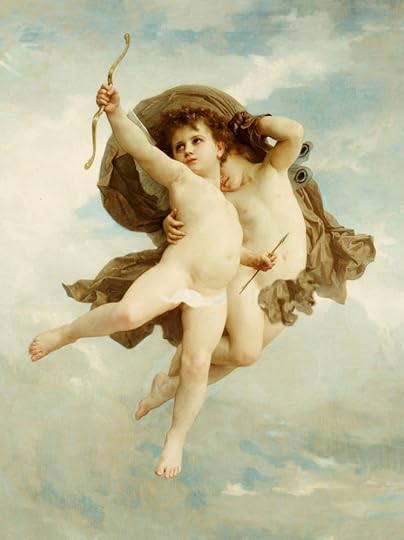
Wandering on to the bouton d'or drawing-room (where Beaufort had had the audacity to hang "Love Victorious," the much-discussed nude of Bouguereau) Archer found Mrs. Welland and her daughter standing near the ball-room door.
Profile Image for Nancy Rust.
Author 9 books2 followers
June 7, 2018
The Age of Innocence is a love story set in nineteenth century New York City. The characters are members of the upper echelon of society which was noted for keeping the status quo. Archer must choose between two loves-May, the ideal beautiful young woman who was innocent of the ways of the world and Ellen, the Countess who had gone against the mores of society and left her philandering husband. Archer purports to see through the false values he constantly encounters, but he is stuck with an inability to break free. May is wiser than Archer thinks, and Ellen is innately more conservative than she appears to society. The choices the three make keep the plot moving.
2 reviews1 follower
March 10, 2017
I thoroughly enjoyed reading The Age of Innocence.
Profile Image for Kristjan.
588 reviews30 followers
January 29, 2024
Book: ***
Performance: ****

A Nice Way to Enjoy a Classic

First off … this is not my typical fare; in fact, I don’t usually care for relationship drama, but I am on a bit of a classics kick and this seemed like an easy way to move outside my comfort zone … and for the most part that is true. The Narration on this collection was great and made it all very enjoyable. In “The Age of Innocence,” we get a Hallmark love triangle set in the NYC socialite scene that now has a bit of a nostalgic feel to it. I am not sure why “The House of Mirth” was not first, but they are remarkably similar stories to my mind, with perhaps a more stinging critique of social expectations and obligations of the time found here. Enough to make me happy to not be living then (while every age has its issues, I would like to believe that there is more freedom and opportunity today for many folks that traditionally had little or none). Granted this is all first world issues … but is still progress. The last piece, “Ethan Frome,” is the weakest of the three and explores an even darker side of human social relationships. All in all, it was worth the effort, but such stories remain a bit of a struggle for me to enjoy much.

The chapters and sections in this work are:

“The Age of Innocence”
Book 1 (5:47)
Book 2 (5:45)

“The House of Mirth”
Book 1 (6:41)
Book 2 5:32)

“Ethan Frome” (3:14)

I was given this free advance review/listener copy (ARC) audiobook at my request and have voluntarily left this review.

#EdithWharton #FreeAudiobookCodes
Displaying 1 - 5 of 5 reviews

Can't find what you're looking for?

Get help and learn more about the design.