Much more than a collection of essays by eminent writers, 'Against the Great Reset' is intended to kick off the intellectual resistance to the sweeping restructuring of the western world by globalist elites.
In June 2020, prominent business and political leaders gathered for the 50th annual meeting of the World Economic Forum in Davos, Switzerland, under the rubric of “The Great Reset.” In the words of WEF founder Klaus Schwab, the Great Reset is a “unique window of opportunity” afforded by the worldwide COVID-19 panic to build “a new social contract” ushering in a utopian era of economic, social, and environmental justice. But beneath their lofty and inspiring words, what are their actual plans?
In this timely and necessary book, Michael Walsh has gathered trenchant critical perspectives on the Great Reset from eighteen eminent writers and journalists from around the world. Victor Davis Hanson places the WEF’s prescriptions and goals in historical context and shows how American politicians justify destructive policies. Michael Anton explains the socialist history of woke capitalism. James Poulos looks at how Big Tech acts as informal government censors. John Tierney lays out the lack of accountability for the unjustified panic over the virus. David Goldman confronts the WEF’s ideas for a fourth industrial revolution with China’s commitment to being the leader of a post-western world. And there are many more.
These writers see the goal of the Great Reset as not just a world without racism, disease, economic inequality, or fossil fuels—but rather, a world with no individual autonomy and power in which our betters rig the system for their own purposes. Find out what the Great Resetters ultimately have in store for you, and join the intellectual resistance—before it’s too late.
Featuring Essays by Michael Anton, Salvatore Babones, Conrad Black, Jeremy Blac, Angelo Codevill, Janice Fiamengo, Richard Fernandez, David P. Goldman, Victor Davis Hanson, Martin Hutchinson, Roger Kimball, Alberto Mingardi, Douglas Murray, James Poulo, Harry Stein, John Tierney, and Michael Walsh.
We’ve got Dave Chappelle and Ricky Gervais, and The Babylon Bee.
2022 was such a long time ago.
Against the Great Reset is a time capsule from a distant age, when Klaus Schwab and the World Economic Forum apparently almost imposed global tyranny. And still might. Somehow.
Confession: I don’t know or care what The Great Reset is. But that’s ok, because I don’t think the contributors of Against the Great Reset really care either, even the ones that do know. The Great Reset is a framing device for the politics of grievance, an intellectually sterile endeavour which explains the endorsements of repeated losers like Stephen Bannon,Jordan Peterson,Christopher Rufo, and Mollie Hemingway.
Out of Place
Maybe it would be exasperating as an editor if your conservative luminaries ignored whatever directive you gave them, instead writing about whatever their pet peeves were. Or maybe it wouldn’t be, if your editorial introduction is a psycho(tic)-religous tour de force, and your own essay is a rambling hodgepodge of confusing cultural references.
And that, at its heart, encapsulates Against the Great Reset. Individualism, if every individual was a dickhead.
It is very funny that Conrad Black opens with how he attended Davos for many years (by invitation even!) just to check out his competition. Impressive gall for him to open his contribution by letting you know how much better he is than the gullible reader. Victor Davis Hanson is a grumpy old man who yells at clouds that look like trains and immigrants. David P Goldman at least tries to show his economic credentials with pages and pages of charts, but rather spoils the effect by citing (with the date!) a gloomy October 2020 report on energy as evidence of the impact of Biden’s nefarious policies.
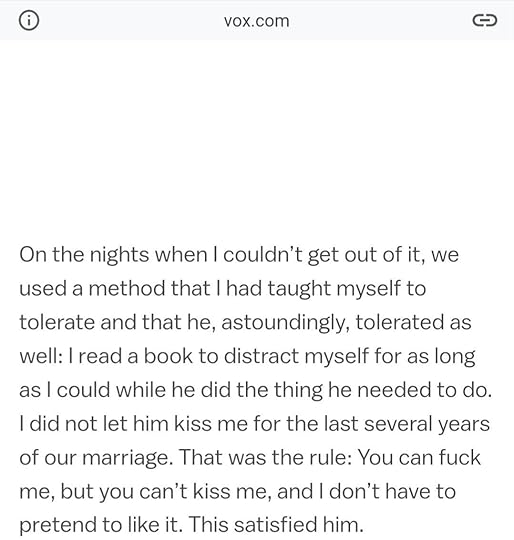
Otherwise the book hodge podge of vaguely anti-leftist stuff that, if you’re one of the converted, you can feel free to enjoy as a bunch of authors phone it in. If you relish being told how bad academia and government is by a guy who appears to have only meaningfully worked in academia or government, then Angelo Codevilla’s your man. Janice Fiamengo’s got your back if the old ball and chain isn’t keeping up her side of the equation, as she snidely complains about a 2018 Vox article that unhappy consensual sex that felt like assault in a marriage actually isn’t sexual assault:
Fiamengo’s utopian marriage, apparently.
....or Harry Stein mostly forgetting what he was meant to write about but generously carrying other people’s grudges over the lack of Little House on the Prairie remakes.
There are key phrases that a number of them remember to repeat, such as how the Taliban get to be on Twitter but Trump was banned or that The Great Reset might make you have to acknowledge transgender people exist, which just makes The Great Reset seem like barely worth the bother. Yes, they do also cite the statement ‘that you will own nothing and you will like it’, but avoid context, or even listing actual examples of licensing rather than owning (such as Spotify or Kindle), probably because if it didn’t come from the World Economic Forum, it’s just good old-fashioned capitalism.
Salvatore Babone’s essay is the one example of how this book could have been done as something other than a quick cash in. He picks a specific element of The Great Reset (Green transportation via large scale public infrastructure works) then provides a competing vision that would rely on private enterprise. It’s well presented and something other than the politics of grievance.
Out of Time
Right now, today, bitcoin can be used as the girders of a new kind of online architecture—one where, for instance, a book about the themes explored here can be unalterably cryptographically written onto the blockchain and bought and sold in bitcoin, That much, at least, has been demonstrated by the sale of my book Human, Forever on canonic.xyz.
Lol.
While most of the essays in Against the Great Reset aren’t particularly focussed, they do suffer from the fact that grievance politics is always on the move. Covid is “over”. Re-litigating lockdowns has limited appeal beyond a small audience. Most of the world leaders castigated within these pages as Great Reset acolytes are gone. Inflation, which admittedly Goldman half-assedly stumbles on (and over) is the new demon to slay.
From a political perspective, The Great Reset is kind of passé. Logic would dictate that Against the Great Reset is similarly afflicted.
Conceded, a number of the vague complaints in this book are transferrable – which is kind of the point - The Great Reset is just a shoddy strawman for anti-leftism. Douglas Murray drips with insincerity when he describes Schwab’s book on The Great Reset as severely unwise for giving rise to conspiratorial interpretations – as though his fellow travellers wouldn’t find another punching bag anyway.
Even so, Against the Great Reset is still incredibly dated. Jeremy Black casting a historiographical hex on the 1619 Project comes off as extremely cowardly to me in the current context, where the issue isn’t whether elements of Critical Race theory are right, but whether you can even by law discuss it. All he is doing lobbing shots as those forbidden to reply, which was becoming apparent well before this book was published. Wuhan lab-leak gains less traction than the resurgence of isolationism, which kind of depends on leaving China with a free hand over Taiwan. Black Lives Matter barely made it to 2021 as a genuine political position. I don’t agree with where the chips fell on alot of these matters, but it is hard to see them as mainstream contestable positions anymore, no matter how much certain media might try to rehabilitate them.
The Great Reset is not a useful framing device – at least from a long-term perspective. It is perhaps an explanation why few of the contributors engage with it – better to protect your brand by speaking in vague generalities than be painted as a conspiracist.
Most of those feel like someone just got paid to write something anti-WEF and they perfunctorily did just that. I'm glad the other side gets their say but this feels very cheap and mercenary.
For the thirty or so years that Klaus Schwab has been strutting his stuff, there has never been any doubt about his intentions, or those of the arrogant poseurs that he attracts to his World Economic Forum. They state their aims clearly and repeatedly. Put simply, they believe they know best; they are the elite in all their fields, and it's time that they ran the world unimpeded. The height of their arrogance and self-belief is so preposterous that most people can't get their heads around it. "You'll own nothing and you'll be happy", proclaims the W.E.F. Young people quite like the sound of that. "Democracy is inefficient and fails to deliver equable outcomes". Socialists generally agree with that one, too. "Capitalism works best under authoritarian control." Sure, just look at China. The fact that this stuff is being endorsed by the richest money-grubbers in the world, and the most deeply entrenched swamp creatures of the deep state, seems to pass people by. This book won't solve the dilemma by magically opening the eyes of the slumbering masses, but it will interest and stimulate the minds of those who know damn well what is going on and relish the opportunity to be proved right. Not all the eighteen essays are worth the effort, but some of them are great examples of the essayists' art.
Since this was a collection of essays by 18 very different authors, my feelings are mixed. I think we were all on the same page... Centralization is never a good plan, and as for handing anything over to the Davos crowd to run, NOT ON YOUR LIFE!
However, some of the essayists were so erudite that I nearly gave up reading. I am glad I persevered to the end, though, as some of my favorite essays came later in the book e.g. "History Under the Great Reset."
Intellectually stimulating and a good overview of Great Reset trends and impact on a wide variety of human endeavors, including some you wouldn't have expected. As with most anthologies, the chapters were uneven. The feminism chapter was trite and disappointing, which is surprising given the rich lode of possibilities it offers for Great Reset analysis, with women and femininity under attack.
The anecdotes from different contributors are mostly engaging and enjoyable. However, a few seem dusted off and put in brackets. These stories start by hinting at The Great Reset and end the same way, but in between, they wander off into topics like the US school system, Russian literature, Napoleon, monetary policies, etc.
A collection of 18 differing views on the World Economic Forum's agenda 2023 and why it is detrimental to global society and is ultimately destined to fail.
Too long and repetitive, but it's easy to skim through the less interesting material. The Codevilla, Anton, Stein, Babones, and Fernandez essays are particularly good.