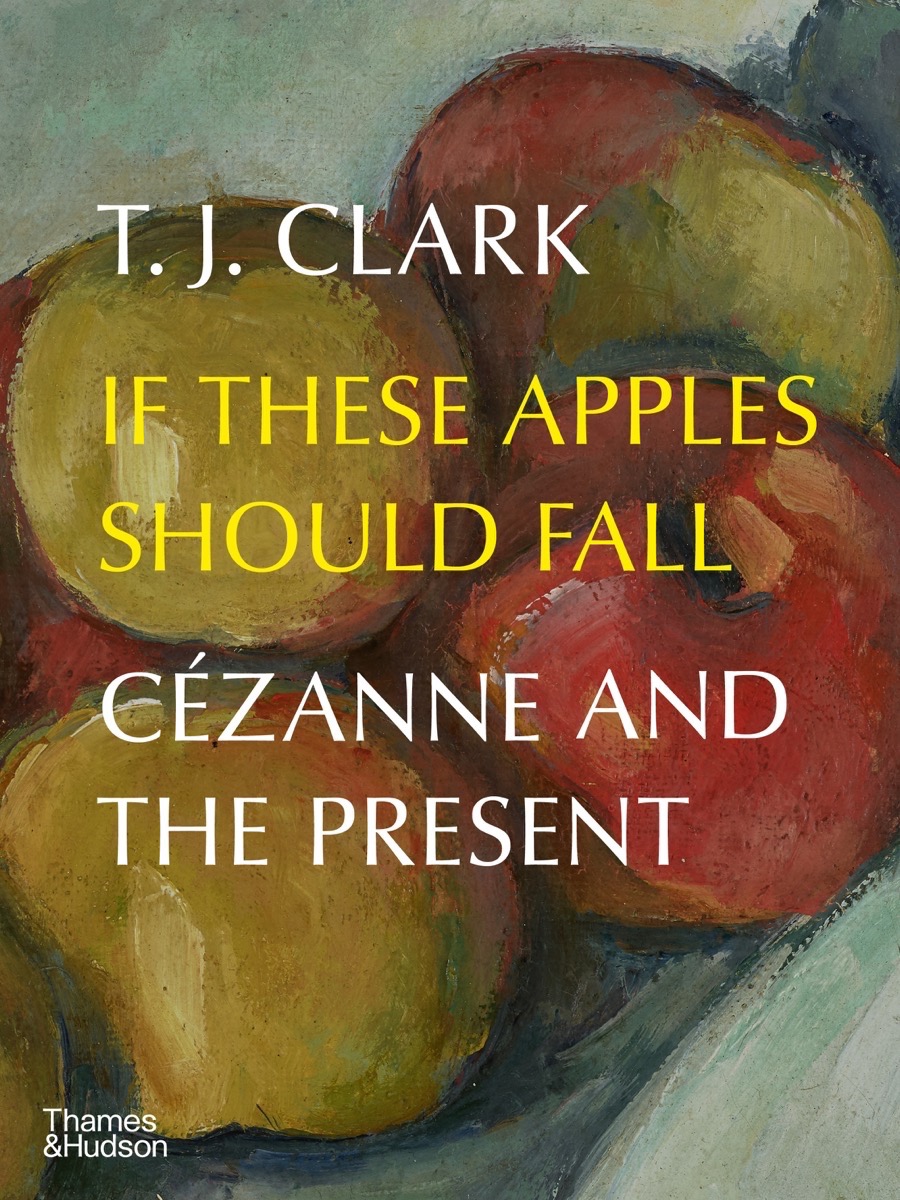
Clark's writing is astounding, evocative, sometimes hard to grasp. My mom read this before I did, and in a discussion of Cézanne's landscapes, she put a question mark next to this passage and a note to ask me what it means:
Interminability and hesitation in Cézanne are thus not rooted in an epistemology of addition—though of course some such naive positivism is operative, at the level of ideological framing and self-understanding—but in an (equally naive) Hegelian prevarication, a waiting and hoping for the moment at which the addition of units turns quantity into quality (128–129).
I think this is the culmination of Clark's criticism of Roger Fry's interpretation of Cézanne as doing something in his painting akin to phenomenalism or subjective idealism, whereby the world is built up out of sense impressions. Here is the quote from Fry that Clark discusses:
Cézanne, inheriting from the Impressionists the general notion of accepting the purely visual patchwork of appearance, concentrated his imagination so intensely upon certain oppositions of tone and colour that he became able to build up and, as it were, re-create form from within; and at the same time that he re-created form he recreated it clothed with colour, light, and atmosphere all at once. It is this astonishing synthetic power that amazes me in the work (p. 125)
Clark agrees that Cézanne is doing something in his paintings about vision, but he's destabilizing it by messing with perspective and edges: "This is the Cézanne effect. The world has to be pictured as possessed by the eye, indeed 'totalized' by it; but always on the basis of exploding or garbled or utterly intractable data—data which speak to the impossibility of synthesis even as they seem to provide the sensuous material for it. The branch flickers between possible positions, possible identities. 'We know not where to have it. 'It seems impossible to grasp'. But it's there all the same" (p. 126).
And by following the phenomenalist logic to its conclusion, Cézanne gives us a glimpse of nothing less than what world-making is:
Cézanne's is the most radical project of nineteenth-century positivism. It stakes everything on the possibility of recreating the structure of experience out of that experience's units...But the very radicality of the project delivers it. Because this painting stakes everything on the notion of the unitary, the immediate, the bare minimum of sensation, the momentary-and-material 'ping'; because it goes on and on searching for ways to insist that here, in this dab, is the elementary particle out of which seeing is made; because it fetishizes the singular, it discovers the singular as exactly not the form of 'experience'. It shows us a way of world-making in which the very idea of a world—the very idea of totality or synthesis...is not drawn from some prior texture of unit sensations 'out there', and therefore potentially 'in here'. It follows that notions as seemingly basic as foreground and background may no longer apply...Maybe not even inside and outside. Nor experience and representation. Nor 'now' and 'then'. (p. 127)
My reading of this passage in Clark is that Cézanne's painting, instead of showing us how our view of the world is built up out of individual sensations, shows how it can't do that, how every attempt to do that breaks down. Clark is more explicit about this later in the chapter:
Cézanne is looking for a mark that would not be a further 'one' in a series, but a kind of 'zero', with the power to replace the dab after dab of addition by a sudden connectedness and unity—by a truly magical multiplier effect. There is no such mark, of course. Effects like this are beyond painting's grasp...The sequence is required to show that no feat of painterly energy, no moment of 'supreme spontaneity', no demonstration of 'intellectualized sensual power' can ever perform the aesthetic conjuring trick. Vividness, then, is the vividness of defeat. The vividness of procedure. *Even this* says the painting, cannot secure the 'Darstellung der Ideen'. You see why the 'even this' had to be so monstrously good (p. 129).
For a negative proof like the one Clark attributes to Cézanne, a proof that a phenomenalist reconstruction of the form of the world is not possible, he has to show the best possible case of painting doing that while it still fails.