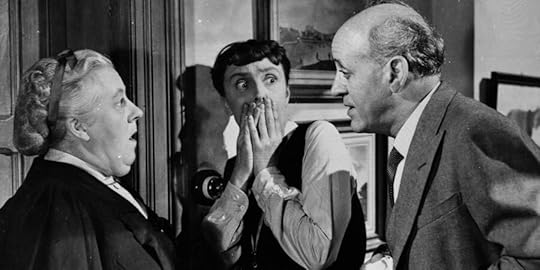
"The sight of duty does make one shiver," said Miss Herrick. "The actual doing of it would kill one, I think."
Ever anxious to keep up appearances, self-avowed intellectual and scholar Nicholas Herrick knows that to involve himself in the running of his own school would be a condescension too far. Assembling around himself a cast of fittingly fawning friends and aides, he sets about unveiling his final masterpiece. Described in contemporary reviews as "a work of genius," Pastors and Masters inaugurated the writing career of an author gifted with a rare skill for characterization and for wry portrayals of domestic scenes.
Dame Ivy Compton-Burnett, DBE was an English novelist, published (in the original hardback editions) as I. Compton-Burnett. She was awarded the 1955 James Tait Black Memorial Prize for her novel Mother and Son.
Miss Burnett, I didn't see you there. Miss Compton-Burnett? I didn't see you there because you didn't tell me you had entered the room, and if I didn't address you in this bit of dialogue no reader of this review would ever realize that you are present. You don't make it easy on your readers, do you? Oh, you expect us to pay attention. Is that it? I see, you don't want your books to become just some light reading before bed. I think perhaps Mr. Henry Green might have looked to you for inspiration as in reading this book I was reminded of his book, Loving. Oh, there you go exiting the scene again, and if I don't mention it nobody will ever know.
In a little would-be posh prep school the head and his few lowly teachers politely snipe at the boys and at each other until the shark tank is positively boiling with repressed hatreds. Doesn’t this sound like fun! And especially when Mr Merry, the master who does most of the donkey work, sounds exactly like Alistair Sim in such classic comedies as The Happiest Days of Your Life
But no, it isn’t fun. Ivy Compton-Burnett famously wrote her short novels almost entirely in dialogue - nothing wrong with that - but I just didn’t get half of the oblique inferences buried in each studied line. They went whizzing over my head. It was like late-Henry-James-lite.
“Well, well, we might begin,” said Herrick.
” Yes, yes, begin, Herrick,” said Bumpus.
“ Yes, it is your business, dear,” said Emily. ” Dickie is a relative, and has to be put last in everything. It would be presuming upon your intimacy with the house to hold back.”
“It is so nice to help in any way,” said Miss Lydia.
“ I said that Lydia did not admire you nearly enough,” said Emily.
“ She really admires us terribly little,” said Bumpus.
“ Well, she has killed any desire in me, but to do my simple best in anything I may undertake,” said Herrick, opening his papers.
“Yes, we must keep Lydia here. She will put the right spirit into it,” said Bumpus.
“ Oh, no, no, I can’t be here. But it is so nice to be wanted, thank you, thank you. So nice to go off to what calls me most, feeling that I should be welcome at what calls me less, calls me too, though it does not need me. For it does call me. It does call me. But I must go to the need.”
It turned out that Ivy Compton-Burnett’s family was much more interesting than her writing. She was the seventh of twelve children of a well-known homeopathic physician. After university she went back home to teach four of her younger sisters. However her stepmother was allegedly an ogre and sent of all the children to boarding school as soon as possible. Later her favourite brother died of pneumonia and another was killed on the Somme. Oh, and her two youngest sisters died in a suicide pact by poison in their locked bedroom on Christmas Day, 1917. And, what about this, none of the twelve siblings had children, and all eight girls remained unmarried.
I thought I had discovered a literary goldmine when I found Ivy's work in the library. A book of just sharp, acerbic dialogue and no descriptions of anything? Sounds good doesn't it!! But about half way through I realised that this form of writing is a bit too much - you never get to hear about what the characters are actually doing, and are never given a break from the intensity of the situations the characters find themselves in. I used to think a long page of descriptive writing was a bit much, but I think I would welcome it in one of these books now...
In The Uncommon Reader, Alan Bennett’s Queen Elizabeth finds Ivy Compton-Burnett demanding, but also “unsentimental, severe, and wise.” I must agree with the Queen.
This is a weird little book. It’s very easy to get lost at the beginning because she doesn’t distinguish her characters in any normal way. She gives you some odd and unnecessary facial details, but doesn’t explain who the people are, so you have to figure it out through the dialog as you go on.
“'Real books coming out of our own heads!’ said Bumpus. ‘And not just printed unkindness to other people’s.’”
Lots of fun if you’re into sarcasm. A little like Oscar Wilde--maybe nastier. She appears to be saying here that teachers are strung out, over-emotional and nervous, and that advanced scholars get so used to taking credit for things they don’t do that they hardly bat an eye when this is taken to an extreme.
Pastors and Masters is better described as a novella than a full blown novel (in my edition it comes in at a scant 96 pages). It’s Ivy Compton-Burnett’s (ICB) second, and the first to use her signature style of minimal description, maximal dialog. As such, she’s still mastering the technique so the novel fails at a couple of levels:
(1) It is hard at times to follow what’s happening even if you’re paying close attention to the text.
(2) ICB introduces too many characters and situations to adequately address in less than a 100 pages. There’s Nicholas and Emily Herrick, headmaster and spinster sister; the Merrys, husband and wife who actually run the Herricks’ boys’ school (such as it is); Mr. Burgess and Miss Basden, teachers at the school; the Bentleys, father, daughter & sons (who attend the school); Reverend and Mrs. Peter Fletcher and his spinster sister, Lydia; and Nicholas’ friends William Masson and Richard Bumpus.
The chief plot revolves around Nicholas’ and Bumpus’ failures as authors, and what ensues when Nicholas steals a manuscript to pass off as his own that turns out to be a copy of Bumpus’ literary efforts. But there’re also the Merrys’ efforts to run at least a minimally effective school, and Mr. Bentley’s suspicions that his sons aren’t getting the respectable education he thinks they need.
There’s good stuff in here, too, make no mistake. The back-and-forth at the awards ceremony is tight, crisp and funny. And the scenes between Mr. Bentley and his children are painful and cringe-inducing examples of the worst type of Victorian father. Both indicative of ICB’s later, mature mastery of her style found in Manservant and Maidservant, written 20 years later.
This is not the book to begin with if you’re interested in ICB but it’s worth it if you’re already a fan. An example of why, even with its flaws, the book’s publication caused a stir among the critics.
I have to say that I have no idea what this book is about. I barely know what happened, let alone what was discussed. This story is mostly dialogue, if you can call it that...more like verbal sparring, a constant back and forth with nuanced word play with innuendoes and more than a touch of sarcasm. I obviously can't write a review with any meaning wince I found it so difficult to follow. That being said, I didn't even hate it (although the fact that it is the length of a novella didn't hurt). During the few moments when I was able to discern the meaning in a sentence or a scene it was often quite comical and really exposed the absurdity of the characters. About two-thirds of the way through is a wonderful scene when two characters are going to read their new books publicly that was really entertaining. But after that I was completely baffled about what the final third was about or why there was even more story when I thought the climax was already revealed. I'm sure that Compton-Burnett had something to say in this book- in fact my book jacket calls this a wok of genius so she must have said something and somebody got it. Unfortunately I wasn't that person.
Clearly I am missing something here. Sure, early 20th century modernism, people were trying to test the limits of what a novel was. Usually that kind of thing leaves me tepid, because it always feels like plot, or characterization, or something get left out along with the Es. But Compton-Burnett seems even more gratuitous. There exists a literary form that eschews all but the most cursory description and detail in favor of dialogue. Why the hell didn't she just write plays? The next sentence started "Of course, I've only read to page 43...", but then I realized it only is 98 pages. The charm eludes me, unlike Thirkell. Where an Adams or a Dickens can go on at length about the rain, entertainingly, I don't mind an author giving description a miss if they don't have anything in particular to say. And it's usually more effective to not bog down in detail. But it's not like the author is giving the description a miss in order to get to the drama or the wit. So far it's just a dull group of people saying dull and stupid things to one another. Maybe I'm just disappointed because the brief bio raised all sorts of fascinating topics that aren't explained. Where did all the family money come from, that Compton-Burnett managed after the death of her mother? Why did two sisters poison themselves on Christmas Day? Seriously, what the hell was up with that family? Cause Compton-Burnett seems to have spent years living as a companion (in the paid sense) to another woman while also managing what appeared to be a family fortune. WTF? The mother sent all the kids off to boarding school as soon as she could, and with twelve, who could blame her. But also the author comes back from college to serve as tutor to her own younger siblings? Is it just so confusing because those pages were bound upside down in my copy? Is Sue Townsend as eliptical as Compton-Burnett? Why is the wiki so devoid of useful detail like where the hell was she is the birth order: I'm not even sure which was her mother. You know how confused I am? I'd rather give it a rest and do taxes and laundry instead, and I am way pissed that I have to do taxes at all. The IRS has already had all of this reported to them by the banks and employers and such. Yes, Turbo Tax has found a fortune lying on the ground and is willing to shell out on lobbying to keep the annual flood coming, and it is a measure of how corrupted our republic is by corporate interest that the lawmakers don't care how annoying and stupid it is to privatize something so pointlessly, blah, blah, blah (I really hate doing my taxes) but still, preferable to finding out what is going to happen on prize-giving day at this unnamed school. By way of contrast, High Rising starts out with the mother at her son's school for prize-giving, and that is quite amusing, and Coming Home, one of my great comfort reads also starts with prize-giving, only it's charming and nostalgic. So it's not the subject matter, is what I'm attempting to say. I'll just go away now and digress quietly by myself out of public view...
I received this little novel from the Librarything early reviewers scheme. I was interested in reading a Compton-Burnett novel, as I recently read a biography about the novelist Elizabeth Taylor, and Compton-Burnett was a good friend of hers, and was referred to in the book a great deal. In the forward to the novel, Sue Townsend suggests that readers might find it a hard read at times, that Compton-Burnett's style takes some getting used to. The novel is written almost completely in dialogue. I didn't however find it a difficult read, the style is a little unusual prehaps, but the writing is so very good that it flows easily and makes for a quick and lively read. The characters are quirky fully developed in spite of being written about in a style that one might think doesn't lend itself to the description of characters, and yet within the great swathes of dialogue there emerges strong and distinct characters. This is the first book by this author I have read, but it probably won't be the last.
The story in this book is driven by dialogue, the dialogue between the staff at a boys' preparatory school in England (a private school for students between the ages of seven and thirteen).
Mr Herrick the headmaster of the school has always wanted to be known as a writer. He can't believe his luck when he finds an unpublished manuscript in the belongings of a recently deceased teacher called Crabbe at his school. He covets the work as his own.
Another teacher called Bumpus wrote a book many years previously that he didn't think much of and he doesn't believe there are any existing copies, other than the one he possesses. He tells everyone that he's recently rewritten it completely, but there's a delay in showing the new version as the copy he gave to Crabbe has disappeared.
Unfortunately for Bumpus, another teacher called Masson has kept a copy of Bumpus's original book. When Herrick and Bumpus read their work, the first sentences are the same, and it becomes clear that neither Herrick nor Bumpus have written a new book.
This ambition and cynical manipulation of the truth set a bad example to their pupils.
Ivy Compton-Burnett's style is very severe and hard-to-follow sometimes (I had to start by writing down the names & relationships of all the characters to keep up with the dialogue-driven style of her writing) but worth it for both the wonderfully evil bon mots embedded therein (and they come quick and fast in her books) and the more poignant meditations on the nature of people and their relationships to each other, to life, and duty.
If you watch Downton Abbey primarily for Maggie Smith's incisive one-liners you might find a lot to appreciate in ICB's novels. I can't decide whether ICB is more humane than that character (because of the sincere statements about the nature of love and life buried under her wit) or less humane (because her gimlet eye is so ruthless), but I know that she had me tittering all the same.
I discovered ICB by accident nearly 50 years ago, and set out to collect all her novels. I'm now on my fourth or fifth reread of her work, and started with her first acknowledged book. It's so wonderful it makes my mouth water reading it. All the seeds of her subsequent monstrous characters are there, the silent children, the tyrant father, the duplicitous intellectuals, all revealed purely through dialogue. She seems to be a love her or hate her writer - I'm firmly in the love her camp. So looking forward to rereading all the rest!
I. Compton-Burnett's first mature attempt at a novel did not satisfy. It was like trying to capture an image of a fractal manually. The characters were boring: the setting was boring: and from what I read, she never made her point, if there was one. Fortunately, it is a short novel. I may try to read one of her more mature works, but this one was a tough slog.
Quite possibly the worst book I have ever read. The whole damn book was dialogue!! Between characters I couldn't even bring myself to care about. And there was ~20 different characters, most of which undeveloped because it was only dialogue, and so many of them irrelevant and bland. The plot was pretty much non-existent, there was nothing to get excited about, nothing interesting at all. Seems like a failed literary experiment. There's a reason books aren't only written in dialogue.
Genuinely just a terrible book overall that felt like torture. Thank god it only cost me $3 and I can throw this trash away.
Whimsical and amusing, a novel almost entirely in dialogue in which nothing much "happens" but we do get a fabulous insight into the minds of the various characters through how they talk about what they value. Very dry, very 'British,' very mannered, and very funny.
Having finally sampled her work, I'd guess Ms Compton-Burnett is like dark chocolate— you either love her or hate her — I loved the astringent wit and cynically revealing dialogue in this early work about teachers at a boys' school.
I discovered this author through a novel by Barbara Pym, in which one of the characters describes another as the sort of person who would read I C-B. It is a clever and original book. I C-B’s characters perfect the art of talking evasively to the point where, most of the time, you are left wondering what exactly they mean and, on more than one occasion, whether they are actually saying anything at all. It makes for a surreal reading experience. I can’t imagine a publisher risking publishing anything like this nowadays. The book alludes to same-sex relationships, though it’s not really homoEROTIC by any strech of the imagination.
It was hard to follow at times because it is mostly dialogue. She often didn't write what was happening in the scene and made you guess through what people where saying. A couple of times people would have left the "room" and I would only know when they came back and someone commented on them returning. Also, because it was mostly dialogue I had a hard time "getting to know" the characters. Most of them I feel like I don't know at all. But I guess they weren't that important to the story anyway.
Mr Herrick owns a boys' prep school but he wants to be remembered as a writer. This tiny novel is a social comedy explores the cloistered world of academics and teachers and lays bare its endemic pretensions and hypocrisies.
There are over a dozen important characters which is quite a lot for a book of fewer than a hundred pages. Sometimes but not always they are introduced. To help me, I constructed a cast list which I offer for the assistance of the reader:
Mr Merry is a senior teacher at Mr Herrick's school, despite having no qualifications (other than he gets on very well with the boys and even better with the parents; Mr M is the perfect salesman for the school). Mrs Merry aka 'Mother' is his wife who runs the catering and teaches Scripture by reading the text book. Miss Basden is matron; she teaches French and English; she's a very clever lady, far more widely read than any of the others, and quite militant in terms of women's rights. Mr Burgess: teaches the senior boys Nicholas Herrick, aged 70, is the owner of the school, putting in a ten minute appearance every day to read prayers. He used to be a university don. He desperately wants to be a novelist so that he can say that he has done something with his life but so far has only been able to be a critic. Emily Herrick is Nick's sister and lives with him. She thinks herself better than those of a lower social class. Richard (Dickie) Bumpus is a university don who once wrote a book but "caused a manuscript to be put into the grave of a friend" (Ch 2); he's now trying to write a second (or is it to rewrite the first?). He is witty and sarcastic with one-liners highlighting the daft things others say. William Masson is another university don. Revd Peter Fletcher, who is invited to spread at Prize Day, is about to retire. He has old-fashioned views about women. Mrs Theresa Fletcher is his wife. Miss Lydia Fletcher, Peter's sister, lives with them and, having a private income, is charitable Revd Francis Fletcher is Peter's nephew Mr Bentley, twice a widower, is the father of two boys at the school, John and Harry, and a daughter Delia.
It's written, as is typical of ICB novels, mostly in quite formal dialogue (for example: "Shouldn't he not have written?"; Ch 2 and "Then I may betake myself with a clear conscience to the solid pursuits which must be my portion, I fear"; Ch 6), almost like a playscript. Some people speak their mind but others hide, using euphemisms such as 'nice' and omissions and downright distortions. "How good we all are at talking without ever saying anything we thing!" one of the characters exclaims in the final chapter. What this means is that the reader must pay close and careful attention to exactly what is said. It isn't easy and I'm not confident I understood all the subtleties of plot, let alone the nuances of character. It is clear that this technique was deliberate so that ICB was able to explore issues that were probably tabu in 1925 within her social circle, if not in the wider literary world. Here are some examples:
She shows sympathy with the unemployed: "The man has struggled to get work until he is hopeless, just to get work, just that, poor soul!" (Ch 3) She can be cutting about the social classes. There is a sardonic edge when she considers the relative positions of Mr Herrick who profits from the school despite only putting in a daily ten-minute appearance and Mr Merry and his team who actually do the work: the Herricks find the sight of Merry doing his duty upsets them: "The sight of duty does make one shiver ... The actual doing of it would kill one, I think." (Ch 2) Emily in particular seems to think she is doing Mr Merry a favour in employing him and, when she discovers that he has a Christian name, says: "How simply and kindly of him it seems to have one!" (Ch 7) Emily also says: "It must be so dreadful to be a servant ... and do the important work of the world. That sort of work, so ill paid and degrading." (Ch 7) There is the suggestion that William Masson is gay. Masson and Bumpus "had meant romance for each other in youth." (Ch 2) Emily says of Masson that he wants to marry her "as much as he wants to marry anyone. Anyone who is a woman. And that is not very much." (Ch 3) But then she also suggests that she is a lesbian: "I might tell you it is that way with me too." (Ch 3) There are comments about god that could be seen as blasphemous. "He always seems to me a pathetic figure, friendless and childless and set up alone in a miserable way. ... And he had such a personality ... Such a superior, vindictive and over-indulgent one. He is one of the best drawn characters in fiction." (Ch 2) Miss Basden fights for the rights of women. She points out that "women often equal and surpass men in literary achievement" (Ch 7) When Francis says that "it is my inclination to put women on a plane of their own, and to regard them as coming down from it, when they take upon themselves the things that might have been held fitter for men" she responds: "There is the usual kind of contempt in that sentimental exaltation of women." (Ch 7)
The characters are created through their styles of speaking as well as what they say. Out of their own mouths they are condemned and their world is condemned but the reader has to follow subtle clues and hints and nuances to spot the condemnation. This means that it is hard work to read but in the end it is very worthwhile.
Superb work, so condensed and "elliptical" that in a few places I'm not actually sure what the characters are saying--but that is like "real life," no? Clever, witty, sharply observed, and very very funny, a la Evelyn Waugh and Randall Jarrell's Pictures from an Institution.
I hated this book. I had no idea who the people were or what they were doing. I finished it simply for my 2019 reading challenge. Toward the end I was just reading words, no idea what they meant. At least it was only 98 pages long!
Ivy Compton-Burnett may be an acquired taste ... you have to not mind that the books are 90% dialogue. In this case it's a short but very witty visit to a third-rate boys' school.
I read this because Barbara Pym admired Compton-Burnett’s writing. I likewise admired it, but agreed with Compton-Burnett’s self-assessment that her books could be ‘hard not to put down’.
Why should I have thought this? It ought not to have been the case, based on the characters Compton-Burnett creates and the way they reveal themselves and the beastliness of their small, parochial, socially exclusive and financially limited world. This is done, as is well known, through a nigh elimination of anything that is not dialogue. This means a Compton-Burnett’s novel reads like a play – except there is not necessarily any indication as to who is speaking. This requires close attention from the reader and skill on the writer’s part in establishing, if I might hazard the word, an idiolect for individual speakers. Moreover, any speaker may in the course of their speech change the person they are addressing or occasionally change topic or digress or go off at a tangent. The reader is required to be, in effect, an actor or a director reading a script, imagining how it might be presented and what it reveals about the characters.
Another feature of the writing is that the characters are often guarded in how they express themselves, or so subtly barbed in their delivery that the reader can miss their tone and either their evasiveness or their petty wickedness.
In fact, I found I had to have wits very much about me.
Broadly, the novel – only 100 paperback pages – explores the relationship between the several members of a small post-WW1 upper middle class group of ‘friends’, varying from academically able to academically pretentious and academically mediocre and those with no academic training at all. One of the academically trained and not untalented, Mr Herrick, owns a small private school for young boys; he is indolent to the point of ineffective lethargy and masquerades as working on a highly original academic study. His reputation is protected by his half-sister who looks after him and his interests. The school is actually run by a third rate master, inaptly named Mr Merry, who is socially inferior to the Herricks and seems obsessed by the difficulty of making boys into young gentlemen. William Masson and Richard Bumpus are the Herricks’ full-time academic friends, one of whom turns out to be working on the same subject as Herrick – except Herrick’s interest is largely as it turns out, in a deliciously concealed way that surely fools no one, fraudulent.
This sense of the concealed is very important. No one in the novel appears to speak his or her mind plainly; their object seems to be to be socially pleasant, habitually complementing each other with practised self-effacing smoothness, fishing for reassuring compliments by apologising for their inadequacies or deftly sneaking in a snide remark under the guise of politeness. Some of the women are simply deluded about their men, and none of them is obviously happy, most of them being unmarried. One, Delia Bentley, 30 year-old daughter of her crotchety clerical father by his first wife, is particularly pitiable in her role as housekeeper and mother to her listless 12 and 13 year old half-brothers, whose mother, Mr Bentley’s second wife, has died. Mr Bentley, a friend of the Herricks’, plays a minor role in the novel, but is used to say things that are cripplingly caustic, degrading, humiliating – sometimes plainly, sometimes couched in verbal structures designed to baffle and mislead: one may imagine the other characters would like to say the things he does, but are simly more restrained. But Mr Bentley’s manner pretty clearly is deployed to allow him to fend off doing something about his deep dissatisfaction with his pointless life by taking out his misery on others.
Compton-Burnett describes for us a world of ‘quiet desperation’ and, once the reader has cracked something of her style, one that we can suffer only through the grimly black humour with which she presents it.
I’ve given it 3 stars, but I’m fairly sure a second reading would raise that to 4. In this respect, Compton-Burnett’s writing is probably like poetry – enjoyable, but deepeningly so with re-reading.
"Let's go up to the fire, Miss Bentley," said Mrs. Merry, and leave the men to talk about the newspapers in the cold."
"Why, what a way for your wife to talk in your presence, Mr. Merry!" said Delia.
"I don't suppose wives ought to talk at all in their husband's presence, said Herrick.
"Civilised countries are so artificial," said Emily. "But you should not speak true words in jest, Nicholas. It is not open of you."
"Well, what about us single women, Miss Herrick?"
"Well, I don't suppose we ought to talk at all. I expect we ought to be exposed at birth, or something like that."
"How would it be known at birth which of us were going to be single?" siad Delia.
"That is really clever of you," said Emily. "Though people exposed at birth would be single, wouldn't they?"
"Well,l we were certainly classed by the state with paupers and idiots and children, before we had the vote," said Miss Basden. "I mean we women were."
"And no nice children, or paupers either, and no really sensible idiots, would talk in people's presence, " said Bumpus.
And so writes Ivy Compton-Burnett with her witty, clipped dialogue which makes up the bulk of the book. Pastors and Masters describes the relationships of those involved with a private English school through their conversation. I found it delightful if confusing as I struggled to clarify their connections (see Wikipedia for a who's who). The gist of the book is a promised new novel written by Mr. Herrick, proprietor of the school, who discovers a colleague has also written a new novel and they plan a joint reading where it all falls apart. Most enjoyable.
I came to this 1925 book because of John Waters' description of Compton-Burnett's writing in his 2010 book, "Role Models." He said to read any of her books and that they are a hard read, but witty and worth the effort. I went to Internet Archive and read her first. Waters and reviewers on Goodreads warn us that: 1) Her novels are almost completely written in dialogue as if they were plays with no stage directions; 2) She introduces a confounding number of characters, with little explanation, sometimes a roomful al at once, and sorting them out requires going back a chapter or two more often than I'd like to admit; 3) This is more a slice of time in the life of a small boys' school with a few little plot lines to follow, than a linear story with a recognizable plot. Again, this means going back to earlier chapters to figure out what's going on. I suspect even people with better short-term memory than I have would need to do this. It's the nature of her style that requires it. Ivy Compton-Burnett falls on my positive side. If you do the work, and if you've enjoyed period drawing room literature focused on the late 19th and early 20th century, you'll find her amusing as can be. I'm an old fan of P.G. Wodehouse and Oscar Wilde. Compton-Burnet is clever, wicked at times, and very observant of character. I will go back to Internet Archive and read other works of hers but in between fiction that flows effortlessly. As a welcome change of pace from time to time.
Where to begin? Let us start with how to properly pronounce her surname, as it should be as clipped and precise as her dialogue: “Cumpton-Burnit.”
To be fair, we were, at first, pronouncing it incorrectly, so if you’re new to Compton-Burnett’s work, then hopefully we just saved you a sigh and an eye-roll when you casually drop her name into your next literary conversation—because once you finish this book, we know you’re going to want to talk about it!
Again, if you’re new to her work, this book will be unlike any that you’ve read before. The narrative is so sparse that closer parallels could be drawn to plays or screenplays. Even she knew how challenging her novels could be: “Once you pick up a Compton-Burnett, it is hard not to put it down again.”
However, there are rewards to be found in the pages ahead, dear reader. The secret, we believe, is in finding the rhythm of her writing. You’ll know once you’ve found it—because you’ll be laughing.
Regarding the text, its short length means there wasn’t a need for us to edit much. We have updated a few hyphenated words to their modern equivalents (to-day is now today, good-bye has become goodbye, and so on). And as Compton-Burnett was English, we have retained all of her original British spellings. Even our customary footnotes are few. In this instance, we believe that’s a good thing as it will allow you to focus solely on the writing.
Compton-Burnett has an incredible ear for dialogue; what it is that we say aloud and leave unsaid, how we try to infer meaning from each other, and either succeed or fail. She wastes almost no lines on a character's inner thoughts but would rather have them speak their musings with one another. A single word or statement can flip the understanding of a scene completely, the novel demands that you give your complete attention; it's not surprising to hear Shirley Hazzard was inspired by Compton-Burnett's work. I could probably write far more about the themes and characters in the novel, but the craftwork is truly astonishing.
I read a few of Compton-Burnett's early novels in the mid-00s, mostly because her name showed up in books about middlebrow fiction, and I didn't really get it. Rereading this now, wow, what a bitterly darkly funny book about women's lives in the 1920s and how incredibly terrible men were! Not that the women are really better, but... just wow, I kept simultaneously cringing and laughing out loud. I am going to read more of her but definitely in small doses over time, she's sort of literary syrup of ipecac -- I feel purged when I am done but also exhausted. (That's a recommendation, really, this book was great, it was just A Lot.)
It’s always nice to finally read an author whose work you’ve been hearing of for a while. In Compton-Burnett’s case, I’ve heard her name several times before alongside some of my favourite authors, and I’ve recently been reading a lot about her in my thesis research, so I figured now would be the time to pick one of her novels up. Unfortunately, it wasn’t as good as I imagined! Sure, the dialogue is sharp, and I particularly enjoyed the little Austen poke, but I found the characters to be much too similar to each other. For some reason, this couldn’t quite keep my attention. Having said that, I didn’t mind the style and am fully willing to try another one of her works in the future!