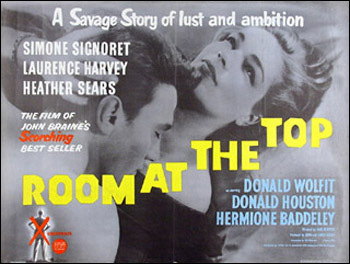
John Gerard Braine was born in Bradford, Yorkshire in 1922. He sprang to immediate fame in 1957 with publication of his first novel, Room at the Top, which was a critical success and a major bestseller in England and America and was adapted for the screen in an Oscar-winning 1959 film starring Simone Signoret and Laurence Harvey. His second novel, The Vodi (1959), met with mixed reviews and a disappointing reception, but was Braine’s favourite of his own works. His next book, Life at the Top (1962), a sequel to Room at the Top, sold well and was filmed in 1965.
Braine, who was commonly associated with what the British media dubbed the ‘Angry Young Men’ movement of working-class writers disenchanted with the traditional British class system, continued writing until his death in 1986, though as of 2013, all his works were out of print. Recently, there has been renewed interest in Braine’s work, with Valancourt Books’ reissues of Room at the Top and The Vodi, and a 2012 BBC miniseries adaptation of Room at the Top.
This is certainly a very readable writing book. There is a lot of good advice - it becomes a bit too prescriptive for my liking at times, but that's inevitable - and I liked the practical approach. Braine quotes directly from what he considered 'great novels'; the final chapter is a reading list that's worth a look.
Unfortunately, it's quite outdated, in more ways than one. Granted, it was first published in the seventies - but any book of writing advice that includes musings on whether or not it is worth buying a typewriter is probably in need of a second edition.
Moreover, as interesting as the passages quoted are, I got about halfway into the book before realising I didn't remember any of the 'great authors' quoted being women. The list of 'great books' in the final chapter contains exactly two by women - both by the same author.
This may say more about what is generally considered great literature versus what women tend to write than about Braine's own prejudices - but as a female writer, it's hard to take a book of writing advice that seriously when it virtually excludes you.
This doesn't get great reviews--yes, it talks about typewriters and other useless details--but it also offers some down-to-earth writing tips from someone who was earning his living at it, so worth considering.
Two stars, and it probably deserves more, for honest, practical advice about dialogue and all the stuff that goes along with it (example: don't be cowardly or lazy about writing scenes set at work. Most people do have jobs).
The missing stars are because, when I went rabbit-trailing after the books he used as examples, I could tell I wouldn't like most of them. Too grim, cold and mid-century for my taste, as is Braine's kind of story. But, as he points out, we might learn more (technically at least) from good craftspeople like that than we do from the incomparables and giants. If nothing else, reading Braine's guide might make you step back a bit when you read your next novel, not necessarily to peer into the foundations, but at least to see more clearly how the windows are hung and what the roof is made of.
I rated this 4-stars, more because I liked the slight carmudgeonly nature of the author. If you think, I'm gonna write me a book, and I'm going to read me a book about how to write it, this is not your book. It's a lot of suggestion based on the author's highly personal experience of having written Room At The Top.
But it's perhaps nicer to get a bit of perspective on the fine art of writing rather than a workbook to fill in with the false hope of writing the next bestselling meisterwerk. And it features a rather interesting bibliography most of which I suspect is well out of print, apart from a few books. The End Of The Affair is one, which is why I'm reading it. And it's funny that he likes it because his Braine's first rule is, do not make your central character a writer.
Do I recommend it? Yeah, actually I do. It's worth a read. It's a library one; can't imagine it's knocking around a lot of bookshops. But, as I say, it's not a practical course. It is more a historical document about how people used to write about how to write quite a few years back. It's one for perspective rather than practical.
I'm really hoping that new writers don't stumble on this book and think it's some kind of literary bible. It's far from it.
Some of the ridiculous advice in here:
-Agents don't take on new writers -Agents shouldn't ask you to sign a contract -Only write what you know -Don't travel too much -Don't spend too much time with other writers
I could go on, but I won't. Take all this advice and do the opposite.
Braine is a good novelist, and I respect the method he proposes--a methodical strategy that is fool-proof, pretty much. It should work, but if you are the kind that finds his way as he is writing a story, it might not be for you. A seeker and discoverer, inductive rather than deductive, may find this method tiresome and a writer's block. On the other hand, you can use this method to maneuver, methodically, out of writer's block.
I've never quite appreciated why an accomplished writer would take out valuable time to tell strangers how he accomplishes his craft. Yet, "craft" is the operable word here, and crafts have apprentices and guilds. I am glad that John Braine did.
I found his advice worth the reading of this book both in January 1991 and later in February 2000.
I started reading this one, but it was really just an overview of all the same stuff every other writing book talks about without the focus of genre or specific writing issues like some of the other writing books I have. It was also written by a snooty British guy who thinks Americans only write crap, so I saw no point in finishing it. I might have a different opinion now as it's been many years since I tried to read it, but I would recommend getting a book on writing by an author you already know you like or one that addresses specific issues such as genre or characters or plot or whatever.
The references and ideas are dated, as this was published in the 70s, but beyond that the book is just abrasive. Braine, who I've never heard of, styles himself a fantastically popular author who has the writing game all figured out. There are a few good tips, but none that you can't find in more recent how-to-write books. Also, he makes this too much of a system for my taste; writing has a certain element of uncertainty, it can't be perfectly mapped out. I'd much quicker recommend Stephen King's "On Writing" to those wishing for a creative boost.
How to write a novel can't tell you how exactly, but it can give you what is obviously a writer's opinion. There are a few nuggets of gold to be found - there is a bit of a world-weariness to the writing, and whilst Braine does dose the advice with reminders that there are always contradictions to the rules, it is an opinion - and one that I found myself not always agreeing with. That makes neither of us right or wrong, but the book does lag at times when you don't see eye to eye with it.
I have read just a few pages and have already gleaned several useful tips:
1. Just sit down and write. 2. Set a schedule of three 2-hour sessions each week. 3. Set a minimum number of words to write at each session; aim for 350 words. 4. Finish your first draft without going back to edit earlier material.
Some good advice, some meh. Leans very heavily on male writers of a certain hyper-masculine type, so the writing examples weren't exactly my thing. I skipped the manuscripts of his own revisions at the end. But there is definitely some good stuff in here. Don't feel like I wasted my time reading what I did read, but I won't be keeping it around as a reference.
Some really useful advice in this book. Although some of what John Braine writes about is a little bit dated now, and some of the quotations did little for me, I think there's enough practical advice in this novel, particularly literary fiction, to make it worth reading.
Some very strong pragmatic writing guidance here (that I am obviously ignoring given the number of adjectives I've just used). However, I feel it is directed towards the typical male novelist of last century. In fact no female novelist is cited at all. Hence 3 stars.
"With part of me I always want merely to dream, to wait to be descended upon [by inspiration], to be possessed and used. I have never met any professional writer who wasn't haunted by this myth. I have never met any professional writer who didn't work set hours." (p.19)
"What exactly is the human condition I've never been quite sure, but once a reviewer uses the phrase, you're home and dry." (p.13)
A creative writing book from the 1970s by John Braine, the author of 'Room at the Top'. It has down-to-earth advice with a nice, dry sense of humour. It's from a pre-internet age of typewriters and painstaking research in the local library's reference section, but much of it still resonates.
His method for writing a novel is: 1) start with the germ of an idea (he says it's unlikely you'll have the whole plot at this stage, you might just have an inkling of one key scene and character) 2) write a quick first draft (he is in favour of the idea of thinking through writing) - even though this rough draft will later be abandoned, he suggests aiming for the word count of a full novel, e.g. 80,000 words 3) then, after this, write a synopsis and chapter break-down (rewriting the synopsis a few times until happy - but keeping a quick, organic feel to it) 4) research - gather maps, pictures and background info needed 5) find the right tone/voice for the book (if you manage this, he suggests, the second draft will flow) 6) write a second draft from scratch, putting in lots of effort/time to nurture it 7) slow down even more when writing the ending so it doesn't seem rushed, and aim for a definitive ending (he's not a fan of loose plot threads or ambivalent fade outs)
In places, the advice is so pragmatic as to seem a bit dour, but there is some room for soul and imagination, in that free-flowing first draft and in discovering the right voice/tone for the story (which he describes as emerging rather mystically, as if predestined).
Found this in a box in the break room in my Japanese workplace, a real surprise.
If there were an updated edition, perhaps it would warrant four stars, but as it is, the good advice in here is side-by-side with debates about whether you should invest in a type writer and the difference between American and British literature, as if the readers and writers were two different species. I think those differences may have been overstated, at least for the present time.
Some solid advice, and the author's brisk way of writing and advising is worthwhile and amusing.