Jump to ratings and reviews
Rate this book

The Short Victorious War: The Russo-Japanese Conflict, 1904-5

Rate this book
Short Victorious Russo-Japanese Conflict, 1904-5

1 pages, Hardcover

First published October 1, 1973

Loading...
Loading...

About the author

David Walder

14 books2 followers

Ratings & Reviews

What do you think?
Rate this book

Friends & Following

Create a free account to discover what your friends think of this book!

Community Reviews

5 stars
5 (21%)
4 stars
7 (30%)
3 stars
8 (34%)
2 stars
3 (13%)
1 star
0 (0%)
Displaying 1 - 7 of 7 reviews
Profile Image for Charles.
621 reviews132 followers
March 29, 2025
British-centric, diplomatic, and military history of the short Russo-Japanese War of 1904-1905.


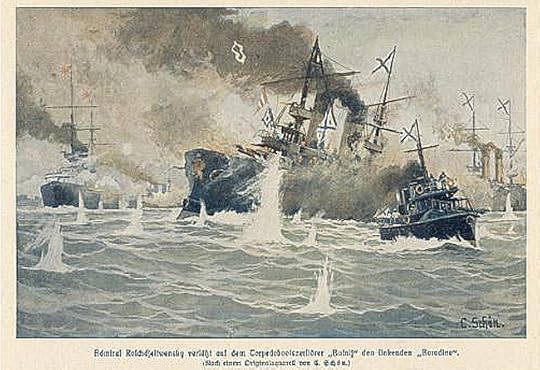
1905 Period graphic Battle of Tsushima 1905, Russian line of battle.

My dead tree version was a modest 321-pages. It had a US 1973 copyright. This book included: Maps, Photos, Appendices, Bibliography, and an Index.

David Walder was a British Conservative Party politician, author and barrister and Member of Parliament. He passed in 1978. He wrote seven books on military and diplomatic history and fiction. This is the first book I have read by the author.

This was an intermediate work. It is recommended having a background knowledge of late 19th and early 20th century military and diplomatic history. Familiarity with East Asian geography and the culture of the European Belle Époque would also be helpful.

TL;DR Synopsis

The Short Victorious War was a 51-year-old history of a war that occurred 120-years ago. The result shook the European Great Powers: Great Britain, Germany, France, United States, Russia, Italy, and Austria-Hungary, of the time. “The world turned upside down.” It was the first time an Asiatic power had defeated a European power in the ‘then’ modern warfare. However, the lessons of that war, which foretold the coming World War I were either: forgotten, disregarded, or misinterpreted in the intervening decade.

The conflict started over competing Japanese and Russian interests in influence over Manchuria and the Korean peninsula, both nominally Imperial Chinese territories. This was part of what was known historically as the Scramble for China amongst the European Great Powers.

Imperial Russia was advancing the development of their Far Eastern possessions. Developing the Trans-Siberian railway to connect European Russia with the Russian Far East, Manchuria, Korea and the vast natural resources of Siberia and the Russian Pacific Maritimes.

Meanwhile, Japan was a developing Asian, regional Great Power likewise with interests in nearby Korea and Manchuria. Japan had recently defeated Imperial China in the First Sino-Japanese War (1894-1895). However, through European Great Power pressure was forced to relinquish territorial gains in both regions to China. Imperial Russia quickly entered them in the political vacuum. For almost 10-years Japan and Russia were at a low-level of contention over Korea and Manchuria.

Meanwhile, Great Britian ended its policy of Splendid isolation . Amongst which included the Anglo-Japanese Alliance (1902-1923 . Japan leveraged this as insurance against European Great Power intervention, as occurred in the Sino-Japanese War.

Finally, diplomacy between the Japanese and the Russians over Spheres of Influence broke down. The Japanese made a Surprise Attack on the Russian Asiatic Fleet at their Chinese base, Port Arthur (now the Lüshunkou District, in the city of Dalian, China) and troop landings on the Korean peninsula.

The war consisted of three major fleet actions (Battle of Port Arthur, Battle of Round Island, and Tsushima). A siege (Siege of Port Arthur), and several major ground engagements in Manchuria (Battle of Nanshan, Battle of Liaoyang, and Battle of Mukden). The Russians did not win any of them. With the Japanese success in neutralizing the large Imperial Russian Navy squadron and its year-round ice-free base of Port Arthur, Japan had sea control of Bohai Sea, Korea Bay, Yellow Sea, and Sea of Japan. While the Russians accounted for themselves well on the ground in defense, the land war was a continuous retreat northward across Manchuria. However, Japanese losses were heavy and debilitating in their victories.

Russia’s consecutive military defeats, triggered severe civilian unrest. The war weary Russians entered peace negotiations. This was despite them being militarily stronger in the field. They were unaware that the Japanese, despite their victories, were at the end of their manpower and financial resources. The Russians conceded Manchuria and Korea to Japan. Despite successfully hiding their relative weakness, the Japanese substantially achieved their territorial goals in the peace. However, they did not receive the monetary indemnification they sought. This economically hampered them and their recovery through till WWI.

Walders’s book was a more of a British-oriented diplomatic history than a military history of the war. It was more European and Russian-centric than Japanese. This was likely due to language issues with Japanese sources? Conversely, there was a very large and deep Victorian-era European news and book coverage of the war. The internal politics of the Imperial Russia and the organizational behavior of the Imperial Russian Navy and Army were well covered. The Imperial Japanese politics, Navy and Army much less so. Most importantly was the description of how Great Power and internal Russian politics influenced Russia’s war fighting capability. In addition, the military technologies, including practices and procedures that evolved from this dress rehearsal for WWI were interpreted, or more appropriately misinterpreted by the Great Powers.

The Review

I have a strong interest in the history of the Belle Époque. Its military history. I became interested in the Russo-Japanese war after reading The Russian Baltic Fleet in the Time of War and Revolution, 1914–1918: The Recollections of Admiral S.N. Timirev (my review). Timirev served in the Russo-Japanese War, and wrote of its long-term effect on the Imperial Russian Navy and Empire in WWI. The Russo-Japanese War was well-covered during its time, somewhat in modern times. Mining the bibliography of Timirev’s book led to this one and Russia Against Japan, 1904-1905: A New Look at the Russo-Japanese War by John N. Westwood (my review). It is never boring to compare and contrast books on the same subject written, if not decades, but 100-years apart. That is why I read this book.

The facts of all three books are not in dispute. Naval officers, and sailors by all accounts, accounted for themselves better ashore at the Siege of Port Authur, than at sea under command of their naval leadership. Timirev and Westwood aside, what I found most interesting in this book was Walder’s insight into the Imperial Russian government and how the British government viewed the war. There are interesting similarities between the politics of Tsarist Russia and that of the modern Russian Federation. The Imperial similarity can also be seen to extend to the organizational behavior of the Russian Federation’s military.

This book was not completely what I expected. However, it was: short, credible and in places entertaining.

The book’s prose was good. Good copyediting left the book well-groomed. The prose level was correct for an intermediate-level military and diplomatic history. Walder’s Public School and Oxford education, and British Army service shown through. Interestingly, Walder having served in the Royal Artillery, he devoted additional attention to its usage in the conflict. I did note vocabulary was a tad advanced. For example, I added: farrago , uxorious and effluxion to mine. Organization was chronological, with diplomatic/political sections being interleaved with military events.

I noted there were no Footnotes. That was peculiar in a scholarly work.

There were 14 pages of large B/W photos. They were good. There were the usual Victorian, head-shots of Generals and Admirals. The ground war photos of both sides were well chosen. There was an equal mix of naval photos between Japanese and Russian ships. You could see the design lineage between Japan's Euro-built battleships and the Russians also Euro-architected ships.

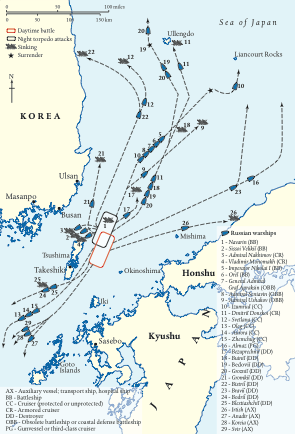
Military history is always about maps. There were three maps. One large scale theater map, and two to support the ground campaigns. All were line maps. They included place names, rails, and major roads. Only the Port Arthur map contained terrain features. Their presentation and annotation supported the narrative. There were no naval maneuvering maps. A map like that below would have been greatly appreciated.

description
The Battle of Tsushima, 1905

The Bibliography was short and contained no reference younger than 1971, with most from the very early 1900’s. There were very few Japanese sources listed. I would have expected it to have been longer.

The Index was brief, with a mixture of references. I would have expected it to be more comprehensive.

Technically the contents were on-par with my previous readings. However, a background in late 19th and early 20th military process, practice, and armaments would be very helpful. For example, the description and usage of the Japanese siege train at Port Arthur with its mix of very large caliber howitzers, lighter Japanese field artillery, and captured Russian (almost all of Krupp licensed manufacture) could be quite complicated. Likewise, with large formation naval maneuvers. Note that the naval sections were not as comprehensive as the ground combat sections.

Only very briefly did Walder mention the effect of the war on the Chinese in the region. There was no casus foederis between the Imperial Chinese and the Japanese or Russians. They de facto ceded the Manchurian and Korean territories to the occupying armies. Walder did note that the indigenous population prospered from trade with the different invading armies. The Japanese being more scrupulous about making payments, and better at communication than the Russians. There was only slightly more on the effects of the war on the Chinese population than I had read in previous books.

The effect of the war on Japanese internal politics was briefly covered. For example, the war was near ruinous to the Japanese fiscal economy. Despite British backing, near the end, Japan had reached the end of its Euro-banking line-of-credit. However, the Japanese population was very disciplined. Walder attributes it to having only recently risen from a medieval society to the Meiji oligarchy . The population was not restive, despite the effects of the war on the economy and the call-ups of the army reserves and conscription ‘classes’ ahead of schedule. This lack of detail was no different than other books I have read.

British politics was covered somewhat in-depth. Through-out the late 19th Century the British and Russian Empires were engaged in The Great Game . The Japanese Navy was trained, and armed by the British. Through their alliance, the Russo-Japanese war was popularly considered a proxy war with the Russians. However, at the highest level it was complicated. The British priority was the Entente Cordiale with France. At the same time, France was in committed to the Franco-Russian Alliance . The result was a benevolent neutrality with the Japanese towards the war. For example, British military and diplomatic intelligence on Russia was shared through the embassy in Tokyo.

Russian politics was covered deeply. Pre-war, Imperial Russia was the Strong Man of Europe with the largest army on the continent. It was the undiagnosed Sick Man of Europe. Neither the Army or Navy had fought a major war since the Crimean War, despite having modern armaments. Czar Nicholas II was a weak emperor and his autocratic regime was unprepared for the stresses of a modern war. The bungled handling of the war created the circumstances for the post-war Russian Revolution of 1905 . It was just one of many until the final revolution in 1918.

On peculiar thing about this book was the political and diplomatic maneuvering involving American president Theodore Roosevelt to host peace talks was almost absent. The peace was a Russian win, and a Japanese loss. This was despite the Russian defeat and Japanese military victory.

The description of high-level strategy, operations, and tactics of Russians and Japanese, was well handled. The use and evolution of the use of: cavalry, artillery, and infantry, between the First Sino-Japanese War (1895) for the Japanese, and the colonial wars fought by the Russians and Europeans. The naval actions had a greater effect on warfare, there not having been a major naval war since the Spanish American War (1898), and that had not involved the latest generation of capitol ships.

Both the climate and the geography of Northern China, and their effect on events was only briefly covered. Climate was only to the detail of the season or its effect on an engagement. (The Battle was fought in a blizzard.) In general, the terrain of a particular engagement was included, but the larger geography of Manchuria, except for the few roads and railroads was neglected. Contemporary maps were of little use. The period geography in China has been swallowed-up in urbanization and agricultural development.

Walder’s story was about: men, organizations, and machines in contention. The men were: PMs, Emperors, ministers, generals, and admirals. The organizations were government bureaucracies, courts, armies, and navies. The machines were: railways, mostly state-of-the-art warships, and armaments.

Walder was very detailed in naming the important characters in the conflict. The Europeans, particularly the Russians and British, being better documented than the Japanese. He did a deep dive on Nicolas II. The Russian Imperial Court was a creature of the Czar. He devoted a lot of pages on the Russian court politics and its organization that lead to defeat and how they would eventually lead to the final Revolution. Unfortunately, he could not provide the same level of detail on the Japanese victory.

Entering the conflict, the Japanese were better prepared than the Russians for this prelude to Modern Warfare, although not by much. The Japanese were armed and trained to European state-of-the-art standards. However, Japanese military doctrine while advanced was not yet completely developed. Their aggressiveness brought victories, but they might almost have been Pyrrhic Victories?

The Russians had not fought a major war in decades. The Russian army was experienced and proficient in the small, colonial conflicts (insurgencies) with tribesman along its southern borders. The Russian navy had not fought a major engagement since the Crimean War (1853-1856). The Russian officer corps and their military doctrine was crucially undeveloped for modern war. The Russians were also very unlucky, in losing their best admirals in combat.

The technology (machines), less motor vehicles and aircraft other than balloons were the technology of the WW1. Walder did a good job with this. However, he did a better job with the Lesson’s Learned (or not). In this war, it was obvious that “close order” infantry formations and machine guns do not mix. This lesson was forgotten by WWI. Torpedoes were remarkably ineffective, whilst floating and tethered mines were devastating. The Russians became naval mining experts. Also, the analysis of the naval battles berthed the all “Big Gun”, Dreadnought-style battleships, that sparked the naval arms race which abetted WW1.

Summary
I have today seen the most stupendous spectacle it is possible for the mortal brain to conceive—Asia is advancing, Europe is falling back, the wall of mist and the writing thereon. --- General Sir Ian Hamilton
The Russo-Japanese war of the last century was forgotten in the greater calamity of WWI. However, it was earthshaking in that an Asiatic power had defeated a mighty European power.

Japan rose in status from a minor power to the lower ranks of the Great Powers and received the colonial trappings of a Great Power in Manchuria and Korea. Russia lost status as a great power, by demonstrating its weakness and backwardness. However, defeat caused no fundamental changes.

The greatest strength of this book was its political analysis. Its greatest weakness was it was unbalanced in that analysis. For example, Japanese politics received very little analysis.

Otherwise, Walder’s military analysis was solid, it was also very mainstream. He did not reveal much that was new about the war either on land or sea. In fact, I found it amusing that almost every book I have read on this war mentions the Foreign Military Observers admiration of the Russian innovation of mobile kitchens in wagons to provide soldiers hot meals in the field.

This is a worthwhile read for someone who already has a background in the Russo-Japanese War. With that background, it is a quick political history toward Japanese rise in power in the region. The military history has likely all been seen before in greater detail.

Readers interested in a longer and more contemporary book, I liked, might read The War of the Rising Sun and Tumbling Bear (1988) by R. M. Connaughton.
Profile Image for Nick.
413 reviews40 followers
August 7, 2022
The Short Victorious War: The Russo-Japanese Conflict, 1904-5 is a decently written relatively short introduction to the Russo-Japanese war of 1904-1905. This account covers all aspects of the war to varying degrees. The author focuses on the naval forces of both nations and the subsequent naval engagements, and the Russian's internal challenges of the early 20th Century - both political and military. The execution of the ground war is not covered in great depth other than the siege of Port Arthur and the battle around Mukden.

Recommended for those that have a general interest in the war without looking for an in-depth study.
Profile Image for Christopher Saunders.
1,070 reviews974 followers
March 15, 2025
David Walder's The Short Victorious War offers a short, readable account of the Russo-Japanese War, the conflict which forever changed the balance of power in East Asia. Walder (The Chanak Affair) hastens to sketch the imperial rivalries over the Far East (Russia's ambitions in Manchuria, Japan's meddling in Korea and humbling of China, the Boxer Rebellion and the Western Empire's fractious Open Door policy towards China) before moving onto the military action. Walder provides concise sketches of the war's major battles, from the Yalu River to the epic clash at Mukden, demonstrating the faulty strategy and flawed tactics of both sides: the Imperial Russian Army, poorly supplied and led by ennobled incompetents who seemed incapable of winning even a minor skirmish; the Japanese military was better-trained and motivated, but recklessly wasted in suicidal bayonet attacks against Russian trenches. Like other historians, Walder finds a prelude to the First World War in the mechanized trench warfare which stacked Manchuria with barbed wire and mangled bodies; he also makes note of how warily the non-engaged powers watched the conflict, from Germany (whose Kaiser had encouraged Russia's eastward expansion to distract from his own ambitions closer to home) to Britain and France (whose cross-cutting alliances with Japan and Russia, respectively, caused friction in the nascent Entente Cordiale). Walder makes the case that Japan was on the verge of collapse, simply through exhaustion of their resources, before Admiral Togo's decisive victory over the Russian fleet at Tsushima (whose grim round-the-world voyage has inspired books of its own) allowed them to claim victory and assert suzerainty over Korea and much of the Far East. The book also comments, albeit more briefly, on the domestic destabilization that set Russia towards Revolution, and the broader ramifications of an Asian army fighting Europeans on equal terms and win. Walder's book is shorter and more modest in scope than Denis and Peggy Warner's The Tide at Sunrise, probably the best popular account of this war, but it's still a readable introduction to a largely forgotten, but hugely impactful moment in world history.
371 reviews2 followers
November 21, 2021
Overall, a pretty good rundown on the Russo-Japanese War, and how it was viewed by the various European powers. Also, a rather decent illustration of the ineptitude of the Russian command structure and government, overall.

I can't imagine what it must have felt like to be a sailor in the Baltic Fleet / 2nd Pacific Squadron. To have traveled nearly all that way, past Europe, around Africa, across the Indian Ocean (a first - being recoaled only at sea), and through the islands of Southeast Asia/Oceania, with no friendly ports-of-call to visit, constantly in fear of both the Japanese Fleet (irrational - like they could somehow have materialized in the Baltic Sea) and the British Fleet (somewhat rational - as they were now allies with Japan) to have finally arrived off the coast of Korea to bring back honor to your homeland (as misguided as such a task may be) to be completely savaged by the far more competent and capable "upstart" Japanese fleet in such a one-sided battle.

Of personal interest, the war definitely seemed to have played a pretty good contribution to the burgeoning Soviet revolution. I'm definitely going to do some more research into this conflict, as, had Nicholas II been something completely different the world could have been robbed of such a momentous occasion as Russia could have potentially devolved into a "liberal democracy" rather than the Soviet Union.
Profile Image for Jeffrey Bloomfield.
23 reviews
November 8, 2018
David Walder wrote this book in 1972, and it remains a good volume to begin to learn about one of the least remembered, but important pre-World War I conflicts of the 20th Century. The Russo-Japanese War of 1904-1905 was caused by conflicts arising out of rival imperialist ambitions in Asia between the Russian Empire and the Japanese Empire. Both were staking claims to territories that were part of China at that time (and still are today). In 1867 Japan began the Meiji period of dynasty and politics, which called for her to modernize, and it turned out that of all the major Asian based states of that period only Japan proved up to the task of becoming a modern state. Her biggest enemy at the beginning was the Chinese Empire, which was tottering to her collapse in 1911, and which Japan, unexpectedly, helped to weaken in the First Sino - Japanese War of 1894-95. Japan's success was due to better military preparation, but it was aided by the vast amount of corruption in the Chinese Imperial Government. At this time most of the major powers had special ports or settlements that were in China proper, but under their control. The Chinese did not especially care for this treatment, and in 1900 the Boxer Rebellion broke out in China. When the international legations in Peking were under siege by tens of thousands of angry Chinese rebels (known as "Boxers", because they had warlike names like "the Harmonious Fists", which the Europeans mistakenly thought were boxing teams), for the only time in that period from 1870 to 1914 the major powers of Europe, plus the United States and Japan, cooperated in smashing the rebellion. Looked at today it astounds us all - while one sympathizes for the Chinese, one wishes this momentary unity of purpose of the major powers had lasted. But the "Guns of August" were only fourteen years away.

Russia's sphere of influence was in Manchuria. Unfortunately, Japan had carved her empire to include neighboring Korea. She now wanted to have Manchuria. The Russians were not willing to negotiate for a division of the sphere of influence, basically due to arrogance. In 1900-04 it was rare for a major country to pay heed to what they considered a backwater. Except for the United States, which was basically full of descendants and immigrants from European backgrounds (although the Chinese and Japanese also had been emigrating there), all the real powers were in Europe.

Not everyone was quite so blind as the Russians to Japan's rise to eminence. The U.S. had helped to open Japan to the West in 1853 when Commodore Matthew Perry's fleet visited the islands, and had been watching the modernization, the Sino-Japanese conflict, and the expansion with interest. So was Great Britain. Britain was actually the first European state to show active recognition of the growth of Japan. In the wake of the growing naval rivalry with the German Empire, the British Government decided to pull back some of the units it had in the Pacific and return them to Atlantic and North Sea waters. At the same time the reason they had kept ships in the Pacific was to keep an eye on the Russians in Vladivostok in Siberia, and now at Port Arthur in Manchuria. So in 1902 the Anglo-Japanese Naval Agreement was signed that allied the two sea powers, and put the Japanese into a junior partner position with Britain in keeping an eye on what Russia was doing.

It was a time of turbulence in Russia, with strikes and unrest. Tsar Nicholas II had been on the throne only a decade by 1904, but his appeal to his subjects was already somewhat tarnished. In 1896, when he married Princess Alexandra, Nicholas and his wife had set up a huge feast for the people of St. Petersburg, which ended in a totally horrible tragedy when a rush for the food led to mass crushing of people - several hundreds died in the incident. As it had been supposed to celebrate a wonderful social event, Nicholas and Alexandra's marriage now seemed cursed. To try to take the public's attention off economic hardships and social inequalities that the Tsar and most of his ministers (the exception was the intelligent Count Serge Witte, the brains behind the "Trans Siberian Railroad) could not or would not solve. This led to an old standby - "blame it on the Jews". In 1903-05 there were a series of pogroms throughout Russia, leading to such massacres as befell Kishenev in 1903. These were caused by an anti-Semitic group, "The Black Hundred", but the government was really in back of it. The prime motivator was von Pheve, the Interior (Secret Police) Minister. However Nicholas apparently approved of it. In 1904 von Pheve's carriage was blown up by a bomb while he was in it. It did not end the campaign but it did end it's creator.

With his own home land in turmoil that was growing, Nicholas was convinced that a war to put those Japanese in their place was just what was needed to restore patriotism in his realm. He was egged on a bit by his fellow autocrat (though of a more constitutional state) Kaiser Wilhelm II of Germany. Wilhelm was upset that Russia had allied (in 1894) with France in the Dual Entente, and how this created for his military the threat of a two front war on his empire. Up until 1914 Wilhelm tried every way to influence Nicholas' policies or to convince him to end the agreement with France and join Germany and Austria-Hungary in a renewed "Drei-Kaiser Bund". Once in 1907 it momentarily happened when the two Emperors had a meeting in Finland's Gulf of Bjorko, on their yachts, and Nicholas signed a treaty, but his ministers made him see he could not have that treaty and the one with France (which by 1907 also included Great Britain).

Russia demanded that Japan stop her claiming parts of Manchuria. The Japanese were not ready to do that, but decided to show they wouldn't. The main Russian Pacific fleet was in Port Arthur, and the Japanese navy attacked the battleships there unexpectedly. They did considerable damage on the fleet, and soon had it fairly well bottled up in the harbor. Fortunately for Russia the fleet was commanded by Admiral Makaroff, a highly respected naval innovator and Arctic explorer. The circumstances of the war might have been different except Markaroff sallied out with his fleet on his flagship "Petropovlosk". It had barely cleared the harbor entrance when it hit a newly laid Japanese naval mine, which blew up and sank the ship and killed over 700 sailors including the admiral. The fleet hastily retreated, and the naval blockade on Port Arthur tightened.

Nicholas decided to do what seemed the only course open to him (aside from surrendering Port Arthur). He ordered his Baltic Sea fleet to leave home waters and head for the Pacific to relieve Port Arthur. The fleet did precisely that, led by Vice Admiral Zinovy Rozhestvensky, whom was dubbed by the press, "the Admiral with the whiskers and the fierce name". He had little to really recommend him - he was no Makaroff. He soon proved this by what is recalled as the "Dogger Bank Incident" of 1904. Nervous because he had read reports of the Japanese use of torpedo boats and even submarines, Rozhestvensky was looking for anything that might suggest another sneak attack on his fleet by the Japanese, even though they were over 13,000 miles away. In the fog off the Dogger Bank fishing grounds of Great Britain, the Russian admiral saw dozens of small craft in the water in his path. He ordered his guns to start blazing. In the end several fishing trawlers were sunk, and there were some casualties. The British Government was not amused by this incident, and briefly the previously mentioned Angl0-Japanese Naval Agreement might have turned into the Anglo-Japanese Naval entente, with a British fleet sailing up the Baltic to attack St. Petersburg. Fortunately the Tsar agreed to pay an indemnity, but until the Russian fleet left British home waters a large British squadron followed it and watched it's every move.

Nicholas had some difficulty keeping his huge fleet full of coal, and supplies. The French (carefully trying to arrange an entente with Britain at that time) were not as helpful as supposedly they would be. Ironically the Kaiser did assist in refueling and restocking the ships, ever mindful of that goal to get Nicholas to switch allegiances. Initially it was hoped that the British would allow the Russian Baltic fleet to sail through the Suez Canal, but after the Dogger Bank Incident this was impossible. So Rozhestvensky had to take the huge fleet around the southern point of Africa, the Cape of Good Hope, and head for the Indian Ocean and then the Pacific. The public was fascinated at this huge undertaking, as though it was on par with the later expeditions to the North and South Poles, but the fascination was now in the form of wondering whether the Russians would or would not make it.

They didn't. Japan was blessed by having a genuine naval military genius, Admiral Togo. He set up a trap at the Tsushima Island and strait, and when the Russian fleet appeared he blasted most of them into wrecks, and sank many. It ended any chance for the Russians to win or break even by breaking the siege of Port Arthur. Russian forces finally had to surrender.

It sent a shock wave in Europe and the U.S., Never had there been such a battle between modern steel warships (though this is before the creation of HMS Dreadnought in 1906). It was also unheard of for a backwater country (as Japan was considered by most people) to beat a major European power (there had been an embarrassment in 1896 when the Italian army was beaten in attempting to invade Abyssinia/Ethiopia by a savage defeat at Adowa, but Russia was widely considered a more powerful nation than Italy). The U.S. was also concerned (and not just for racist reasons, though they played a part), because they realized that once ensconced in Manchuria, the Japanese might consider trying to grab the Philippines or Hawaii or both. President Theodore Roosevelt stepped in, and offered to negotiate the peace treaty for both powers. The Japanese hesitated, but Serge Witte (head of the Russian delegation) welcomed it. Witte charmed American newspaper readers in a series of interviews, while the Japanese kept to themselves. In the end Russia had to pull back in Manchuria, although holding on to some islands that Japan wanted. Roosevelt's efforts actually earned him the 1906 Nobel Peace Prize. However the Japanese were somewhat uptight about those islands (like Sakhalin) which they felt they should get. This coupled with a diplomatic foray by Secretary of State Elihu Root regarding limiting Japanese immigration to the U.S. did not really set well with them.

The war did not help Russia at all - in fact it did the reverse. It ended in humiliating disaster at the hands of a country the average Russian thought was worthless. It did not cure the economic disasters that were bedeviling the people. In January 1905 a march led by one Father Gapon of thousands of citizens on the palace to beg the "little father's" help for his people ended in what became known as "Bloody Sunday" in Russian history, and thousands were killed by Cossacks. Revolution swept Russia. In the end Nicholas was forced to create a parliament of sorts (really an advisory council) called the "Duma'. Typical of Nicholas it was too little, too late. His reputation was never to recover with his people, and soon rumors of a strange holy man named Rasputin helped undermine it further. Even when there was a brief respite in the 1907-1911 period when a partial reformer, Pyotr Stolypin, made some needed changes it was too short and cut short by the murder of the reformer himself. Russians now knew the masses had power, although it would still take a World War for three years and a humiliating peace with the Kaiser's Germany to end the tsarist regime.

Japan was now entering it's moment of glory, having beaten first China and then Russia. But now it began considering the United States (as Roosevelt feared). And in 1941 it would take the plan for the sneak attack at Port Arthur and repeat it at Pearl Harbor. But the results would be more disastrous for the Japanese this second time.

Most of this is covered in Walder's book, which is well researched, and quite readable, and well illustrated with maps and photos. Certainly I recommend it to anybody who is interested in the history of the Asian continent and Pacific, the growth of Japan, and the road to the Bolshevik revolution of 1917.


616 reviews7 followers
September 27, 2022
I've read three books on the Russo-Japanese War and I consider this the best of the three. It could have been a few more maps and I wasn't used to the way the author transliterated peoples' names, in particular Russian, as well as some place names.
The book is full of little insights and details that I don't believe either of the other 2 titles covers. Political considerations, while important, get little coverage in this title. That to me is a positive. To many titles focus way too much on diplomacy and internal national politics. If this book ever becomes available on Kindle I will definitely buy it. If you have to read just 1 book in on this conflict, I would recommend this.
219 reviews6 followers
April 4, 2025
The Russo-Japanese War 1904-05 pitted the arrogance and ineptitude of Tsarist Russia against the heretofore isolationist Japanese. Walder's account is well-told from largely the perspective of the vanquished. It covers the sea and land campaigns and could serve for those interested as a starting point for further study. The ramifications of this little known, today anyway, war were consequential for the Japanese, the Russians and the rest of the world as the failure of the Tsar paved his path toward extinction and the success of the Japanese paved their path toward military militancy.
Displaying 1 - 7 of 7 reviews