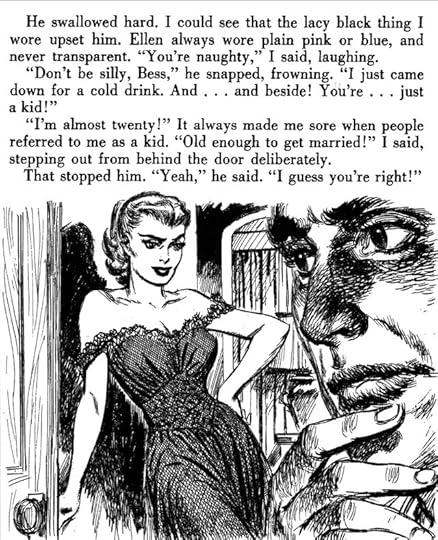
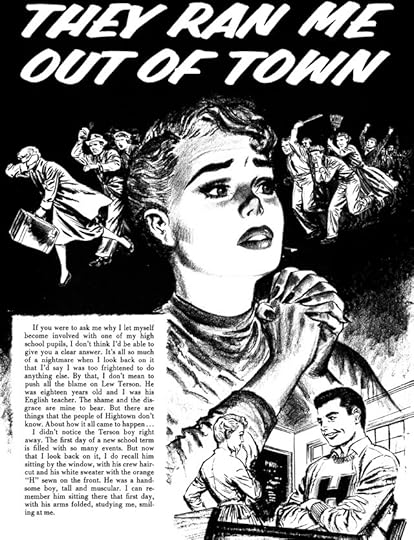
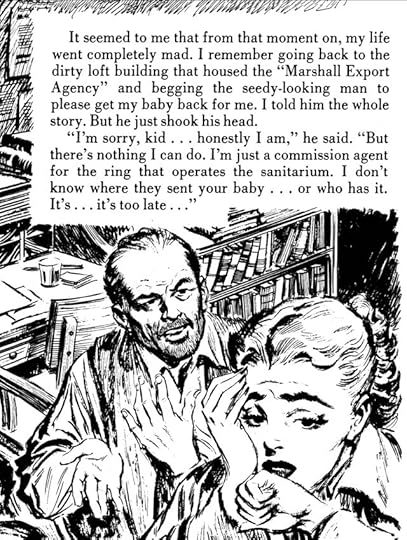
Contained here is thecomplete run of Confessions Illustrated, an innovative "Picto-Fiction" magazine.
Containing illustrated prose stories of scandal and forbidden romance, The EC Archives: Confessions Illustrated collects the entire Confessions Illustrated in one volume and is illustrated by industry legends: Wally Wood, Joe Orlando, Reed Crandell, and more!
This archive volume contains Confessions Illustrated issues 1 though 3.
Daniel Keyes was an American author best known for his Hugo award-winning short story and Nebula award-winning novel Flowers for Algernon. Keyes was given the Author Emeritus honor by the Science Fiction and Fantasy Writers of America in 2000.
Keyes was born in Brooklyn, New York City, New York. At age 17, he joined the U.S. Maritime Service as ship's purser. He obtained a B.A. in psychology from Brooklyn College, and after a stint in fashion photography (partner in a photography studio), earned a Master's Degree in English and American Literature at night while teaching English in New York City public schools during the day and writing weekends.
In the early 1950s, he was editor of the pulp magazine Marvel Science Fiction for publisher Martin Goodman. Circa 1952, Keyes was one of several staff writers, officially titled editors, who wrote for such horror and science fiction comics as Journey into Unknown Worlds, for which Keyes wrote two stories with artist Basil Wolverton. From 1955-56, Keyes wrote for the celebrated EC Comics, including its titles Shock Illustrated and Confessions Illustrated, under both his own name and the pseudonyms Kris Daniels, A.D. Locke and Dominik Georg.
The short story and subsequent novel, Flowers for Algernon, is written as progress reports of a mentally disabled man, Charlie, who undergoes experimental surgery and briefly becomes a genius before the effects tragically wear off. The story was initially published in the April 1959 issue of The Magazine of Fantasy & Science Fiction and the expanded novel in 1966. The novel has been adapted several times for other media, most prominently as the 1968 film Charly, starring Cliff Robertson (who won an Academy Award for Best Actor) and Claire Bloom. He also won the Hugo Award in 1959 and the Nebula Award in 1966.
Keyes went on to teach creative writing at Wayne State University, and in 1966 he became an English and creative writing professor at Ohio University, in Athens, Ohio, where he was honored as a professor emeritus in 2000.
Keyes' other books include The Fifth Sally, The Minds of Billy Milligan, The Touch, Unveiling Claudia, and the memoir Algernon, Charlie, and I: A Writer's Journey.
PUBLICATION DAY! 4 stars for sheer nostalgia and the effort taken to restore these time capsules!
I don’t know how many of you had grandmothers or great-grandmothers who had a stash of 1950s magazines and books. I certainly did. My maternal grandma and her sisters, in particular, had a veritable treasure trove of stuff you wouldn’t see laying around nowadays. Those True Detective magazines and others of their ilk, all with questionable covers featuring illustrations of bound and gagged women with fear in their eyes. And, of course, the Confessions collections. They felt so taboo back then, and reading this restoration brings a lot of that back.
THE EC ARCHIVE has been doing great work for some time now, gathering ‘80s gems like TALES FROM THE CRYPT and WEIRD SCIENCE for modern consumption. They’re back with CONFESSIONS, which is by any metric a wild ride. Check your feminism at the door, folks.
Each story – purportedly written in by a burdened housewife just bursting with her secret – generally centres around something its writer has done that she should never have been allowed to do. From the outset we get a tale of a teenage girl who joins a gang and sees her family suffer the consequences, and another about a woman who is past marriageable age (she’s almost 30!) and goes to great lengths to remedy her situation. There’s a breathless sort of fly-on-the-wall energy around these stories, and you can just imagine how mind-blowing it would have been to sneak the magazine into your 1955 Sears catalogue so your husband wouldn’t see you reading it. I mean, a magazine like this would give you ideas, and he wouldn’t want that.
As a modern reader, of course, these stories all get quite repetitive after a few, and none of them are particularly shocking nowadays. Well, not in the way they were intended to be, anyway. I admittedly gasped a couple of times when a man in a story wound up to slap the woman telling it, and it’s treated like the most normal thing in the world. But the stuff that was titillating in its heyday are pretty standard now, and are certainly outdone by Harlequin and the endless parade of E.L. James and Sylvia Day novels.
But make no mistake: I think it’s actually cool as hell that CONFESSIONS is out there again to be discovered by a new generation, especially those who like vintage graphic novel art. You thought watching MAD MEN was jarring in seeing how different things were for women? These pages will do a number on you. And disturbingly enough, as a slice of Americana that should be wildly outdated, some of the stories – like the one about a young woman who has to seek out a back alley abortion and suffers terrible consequences – have become timely again. It’s harder to look down your nose at how overwrought and dramatic these scenarios seem when we’re watching the clock turn back right before our eyes.
Sometimes fun, sometimes dark and disturbing, always a little bit campy, CONFESSIONS is nothing if not entertaining. As a look backwards...well, maybe some of this isn't as far in the distant past as we'd like to believe.
Thank you to Edelweiss for the ARC in exchange for an honest review.
I have to admit that I was misled by the name of one of the authors, the one from "Flowers for Algernon" to be clear, and asked to read the DRC of this collection of pseudo-comics without bothering to figure out what it was first. Apart from that, the stories are particularly excessive, from any point of view we want to look at them and especially very dated, that's not to say they weren't entertaining in some ways and certainly the stories accompanied by the drawings, place this collection in a category all their own, which is somewhere between graphic novels and photostories.
Devo ammettere che mi sono fatta fuorviare dal nome di uno degli autori, quello di "Fiori per Algernon" per capirsi, e ho chiesto di leggere l'DRC di questa raccolta di pseudofumetti senza preoccuparmi prima di capire cosa fosse. A parte questo, le storie sono particolarmente eccessive, da qualsiasi punto di vista vogliamo guardarle e soprattutto molto datate, non per questo non sono state divertenti per certi versi e sicuramente le storie accompagnate dai disegni, posizionano questa raccolta in una categoria tutta loro, che sta a metá tra la graphic novel e i fotoromanzi.
I received from the Publisher a complimentary digital advanced review copy of the book in exchange for a honest review.
Middle-aged men trying to write from the perspective of young women
1950's middle-aged men at that. The results are pretty cringe worthy. Young women make mistakes in love and are either horribly punished with lives ruined forevermore, or they learn to appreciate the dull lump of a guy they left behind. Apparently, for a woman to want more out of life than to be a perfect little wife in the suburbs is just plain wrong. The artwork is beautiful, however.
I'm giving this book two stars, but only grudgingly. It's entirely a testament to how great the illustrators are and how much I dig the "picto-fiction" format. Kamen, in particular, kills in this format. Some of the others - I mean, I get the vibe that this book got canned before it got off the ground, so I'm not sure the other artists even finished some of their drawings, although even a sketch from Johhny Craig or Wally Wood is awfully purty.
The stories... Jesus... If you had only one word to describe this book, it's misogyny. No, let me correct that: the word is MYSOGYNY. It needs to be big, bold, and unmissable. It's story after story of a young woman who dared to dream a little bit outside the rigid restrictions of a woman's role in mid-1950s America. "The war's over, ladies. Back to the house and the children!" is the relentless theme of every story here.
Wow. This is such a time capsule of mainstream attitudes toward women and marriages from the 1950s. The stories are hard to read (emotionally) because they're so unbelievably misogynistic, but I believe it's important to showcase how life was for many women at that time.
Three stars because the artwork is beautiful, and this collection has historic value. The stories' content gets negative 100 stars. Let's treat women better, please.
It was like travelling back in time as these magazines are the perfect depiction of a type of morality and the role of women. They were also the work of great illustrators. I loved them and I think they must be read as document of a past age. Highly recommended. Many thanks to the publisher for this ARC, all opinions are mine
This was my first picto fiction read and I quite liked it. Jack Kamen art was wonderful. Also there were several adult topics I did not expect from a 1955-56 EC work!