
What do you think?
Rate this book

64 pages, Hardcover
Published September 7, 2021


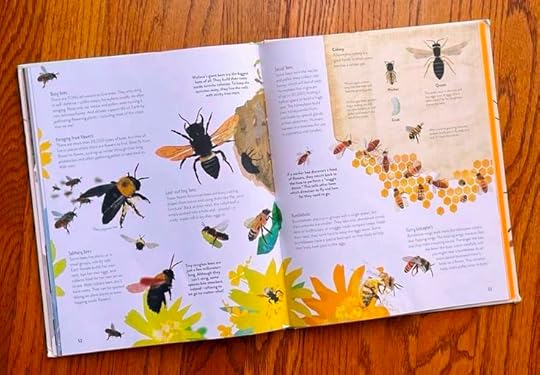
• Insects are the only "proper" independently-winged creatures; all others (birds, flying mammals and fish) have just evolved reshaped arms or fins.Insects have been around (and in many cases, remained virtually unchanged) for 400 million years. And yet today they are threatened like never before, with almost half of species falling in numbers and insects overally dying out eight times faster than mammals, birds and reptiles. So plant a wildflower garden; let your grass grown a little longer and leave your weeds alone; and maybe even compost!
• Female insects are just the worst. Only female mosquitos and horseflies bite; in fact, male mosquitos eat nectar and are important pollinators for flowers like orchids (aww!). And female stylops are about the most disgusting animal of any sort I've ever heard of…I can't even bring myself to describe them here; you'll have to Google for yourself.
• I had no idea that praying mantises — including the gorgeous flower mantises — are most closely related to cockroaches.
• New Zealand's giant wētā is the world's heaviest insect, "weighing as much as a small apple," (an odd comparison; they were the model for the giant grasshopper-like bugs in Peter Jackson's 2005 version of "King Kong," Jackson himself also being from NZ).
• Dragonflies are the world's most perfect hunters, catching fully 95% of the prey they attack. Their front and back wings can beat at different angles and speeds, allowing them to fly backward, vertically and even upside-down. Their heads are almost entirely eye, with 30,000 lenses that can detect at least 11 different colors, including ultraviolet, (humans can detect just three colors of light — red, green and blue).
• Glasswing butterflies' wings are transparent because they don't have scales, which are what give other butterflies their iridescent colors. And there are nine times as many moth species as butterflies; the easiest way to tell them apart is either by their antennae (moths are feathered, butterflies are thin and club-like) or resting postures (moths spread and flatten then wings, butterflies close them together). And finally, the monarch butterfly's annual Canada-to-Mexico migration takes several generations to complete, as each butterfly in this relay only travels a few hundred miles before stopping to lay eggs and then die.
• There are about 14,000 species of ant — which may sound like a lot, until you realize there are at least 20,000 types of bee, 30,000 species of wasp, 150,000 species of fly, 180,000 species of moth, and 300,000-400,000 (no one really knows, as new ones are being discovered all the time) species of beetle! (And yes, I do wonder sometimes if someone somewhere is just making this stuff up...)
• The beautiful luna moth never eats; in fact, it doesn't even have a mouth. It lives for only a week, surviving long enough to mate on the food it ate as a caterpillar.
• Wasps/bees: cool. Beetles: even cooler. Don't get me started…
• And lastly, my favorite is the glowing fungus gnat maggot, as it's fun to say and sounds like a Shakespearean insult: "thou, Sir, art a glowing fungus gnat maggot!"


