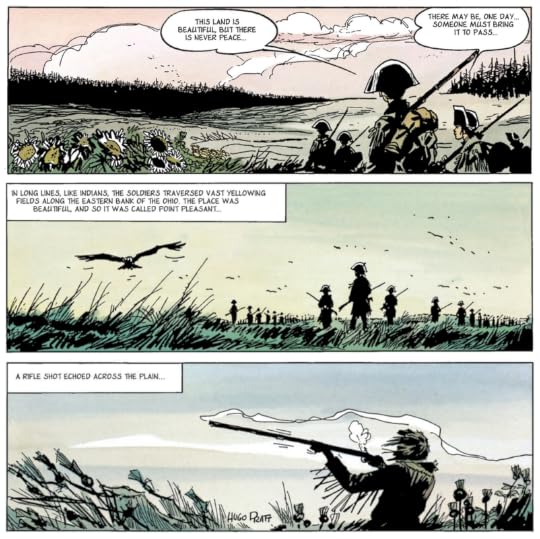
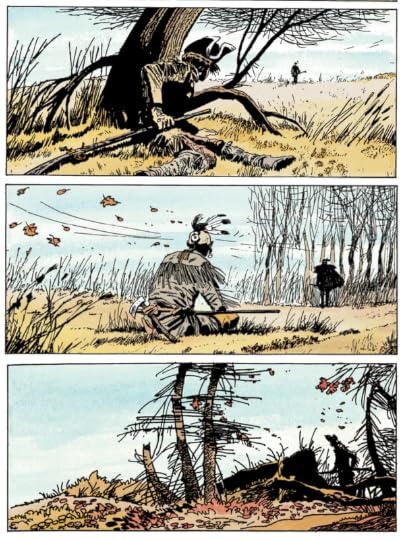
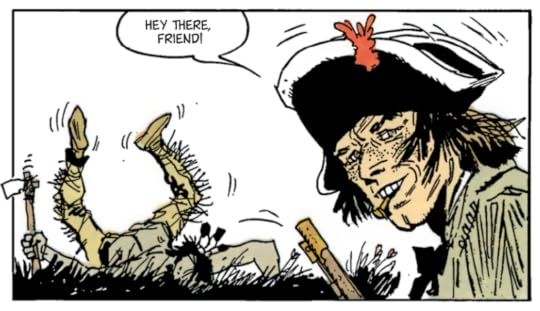
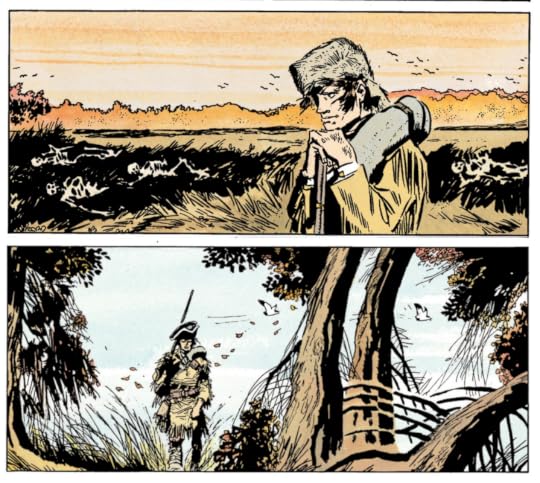
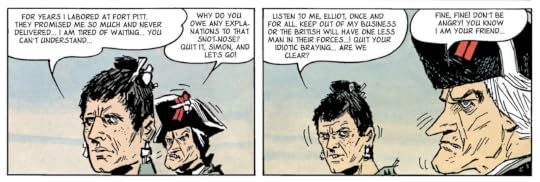
Créé à l'orée des années 60, Fort Wheeling explore et met en scène la fascination d'Hugo Pratt pour l'Amérique coloniale à l'époque de la " frontière ", à la veille de la naissance des Etats-Unis. Une époque et une terre de pionniers, de violence, mais aussi de liberté : là, dans les boucles du fleuve Ohio, dans les plaines et forêts sillonnées en tous sens par les tribus Shawnee et Delaware, souffle pour toujours l'esprit de la grande aventure... Généreuse et mouvementée, la saga de Fort Wheeling est proposée ici sous la forme d'une intégrale noir et blanc, en format compact. À cette création majeure de l'oeuvre de Pratt s'ajoute une série de courts récits en noir et blanc rarement publiés en français, Les légendes indiennes. Conçues dans les années soixante pour un magazine jeunesse, ces histoires en quatre pages mettent en scène, parfois avec humour, les mythes et les contes de ce monde indien qui fascinait tant l'auteur de Corto Maltese.
Hugo Pratt, born Ugo Eugenio Prat (1927–1995), was an Italian comic book writer and artist. Internationally known for Corto Maltese, a series of adventure comics first published in Italy and France between 1967 and 1991, Pratt is regarded as a pioneer of the literary graphic novel.
Born in Rimini, Italy, Pratt spent his childhood in Venice in a cosmopolitan family environment. In 1937, ten-years old Hugo moved with his parents to Ethiopia, East Africa, following the Italian occupation of the country. Pratt's father eventually died as a prisoner of war in 1942. Hugo himself and his mother spent some time in a British prison camp in Africa, before being sent back to Venice. This childhood experiences shaped Pratt's fascination with military uniforms, machineries and settings, a visual constant in most of his adult works. As a young artist in post-war Italy, Pratt was part of the so-called 'Venice Group', which also included cartoonists Alberto Ongaro, Mario Faustinelli. Their magazine Asso di Picche, launched in 1945, mostly featured adventure comics. In 1949 Pratt moved to Buenos Aires, Argentina, where he worked for various local publishers and interacted with well-known Argentine cartoonists, most notably Alberto Breccia and Solano López, while also teaching at the Escuela Panamericana de Arte. During this period he produced his first notable comic books: Sgt. Kirk and Ernie Pike, written by Héctor Germán Oesterheld; Anna nella jungla, Capitan Cormorant and Wheeling, as a complete author. From the summer of 1959 to the summer of 1960, Pratt lived in London drawing war comics by British scriptwriters for Fleetway Publications. He returned to Argentina for a couple more years, then moved back to Italy in 1962. Here he started collaborating with the comics magazine Il Corriere dei Piccoli, for which he adapted several classics, including works by Robert Louis Stevenson. In 1967, Hugo Pratt and entrepreneur Florenzo Ivaldi created the comics magazine Il Sergente Kirk, named after one of Pratt's original characters. Pratt's most famous work, Una ballata del mare salato (1967, The Ballad of the Salty Sea) was serialised in the pages of this magazine. The story can be seen as one of the first modern graphic novels. It also introduced Pratt's best known character, mariner and adventurer Corto Maltese. Corto became the protagonist of its own series three years later in the French comics magazine Pif gadget. Pratt would continue releasing new Corto Maltese books every few years until 1991. Corto's stories are set in various parts of the world, in a given moment in the first three decades of the 20th century. They often tangently deal with real historical events or real historical figures. The series gave Pratt international notoriety, being eventually translated into fifteen languages. Pratt's other works include Gli scorpioni del deserto (1969-1992), a series of military adventures set in East Africa during WWII, and a few one-shots published for Bonelli's comic magazine Un Uomo Un'Avventura ('One Man One Adventure'), most notably the short story Jesuit Joe (1980, The Man from the Great North). He also scripted a couple of stories for his pupil Milo Manara. Pratt lived in France from 1970 to 1984, then in Switzerland till his death from bowel cancer in 1995.
Typical Hugo Pratt: beautiful artwork in black and white ink and watercolour, great story, engaging characters. Once you have discovered and appreciated Corto Maltese, this is probably where you want to go next!
(PT) A história das guerras de fronteira no século 18, entre índios e colonos, numa altura em que as colónias estão prestes a revoltar-se contra o governo de Londres e formar os Estados Unidos.
You are very naive! It was your race who taught us to break promises... - Tiny
Sporo je išlo čitanje Vilinga, trebalo se probiti. Dosta teksta, dosta imena i plemena, naziva utvrđenja, kretanja duž granice i preko nje. Imala sam utisak da je ovo više ilustrovana priča, nego strip. Na pojedinim mestima objašnjeno i više nego što treba, a onda na nekim nedovoljno. Problem mi je bio protok vremena (moguće da nisam bila koncentrisana dovoljno, pa da mi je promaklo). Na momente mi se činilo da se sve ovo dešava u par dana, možda koji mesec, a onda kao da je razmak između pojedinih događaja par godina. Drugi problem su mi plitki likovi i razgovori. Za sekund se zaljubljujete (ovaj deo je još i najuverljiviji), za isto toliko zaključite da je neko dobar a ne toliko zao kao što se priča, posle dve izgovorene rečenice razmenjuju se ozbiljni i tajni planovi o napadima na neprijateljska utvrđenja ili neke druge pozicije, začas od lika iz suprotnog tabora načinite svog špijuna, začas mu oprostite što je neprijatelj, pojavljuje se lik koji zna 64(?!) jezika, ljudi se maskiraju u Indijance kroz 2 minuta, bitno samo lice umazati, jebeš kožu, fizionomiju, garderobu, jezik... i da ne nabrajam dalje. Tiny mi u celom stripu najsimpatičniji lik. Zar nije bio neki Tiny i u Indian Summer?
I pored toga, ok mi je ovo za pročitati. Priča o nekim prijateljstvima, osvetama, sukobima Amera i britanske krune, Amera i Francuza, Francuza i Engleza, pa opet Engleza i Amera, Amera i Indijanaca, Indijanaca međusobno...
Koji je to haos i koje su to igre, ispadne da više nije ni bitno ko se tu sa kim taba, jer deo ljudi nema pojma za šta i za koga se bori, te se na kraju svako bori za sebe... valjda.
Glave nebitnih i bezimenih se olako žrvuju, što za krunu, što za neku novu otadžbinu, što za nečiji hir, za veći ili manji interes, a ima i onih koje su položene za slobodu, dostojanstvo i neke ideale, jer nađe se tu uvek naivnih, čestitih, ostrašćenih i ludoglavih. Žene uglavnom roba za trgovinu, izrabljivanje i silovanje.
Volim da čitam o Divljem zapadu. Često tu nema mnogo prostora za neko glumatanje. Ljudi prikazani u svoj svojoj sirovosti i surovost, gde sva prolivena krv, nemoralnost i religija bivaju utopljeni i progutani prašinom, prelepom i ravnodušnom prirodom.
I can't fix the world... I just try to avoid the betrayals and injustices which rule it... - opet brat Tiny
P.S. Da li se samo meni čini ili je Prat ucrtao sebe u lik Girty-ja?
Je dois avouer que je découvre le style d’Hugo Pratt avec cette bd. Le style très littéraire, presque chronique, le dessin noir et blanc souvent se concentrant que sur les visages (pas toujours réussis) et peu de décor… c’est très austère, même pour les années 70. Une lecture étrange.
Sei molto ingenuo! Credi ancora che esista l'onore fra bianchi e rossi? Puo' darsi che ci sia ancora qualcuno cosi'... Ma quelli della tua razza ci hanno insegnato a rompere le promesse... (117)
Mestarin otteet alkoivat kivuta paikoilleen, kuvituksen ja tarinan kaunis tasapaino. Jossain välissä alkoi kyllä ärsyttämään selittäminen ja poikakirjamaisuus.
La lunga epopea di Criss Kenton nelle terre dell'antico nord-ovest, la vecchia frontiera, inizia qui. Un fumetto che per anni ho desiderato di leggere perchè, sebbene ami il western in generale, ho una predilezione per il periodo coloniale, antecedente alla Rivoluzione Americana. Questo primo volume ci sta proprio a ridosso, ed ho amato ogni singola tavola. La storia, d'altra parte, è spesso carente nella trama e nelle motivazioni dei personaggi, troppo veloce in alcuni passaggi e troppo lenta in altri.