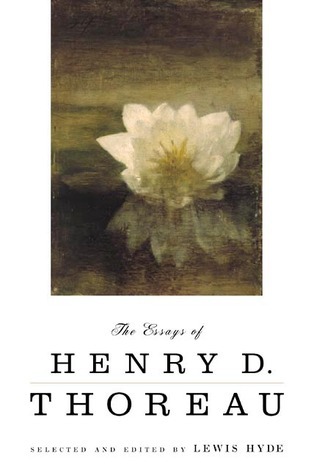
Thoreau's major essays annotated and introduced by one of our most vital intellectuals.
With The Essays of Henry D. Thoreau , Lewis Hyde gathers thirteen of Thoreau's finest short prose works and, for the first time in 150 years, presents them fully annotated and arranged in the order of their composition. This definitive edition includes Thoreau's most famous essays, "Civil Disobedience" and "Walking," along with lesser-known masterpieces such as "Wild Apples," "The Last Days of John Brown," and an account of his 1846 journey into the Maine wilderness to climb Mount Katahdin, an essay that ends on a unique note of sublimity and terror.
Hyde diverges from the long-standing and dubious editorial custom of separating Thoreau's politics from his interest in nature, a division that has always obscured the ways in which the two are constantly entwined. "Natural History of Massachusetts" begins not with fish and birds but with a dismissal of the political world, and "Slavery in Massachusetts" ends with a meditation on the water lilies blooming on the Concord River.
Thoreau's ideal reader was expected to be well versed in Greek and Latin, poetry and travel narrative, and politically engaged in current affairs. Hyde's detailed annotations clarify many of Thoreau's references and re-create the contemporary context wherein the nation's westward expansion was bringing to a head the racial tensions that would result in the Civil War.
Henry David Thoreau (born David Henry Thoreau) was an American author, naturalist, transcendentalist, tax resister, development critic, philosopher, and abolitionist who is best known for Walden, a reflection upon simple living in natural surroundings, and his essay, Civil Disobedience, an argument for individual resistance to civil government in moral opposition to an unjust state.
Thoreau's books, articles, essays, journals, and poetry total over 20 volumes. Among his lasting contributions were his writings on natural history and philosophy, where he anticipated the methods and findings of ecology and environmental history, two sources of modern day environmentalism.
In 1817, Henry David Thoreau was born in Massachusetts. He graduated from Harvard University in 1837, taught briefly, then turned to writing and lecturing. Becoming a Transcendentalist and good friend of Emerson, Thoreau lived the life of simplicity he advocated in his writings. His two-year experience in a hut in Walden, on land owned by Emerson, resulted in the classic, Walden: Life in the Woods (1854). During his sojourn there, Thoreau refused to pay a poll tax in protest of slavery and the Mexican war, for which he was jailed overnight. His activist convictions were expressed in the groundbreaking On the Duty of Civil Disobedience (1849). In a diary he noted his disapproval of attempts to convert the Algonquins "from their own superstitions to new ones." In a journal he noted dryly that it is appropriate for a church to be the ugliest building in a village, "because it is the one in which human nature stoops to the lowest and is the most disgraced." (Cited by James A. Haught in 2000 Years of Disbelief.) When Parker Pillsbury sought to talk about religion with Thoreau as he was dying from tuberculosis, Thoreau replied: "One world at a time."
Thoreau's philosophy of nonviolent resistance influenced the political thoughts and actions of such later figures as Leo Tolstoy, Mohandas K. Gandhi, and Martin Luther King, Jr. D. 1862.
I really enjoyed the political discourses, but the nature stuff was pure torture. My theory is that he was so distraught by the political situation of his time, that he went insane and began getting high and talking long walks. Being so tired of his real writings falling on deaf ears, he decided to try making his political foes commit suicide by reading his nature writings. Lord knows I almost gouged out my eyes several times.
Read several of the essays in this collection and as always found Thoreau’s ideas very interesting even if I don’t totally agree. Some of my favorite ideas was his discussion of how we will always be unprepared for life in Paradise (to be) regained, I found that sentiment really humbling. In Civil Disobedience I liked his idea of the one who was peace of mind having all the possessions in the world. Probably my favorite was in Walking, when he said he didn’t understand how people who didn’t walk didn’t kill themselves.
Reading Thoreau is like taking a nice, long walk in the woods and then, halfway through, starting a big argument about politics.
Yes, his writings are more complex than that -- admittedly Thoreau's essays often intertwine politics and nature, and are neither wholly one or the other -- but to a layperson like me, that offers a reasonable enough description. And that description is not offered as a negative. We are political beasts, even when we think we aren't; "not-politics" is still a kind of politics, a fact that Thoreau sometimes overlooks in his nearly constant throat-clearing about how debasing politics is.
This collection of essays by Henry David Thoreau opens a window to another time and place -- the bustling, burgeoning but still mostly rural New England of the mid-Nineteenth Century, in an America still chained by the sin of chattel slavery. It is slavery that draws out Thoreau's politics most strongly, though he seems overly admiring of John Brown's dubious character (though perhaps rightly laudatory of his 1859 raid on Harper's Ferry, an attempt to foment a slaver rebellion). Since John Brown's actions prior to Harper's Ferry do little to differentiate him from a modern terrorist -- i.e., killing innocents in the name of a religious cause -- I have to part company with Thoreau's near-idol worship of that man.
Rather, it's Thoreau's writings prior to 1859 that hold the most authority and grace. His essay on "Civil Disobedience" is well-known (and his arguments are closely examined even in our times, including a serious treatment by John Rawls in A Theory of Justice). Although Thoreau's argument doesn't necessarily support the type of nonviolent resistance many believe, it's clear that Thoreau provided a major source of inspiration for Martin Luther King, Jr., Nelson Mandela, and Mahatma Gandhi.
For a man who professed to despise politics, he seemed to possess a great gift for political invective, made abundantly clear in his sarcastic, hilarious, and brilliant "Slavery in Massachusetts" (just think about that title for a second) -- a damning attack on Northerners who profited from the raw materials provided by Southern slave labor and the complicity of the North in supporting the Fugitive Slave Law.
Elsewhere, Thoreau writes what might be called "poetry in prose," such as in "A Winter Walk," reading so evocative that it should be mandatory on Christmas mornings. Thoreau's descriptive ability is so engaging that reading him is like reading a painting. When it comes to his essays that focus mostly on nature, at times I found myself mesmerized, reading along and, without realizing it, becoming completely immersed, like I were actually standing there in a bucolic setting in 1843. It's clear why many still read Thoreau today.
Then there's the writing, nearly flawless, and which conveys hope and despair at once. I'll end on this sample from "Walking" -- another gem found in this highly recommended, but not necessarily easy-to-read, collection:
"We are accustomed to say in New England that few and fewer pigeons visit us every year. Our forests furnish no mast for them. So, it would seem, few and fewer thoughts visit each growing man from year to year, for the grove in our minds is laid waste, —— sold to feed unnecessary fires of ambition, or sent to mill, and there is scarcely a twig left for them to perch on. They no longer build nor breed with us. In some more genial season, perchance, a faint shadow flits across the landscape of the mind, cast by the wings of some thought in its vernal or autumnal migration, but looking up, we are unable to detect the substance of the thought itself. Our winged thoughts are turned to poultry. They no longer soar."
As with any collection, some essays were better than others. My favorites were "Wild Apples" and "A Plea for Captain John Brown" (because John Brown is awesome).