

What do you think?

Fassbinder Film Maker
Book by Hayman, Ronald
192 pages, Hardcover
First published January 1, 1984
About the author
Ronald Hayman
67 books14 followersRonald Hayman is a critic, dramatist, director and writer best known for his biographies.
Ratings & Reviews
Friends & Following
Create a free account to discover what your friends think of this book!
Community Reviews
Displaying 1 - 7 of 7 reviews

April 25, 2023
CRITIQUE:
Preface
This book isn't so much a study of Fassbinder's filmography (1), as a critique of his personality, and a speculation on how it might have affected the style and content of his films.
This doesn't mean that it lacks significance or value. While, initially, I questioned its merit as a critical study, it did stimulate some new perspectives on his films.
Reckless Self-Destruction
Fassbinder made many vehemently bitter assertions about his childhood. He was only six when his parents divorced, so he tended to blame his mother for his unhappiness:
Hayman draws the following inferences from Fassbinder's background:
No matter how powerful and successful he was, he still needed admiration and respect.
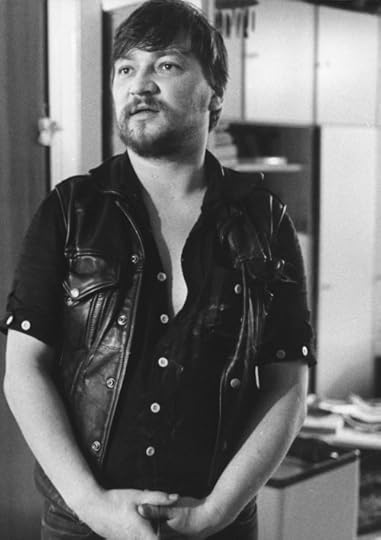
Rainer Werner Fassbinder (in leather jacket) (Source:)
Despotic Oppression
Hayman argues that, by becoming a film director:
Hayman quotes an opinion that he was "fairly despotic" with the actors:
No matter how much the actors liked him on an individual basis, they were still oppressed.
Private Life
Hayman also suggests that Fassbinder's films reflected his personal life. He behaved the same in both spheres:
Hayman asserts that:
He believed that the legend surrounding his life would equally surround his work.
My Life Become a Film
One thing that Hayman doesn't overtly suggest (but which emerges from a reading of his book) is that Fassbinder might have lived the lifestyle he did, in order to create subject matter for his films.
Coincidentally, in a quiz (2) in 1960, in which Fassbinder is asked about his plans and hopes for 1961, he responded:
FOOTNOTES:
1. As far as I can recall, I've seen seven of Fassbinder's 44 films. I only saw one of his films before he died in June, 1982: that was "The Third Generation", which I think I saw in London in April, 1982. I probably saw the other films at the Classic Cinema in East Brisbane or at one or more retrospectives after his death:
* "The Bitter Tears of Petra von Kant";
* "The Marriage of Maria Braun";
* "Lili Marleen";
* "Lola";
* "Veronika Voss";
* "Querelle".
2. Rainer Werner Fassbinder, "The Anarchy of the Imagination", page 110
SOUNDTRACK:
Preface
This book isn't so much a study of Fassbinder's filmography (1), as a critique of his personality, and a speculation on how it might have affected the style and content of his films.
This doesn't mean that it lacks significance or value. While, initially, I questioned its merit as a critical study, it did stimulate some new perspectives on his films.
Reckless Self-Destruction
Fassbinder made many vehemently bitter assertions about his childhood. He was only six when his parents divorced, so he tended to blame his mother for his unhappiness:
"It wasn't so much a messed-up childhood as no childhood at all...
"As time passes, the parent becomes the figure which the child in one respect accepts as dominant, which means that all through their lives they will accept dominant figures while at the same time trying to destroy this dominance in order to exist...
"Actually a child develops a dual need for dominance and destruction, which is to say that one becomes sadistic and masochistic at the same time."
Hayman draws the following inferences from Fassbinder's background:
"The compulsive recklessness had its roots in emotional deprivation during childhood.
"Fassbinder, in living the way he latterly did - overeating, overworking, drinking heavily, taking drugs and sleeping pills in outrageous quantities - was making a similar point about the relationship in his own life between childhood deprivation and the need to take risks...
"At the end of his life he was averaging about three hours's sleep a night, overeating, drinking two bottles of bourbon a day, as well as strong Bloody Marys, smoking marihuana or hashish on the set and taking powerful sleeping pills (Mandrax)...
"...he had launched non-stop assaults against his own physique, but never without the irrational hope that it could withstand them...
"...he had gone on to become a gambler playing against himself, for want of a better opponent.
"Generally he tended to ally himself with proletarian or criminal characters against the middle classes; the leather jacket he so often wore was a symbol of this rebellion, and he went on identifying education with the unenlightened schools he had detested and with his family's frigid attempts to discipline him.
"His importance as a film director depends on his ability to translate his neurosis into cinematic fiction...
"Film was a form of therapy in which he could project his identity into the glamorous men and women who spoke his dialogue and obeyed his instructions, but in overworking so drastically and indulging himself so recklessly, he was constantly appealing for help."
No matter how powerful and successful he was, he still needed admiration and respect.
Rainer Werner Fassbinder (in leather jacket) (Source:)
Despotic Oppression
Hayman argues that, by becoming a film director:
"He discovered that a combination of talent, determination, energy, aggressiveness and charm gave him the power to make a group of trained actors accept him as their leader."
Hayman quotes an opinion that he was "fairly despotic" with the actors:
"He alienated some actors with his rudeness...
"It was only occasionally that he indulged the whim of making attractive actors look less attractive, but he was regularly compulsive about testing how far he could make people go in their obedience to him...
"He drives people to the point of bringing something up from inside themselves, and he finishes with them when there's nothing left to suck out...
"Pressure was building up that would have, sooner or later, to be violently released...
"It was partly the unpredictability of his behaviour that made him so fascinating."
No matter how much the actors liked him on an individual basis, they were still oppressed.
Private Life
Hayman also suggests that Fassbinder's films reflected his personal life. He behaved the same in both spheres:
"What he did in private life to generate erotic tension was continuous with what he did on the studio floor - a theatre of cruelty in non-stop performance...
"One danger in merging his private life with his professional life was that he would feel justified in doing anything that would deepen the actor's dependence on him...
"Fassbinder willingly gives away far more about his private life...
"He seems to have disliked the convention of privacy as much as he disliked the kind of superficial considerateness that is guaranteed by bourgeois politeness."
Hayman asserts that:
"The statements he made about himself and the statements that are contained in anecdotes about him become inseparable from the statements made in the films. He understood that their reception would depend partly on his image, and one reason for behaving outrageously was that outrage would promote them. He needed the legend, but he sacrificed himself to it."
He believed that the legend surrounding his life would equally surround his work.
My Life Become a Film
One thing that Hayman doesn't overtly suggest (but which emerges from a reading of his book) is that Fassbinder might have lived the lifestyle he did, in order to create subject matter for his films.
Coincidentally, in a quiz (2) in 1960, in which Fassbinder is asked about his plans and hopes for 1961, he responded:
"To make many, many films, so that my life would become a film."
FOOTNOTES:
1. As far as I can recall, I've seen seven of Fassbinder's 44 films. I only saw one of his films before he died in June, 1982: that was "The Third Generation", which I think I saw in London in April, 1982. I probably saw the other films at the Classic Cinema in East Brisbane or at one or more retrospectives after his death:
* "The Bitter Tears of Petra von Kant";
* "The Marriage of Maria Braun";
* "Lili Marleen";
* "Lola";
* "Veronika Voss";
* "Querelle".
2. Rainer Werner Fassbinder, "The Anarchy of the Imagination", page 110
SOUNDTRACK:
October 24, 2014
All the gory details... Astoundingly bitchy behavior throughout, on the parts of all involved. It's a brief and entertaining read, but Hayman still does a great job of laying out the important details of Fassbinder's life as it led into each project, and describing the endless interpersonal melodrama between director, cast and crew that surrounded (and eventually filtered into the content of...) each film.
February 23, 2020
Very good for the first chunk of the book, taking us through Fassbinder’s offscreen world and how it influenced his work, but towards the end it felt way too subjective. I don’t want to hear about what Hayman saw as “ridiculous” or “bad writing,” and that blatant opinionating really made it a slog to get through.

October 24, 2020
Patchy, disjointed and frankly all over the place

November 18, 2013
Short, fascinating look at the legendary filmmaker. Written just two years after his death, it manages to cover both his personal life and his career in a way that helps you understand how directly related they were. For Fassbinder art didn't just imitate life. It was life.

May 22, 2017
Good information, solid analysis. I'm a fan of RWF's work, so keep that in mind, but this would be a much better choice if one was inclined to read about him than Robert Katz's biography, which from what I recall is preoccupied with dirt. There's plenty of that here too, and it's essential to an understanding of the man (even if the personality tended to overshadow an oeuvre of significant merit, which appears to have been the case for quite some time in his own country), but this book elucidates on how his behavior towards collaborators and lovers ties into the themes in his work. For Katz, the art is merely incidental; Hayman does not make that mistake.

January 16, 2013
I have been watching Fassbinder movies and this was recommended not only to understand this very strange director, but also how it influenced his movie making. He was a man who had to dominate his actors, some were subjected to humiliation, etc. others were treated well. He tries to analyze him psychologically, and although I found it interesting, it was upsetting. A lesson in how some people allow subjugation - the abused wife who can't leave home. Anyhow, glad I read it but will try to forget information about the actors as I watch his films.
Displaying 1 - 7 of 7 reviews