Monsieur de Pourceaugnac is a three-act comedy-ballet in prose.
Two young Parisian lovers, Éraste and Julie, met in secret for fear that Julie's father, Oronte, discovers their relationship. Oronte has promised his daughter to Monsieur de Pourceaugnac, a bourgeois of Limoges. The lovers seek a solution that will allow Julie to escape the marriage. For this they use a matchmaker Nérine and a Napolitan cheat Sbrigani. When Monsieur de Pourceaugnac arrives, they do everything to ridicule him, to make it look like he’s crazy, to make it look like he’s somebody with many debts ... And when that doesn’t work, Sbrigani goes find the poor man to tell that Julie is just a nasty coquette and she does not deserve him to marry her. Julie enters the scene and claims to be madly in love with the unfortunate young man. Monsieur de Pourceaugnac, convinced of the vanity of his bride refuses to marry her. When Pourceaugnac wants to leave the scene, two women pick on him and say he is the father of their many children. Monsieur de Pourceaugnac has now only one possibility to escape a charge of polygamy: to run. Disguised as a woman he manages to escape. Sbrigani then convinces Orontes that Pourceaugnac has kidnapped his daughter, and when Éraste "saves" her, Orontes gives their marriage his blessing.
French literary figures, including Molière and Jean de la Fontaine, gathered at Auteuil, a favorite place.
People know and consider Molière, stage of Jean-Baptiste Poquelin, also an actor of the greatest masters in western literature. People best know l'Ecole des femmes (The School for Wives), l'Avare ou l'École du mensonge (The Miser), and le Malade imaginaire (The Imaginary Invalid) among dramas of Molière.
From a prosperous family, Molière studied at the Jesuit Clermont college (now lycée Louis-le-Grand) and well suited to begin a life in the theater. While 13 years as an itinerant actor helped to polish his abilities, he also began to combine the more refined elements with ccommedia dell'arte.
Through the patronage of the brother of Louis XIV and a few aristocrats, Molière procured a command performance before the king at the Louvre. Molière performed a classic of [authore:Pierre Corneille] and le Docteur amoureux (The Doctor in Love), a farce of his own; people granted him the use of Salle du Petit-Bourbon, a spacious room, appointed for theater at the Louvre. Later, people granted the use of the Palais-Royal to Molière. In both locations, he found success among the Parisians with les Précieuses ridicules (The Affected Ladies), l'École des maris</i> (<i>The School for Husbands</i>), and <i>[book:l'École des femmes (The School for Wives). This royal favor brought a pension and the title "Troupe du Roi" (the troupe of the king). Molière continued as the official author of court entertainments.
Molière received the adulation of the court and Parisians, but from moralists and the Church, his satires attracted criticisms. From the Church, his attack on religious hypocrisy roundly received condemnations, while people banned performance of Don Juan. From the stage, hard work of Molière in so many theatrical capacities began to take its toll on his health and forced him to take a break before 1667.
From pulmonary tuberculosis, Molière suffered. In 1673 during his final production of le Malade imaginaire (The Imaginary Invalid), a coughing fit and a haemorrhage seized him as Argan, the hypochondriac. He finished the performance but collapsed again quickly and died a few hours later. In time in Paris, Molière completely reformed.
Jean Baptiste Poquelin, better known as Molière visited Madrid for three days. And he did so led by the hand, I should say the baton, of William Christie.
And what a visit it was! Almost straight from Versailles where this production was first staged , it came not to the Royal Palace of El Escorial, but to a more democratic venue in a theatre in the center of Madrid.
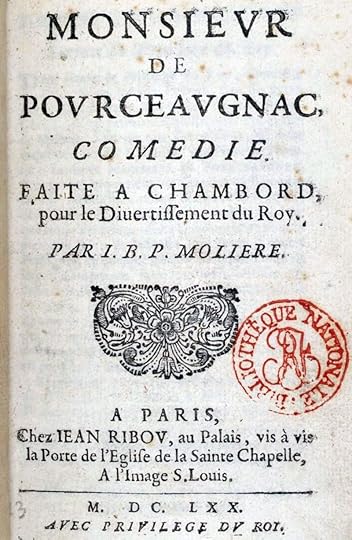
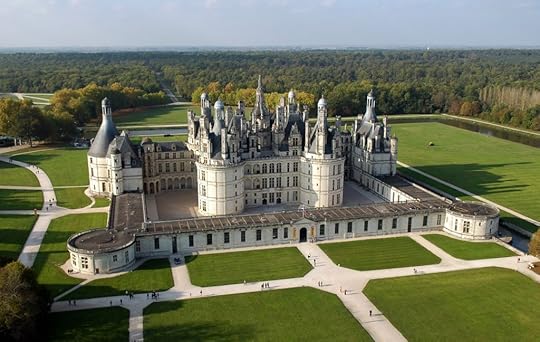
Molière would have approved even if this comédie-ballet was produced for the very regal Louis XIV and first represented in 1669 at the Chateau de Chambord by Molière’s troupe with its Director in the role of the ineffable Monsieur de Pourceaugnac. Jean-Baptiste Lully, the Florentine who became French, composed the music and for this production Christie occupied his seat.
It was a tremendous success. And I am not surprised. The work offers a perfect mix of visual, literary and musical beauties. Accompanied by unforgettable merry laughter.
The plot is composed of Molière’s pet themes and elements. Forced marriages between a young woman and an older man, sweet love, crooks and swindlers, doctors and lawyers (read crooks and swindlers again), Italian Commedia dell’Arte, disguised identities, money, textual ambiguities and sous-entendres, and humorous echoes rung by the names with Pourceaugnac being the best of all. And all of this intelligently wrapped up to sustain the intrigue and conclude in a Happy End.
And the enchanting Ballet.
Not surprising then that this was a memorable performance. In particular I am a long-time fan of Molière, and feel fulfilled that I had the opportunity to leave a red rose on his grave at the Père Lachaise a few years ago, as well as of Baroque Opera. Nothing in the world would make me miss a production directed by William Christie in the town where I happened to live.
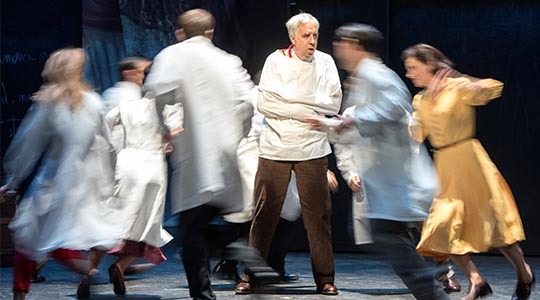
His goal was to connect the various pars of the work. So he and the music players sat on the stage, not on the pit. And they interacted. The actors and the musicians worked and had fun together. Some actors approaching a music stand to have a closer look to the musical cipher and the musicians, who at times made use of wacky instruments together with their valuable violins, applauded and cheered on the actors. And a couple of actors then came down and visited the audience, with Monsieur Pourceaugnac himself sitting on the lap of the man next to me. I wish it had been Molière himself. But this actor wan the audience when he spoke in broken Spanish to the Madrid audience.
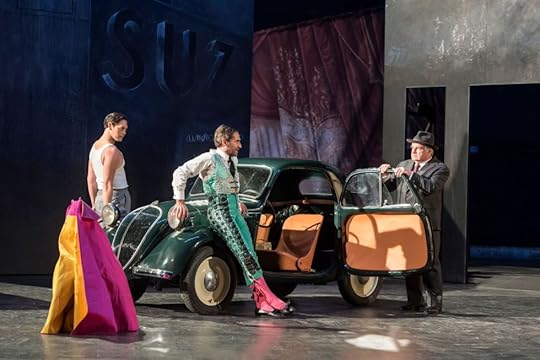
It certainly captivated the audience which broke into immediate applause when out the Italian Topolino that had been rolling around the stage to everyone's amusement, a couple of toreadors (!) came out and spoke in perfect Spanish some interjections added to the original text. For no, Molière did not refer to Seville, although he could have as later did Mozart. But those additions were not done for the Spanish visit. The Topolino and the bullfighters had been included in the Versailles version already.
At the end we had the chance to talk for a bit to the laudable William Christie. And I have now ordered a couple more of his recordings -- and one of them is another Molière.
"ne voyez vous pas l'amour qu'elle a pour cet homme là ? et voulez-vous que je possède un corps dont un autre possédera le cœur ?" Une comédie de Molière, l'habitude de Molière. Molière joue très bien avec le comique de mots ici , un peu comme le marivaudage. Très bonne pièce à lire si vous vous sentez ennuyé ou triste.
OMG, Moliere you long-haired hottie, if you would just shave that moustache...
Ballet, music, singing, AND drag! What doesn't this play have? The one BIG drawback in the public domain PDF I read was the translation of the French country bumpkins accents into unrecognizable English; the Swiss characters were only a LITTLE easier: I just got the gist of the scenes. It's fair for the French to malign the French.....I just wish I didn't have to read what looked like some of Faulkner.
Je ne connaissais pas du tout cette pièce de Molière. J'avais très envie de la découvrir surtout que je suis fan de ce dramaturge. Dès lors, cette lecture me paraît une évidence. Molière nous propose une comédie-ballet avec les meilleurs comme Lully, etc. Néanmoins, je trouve que sa comédie est moins subtile que d'autres pièces. Il est évident qu'il dénonce la médecine, se moque de certaines catégories ou rangs sociaux. On est davantage dans une farce puisque nous avons une situation assez classique chez Molière : le père contraint sa fille à épouser un vieillard alors que la demoiselle aime un autre. Nos amoureux feront pour faire annuler le futur mariage en ridiculisant le vieillard. Pourtant, c'est classique mais on rit toujours autant. J'ai beaucoup aimé les différents thèmes, sujets présents dans cette pièce. Nous avons tout d'abord la critique de la médecine avec des mots savants, l'invention de maladies. Je trouve que Molière excelle parfaitement dans ce domaine-là puisqu'on a l'impression que la médecine est un culte et non un domaine scientifique. En outre, nous avons aussi l'opposition entre les parisiens et les provinciaux perçus comme des naïfs, etc.
Pour conclure, Molière nous fait du Molière. Monsieur de Pourceaugnac est une comédie peu subtile mais ô combien intéressante dans ses thèmes. Nous avons une certaine vision notamment des clichés de l'époque.
Oronte, « vieillard » parisien de 63 ans veut marier sa fille Julie à Monsieur de Pourceaugnac, prospère gentilhomme de province. Or, il l’avait auparavant promise à Éraste, qui l’aime et qu’elle aime.
Éraste et Lucie, avec l’aide des deux intrigants, Sbriganti et Nérine, tendent une série de pièges à M. De Pourceaugnac pendant tout le séjour de celui-ci à Paris. Sans en dire davantage, rappelons qu’il s’agit d’une comédie, et que donc tout va bien qui finit bien.
Cette pièce relativement courte concentre tant de traits du génie de Molière. Je me suis surpris à rire à haute voix en lisant les scènes récitées avec l’accent gascon, picard, flamand et suisse. L’humour est souvent osé, ce qui nous fait refléchir sur l’évolution des mœurs et des mentalités depuis le XVIIe siècle…
Bien entendu, ne pouvait pas manquer non plus la satire des médecins.
Je suis content d’avoir lu cette pièce souvent considérée mineure dans l’œuvre de Molière. Par la suite, j’ai assisté à la mise en scène de Philippe Adrien pour la Comédie Française (2001), avec notamment Bruno Raffaelli, excellent dans le rôle-titre, et Denis Podalydès, remarquable comme toujours, dans le rôle d’Éraste.
À moins que vous ne soyez familier avec le français du XVIIe siècle, je vous recommande vivement de lire une édition annotée, comme celle des Petits Classiques Larousse ou du Livre de Poche. Et bon amusement !
Very fun read! I enjoyed all the dialects. I can imagine Moliere playing Mr. Pourceaugnac and scattering about the stage with his peculiar ways. Ha ha ha!