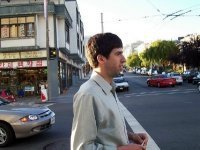
Dobyns was raised in New Jersey, Michigan, Virginia, and Pennsylvania. He was educated at Shimer College, graduated from Wayne State University, and received an MFA from the Iowa Writers' Workshop at the University of Iowa in 1967. He has worked as a reporter for the Detroit News.
He has taught at various academic institutions, including Sarah Lawrence College, the Warren Wilson College MFA Program for Writers, the University of Iowa, Syracuse University, and Boston University.
In much of his poetry and some works of non-genre fiction, Dobyns employs extended tropes, using the ridiculous and the absurd as vehicles to introduce more profound meditations on life, love, and art. He shies neither from the low nor from the sublime, and all in a straightforward narrative voice of reason. His journalistic training has strongly informed this voice.
I am a huge fan of Dobyns' poetry and Heat Death does not disappoint. Reading Pablo Neruda's poetry whilst reading Dobyns' poem 'Pablo Neruda' was a surreal experience.
For me, Dobyns is a seasonal/transitional writer - I can only read and comprehend his work in the late Summer transitioning into Autumn, so it is the perfect time to indulge.
'The day hates you and the wind has stolen the coat from your back. Take this poem. Unfolding it from the page, it becomes a cloak. Now as you walk through the streets of winter, you listen idly to the talk of the unfaithful: how you must have flattered the sun for it to give you a ray to wrap around you.'
Here the weather remains the same. Constant summer sun. When was the sky anything but blue? In the harbor park, boys on bikes plague lovers and the pink-eyed dogs of the elderly. Across the water, freighters take on cargo. I stand on the shore, envying each destination. Because you are not here, I think of you everywhere; wherever they are going they must be going to you. We were like fat people in old cartoons who could barely kiss for all their mortal baggage; like holiday travelers who have missed their trains, are stranded in a European station surrounded by wicker baskets, belted trunks. We had such baggage. It increased and became such a mountain that we lost each other behind it, until our voices grew distant and we returned to writing letters. Whose baggage, whose mistakes, who cares now? Listen, I am thirty-six, I have lived in many cities and within me it is raining. The deliberate ocean repeats and repeats. Empty lifeguard stands, paper cups and plastic spoons, the folded green cabanas– all mark the deserted beaches of the heart. Water drips from colored pennants, glistens on the black taxis on the esplanade. In the empty ballroom of a beach hotel, someone is practicing the piano. In sitting rooms and parlors, guests turn the pages of their magazines, look at rain on windowpanes, look at watches, look at the closed door of a dining room from which they hear the rattle of dishes and silver, of tables being set. Listen, from such a place I am writing you a letter. Again and again, I try to put down a few words. As day and sky dissolve in sheets of gray, the sea repeats your name to the desireless sand.
Heat Death is a really interesting little specimen. I don't claim to be even a little bit knowledgeable about poetry so this is just a novice's general impression.
Some of the poems really struck me, particularly those about that very peculiar and terrible kind of consuming loneliness that can occur when you are in a relationship with someone and yet at a distance. I appreciated the efforts at some of the more experimental content and the odd changes in point of view, but I didn't really think those worked all that well. It felt like he was struggling to make them work.
Part of the reason I enjoyed it so much is I felt like I was getting to see through the eyes of a 40-something male adult and that's not a perspective I read about very often. It felt foreign but intriguing and for the most part, I really enjoyed his work.