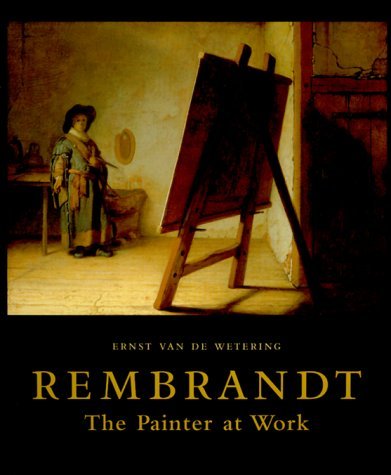
Rembrandt's intriguing painting technique has stirred the imagination of art lovers during his lifetime and ever since. In this book, Rembrandt's pictorial intentions and the variety of materials and techniques he applied to create his fascinating effects are unraveled in depth. At the same time, this "archaeology"of Rembrandt's paintings yields information on many other levels.
In art-historical research, the work of art as a material object is used increasingly as an important source of information about the painting itself, as well as about historic studio practice in general. The range from practical workshop devices to aesthetic and art-theoretical matters combined in this book offers a view of Rembrandt's daily practice and artistic considerations, while simultaneously providing a more three-dimensional image of the historical artist.
Yes. This book has a whole chapter on the thread density in the warp and weft of Rembrandt's canvases. Seriously geeking out stuff. So far my favorite section is "The visible brushstroke," a section that addresses Rembrandt's use of sprezzatura, "the rough manner," that technique which he grew into later in life. Analyses of brush work, comparing a single eye in a painting with another single eye in a painting~! Gotta love it. Wetering soberly demythologizes the romantic view of Rembrandt and gets down to the ground of his processes, methods, and materials. No really, he literally discusses Rembrandt's ground, does chemical analyses that show what sealed his canvases. It's usally a mixture of lead white, some red ochre, quartz, glue and chalk.
Beautifully illustrated and heavy book. Not a light read. It is a rarity among art books in that it focuses primarily in the habits, techniques and studio inner workings of a famous artist instead of the usual historical or symbolic context of the art.
This book is exhaustively thorough in its research of studio practices, apprenticeships, preliminary works on tablet, supports, palette, binding materials and painterly technique of Dutch art in the Seventeenth Century and Rembrandt in particular without omitting possible influences and comparisons.
The book seems mostly aimed at restoration experts even though the chemistry and scientific lingo is reduced to a minimum with some serious omissions like the chemical nature of Rembrandt's pigments for example which are mostly mentioned by their common name and period nomenclature but rarely reduced to their chemical origin. A working painter will surely find the chapters on binding, imprimatura and color palette very interesting as well as the evolution of Rembrandt's style from a tight style in stages to a "pittura macchiatta" influenced possibly by Titian or a byproduct of the artists' lengthy experience.
The main "thesis" of the book in my opinion is debunking the merely visual attempts made by many to elucidate the alchemy behind Rembrandt's mysterious techniqu. Starting with painter Josefz Israelis muddled interpretation of the master's beautiful palette and "houding" = (I understood this to mean a masterful unity in color and composition , what makes a painting come together form a distance).Israelis work just looks muddy, not particularly compelling in my opinion.
Other students of Rembrandt's masterpieces include Reynolds (who attributed the lusciousness of Rembrandt's art to an abundant use of wax), a Jacques Maroger who claimed to have come close to the mysterious binding medium ( a mix of mastic, lead, turpentine and other substances) and Max Doerner's, whose thesis regarding the use of glazing and resins seems to be misoriented.
Through the use chromatography the author finds nothing but linseed oil, walnut oil and traces of egg emulsion in the artwork. . Moreover, through analysis of unfinished works, etchings and X-rays, the author also deduces that much of Rembrandt's work was a lot more direct than initially thought with sketching done directly in oils and local color applied fairly early on. In many ways, Rembrandt and his contemporaries owe a lot to Van Eyck, an earlier master whose breathtaking technique and splendor were probably the direct antecedent to many in the Netherlands.
I did appreciate this fabulous book despite the difficult reading and I'm sure new discoveries will come forward in time. I just wish there was a more abbreviated and lighter version and that more attention had been paid to link older and current pigments.
This book uses modern research and information that has come to light to reconstruct the work life of Rembrandt and his contemporaries. Copiously ilustrated. I found this fascinating.
For people interested in the actual studio practice of Rembrandt, the art materials and methods, this has a lot to chew on, and many myths are shattered. There are plenty of beautiful reproductions, for those who wish to skip the text, diagrams and x-rays. But in getting a greater appreciation for Rembrandt, it would be a shame if you do.
Wetering is thorough in his explorations and explanations of Rembrandt's techinques, materials, and time. I often go gagga for these technical analyses of paintings, and this book provides ample photos of everything; e.g. the stitchings of the various types of canvases that Rembrandt used, various methods from the period of fastening the canvas to the stretchers, how he prefered to mount panels, his different palettes, mixes for mediums, etc. It's a lovely book, the only reason that I gave it four stars instead of five, is for the lack of big prints of Rembrandt's paintings; make no mistake, there are quite a few, but a book of this magnitude should boast an overflowing of Rembrandt's paintings, more so than there are.
THE book to read with regards to an analysis of Rembrandt's painting technique. The author goes into delightful detail, examining everything from the type of boards a student would use to sketch as a young artist to the various weave styles of canvas of the day. This work is a result of years of careful research. I highly recommend it. The print reproductions inside are exquisite and detailed - the absolute best of any book I've found on Rembrandt.
It's a huge publication, more like a coffee-table book so not easy to hold no less read. Though fascinating to read about Rembrandt's early career and how his technique developed. Our museum has a Rembrandt portrait of Jesus, one of the gems in our collection so I enjoyed reading about this phenomenal painter.
"Who would not have wanted to look over Rembradts shoulders while he painted? This book has taken us further than almost any study over the past twenty years, towards an understanding of the machinery of Rembradt´s genius."