One of the most successful women artists in history, Angelica Kauffman became the toast of Georgian England, captivating society with her portraits, mythological scenes, and decorative compositions. She knew and painted poets, novelists and playwrights, collaborating with them and illustrating their work; her designs adorned the houses of the Grand Tourists she had met in Italy; actors, statesmen, philosophers, kings and queen sat to her; and she was the force that launched a thousand engravings. Despite rumors of relationships with other artists and an apparently bigamous and annulled first marriage to a pseudo Count, Kauffman was adopted by royalty in England and abroad as a model of social and artistic decorum. Kauffman's life and work is full of apparent contradictions explored in this first biography in over 80 years.
A few months ago I went to see an Art exhibition at the Tate Gallery in London, called “Now you See Us: Women Artists in Britain, 1520–1920”. Since my area of interest focuses on late 19th and 20th century Art, I knew many of these 400 paintings would be unfamiliar to me. Also, male artists dominate most national collections of Art. Between Artemisia Gentileschi (1593–1652) and the late 19th century onwards, there is a big gap in the popular knowledge of female artists.
The exhibition’s aim was to demonstrate how women overcame barriers to establish themselves in the art world, with female artists challenging what it meant to be a working woman and paving a new path for generations to come. Queen Victoria disapproved of females working in areas she considered inappropriate, but before her reign there were many women prominent in their day as working artists. They were the daughters, sisters or wives of artists, so they often belonged to a social class which allowed them the time and opportunity to develop their talents. Nevertheless, many practised art as a livelihood, rather than an accomplishment or leisure pursuit, fighting to be accepted as professional artists, on equal terms with men.
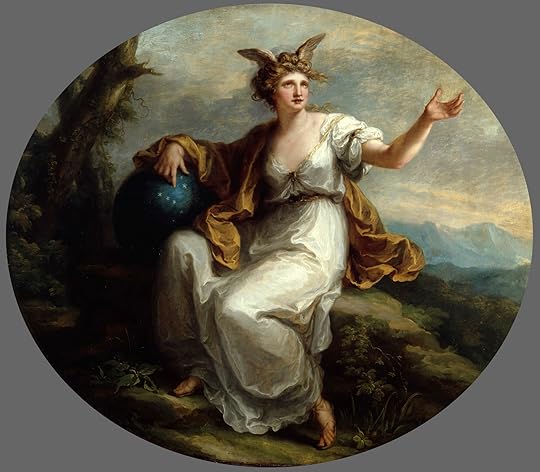
The first painting was by Angelica Kauffman. Titled “Invention” it was one of four allegorical roundels representing the Elements of Art which she had been commissioned to paint for the ceiling of the Royal Academy’s Council Chamber. These Elements were “Invention, Design, Composition and Colouring”, considered the four fundamental stages of creating an artwork. In Angelica's painting a figure representing Invention looks upwards for inspiration. This is an extraordinary painting; an astonishing and bold interpretation of the commission, because Invention is portrayed as a woman. Moreover, Angelica Kauffman defiantly chose to paint a female figure on each roundel, to represent each of the 4 Elements.
I looked at more paintings by Angelica Kauffman, and realised that she had no intention of staying in her designated box of pretty flowers, and portraiture. There were huge oils of historical battle scenes – the preserve of men. I needed to know more about this brave artist, active during the Age of Enlightenment.
So I borrowed this scholarly biography, Miss Angel: The Art and World of Angelica Kauffman by Angelica Goodden, who is an 18th century history specialist. It was written in 2005, and tells Angelica Kauffman’s story over thirteen chapters.
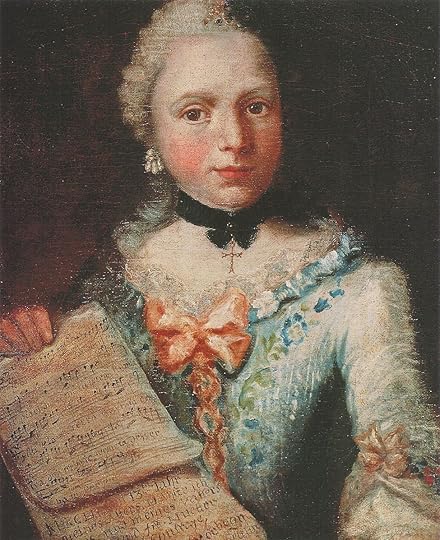
Angelica Kauffman had tried to obscure her birthplace: a town in Switzerland, but it is not clear why. Little is known about her mother, Cleophea Lutz, except that she was a Swiss singer, and died in 1757. Father and daughter had moved twice by the time Angelica was 11, and it is not clear at what point her mother was out of the picture. Cleophea Lutz taught Angelica four languages: German, Italian, French and English, and inspired her love of music. Angelica’s father Joseph Johann Kauffmann, an ecclesiastical painter, taught her to paint. He rapidly discovered that Angelica’s talent far outstripped that of his own, and realised that his daughter was a child prodigy. This is her self-portrait at the age of 12:
By this time Angelica had already become known as a painter, with bishops and nobles sitting for her. She was also a talented singer and musician, and found it difficult to choose between opera and art. Angelica settled on art, because a Catholic priest told her that the opera was a dangerous place filled with “seedy people”.
Her mother died when Angelica was 16, and she accompanied her father to Schwarzenberg, Austria where he had a commission from the local bishop. He also worked in Milan that year. Joseph Kauffman was a skilled Austrian muralist and painter, but relatively poor, so they both travelled a lot for his work. Angelica worked as his assistant, as they moved constantly through Switzerland, Austria and Italy; in Parma she copied the paintings of Correggio, and in Bologna those of the Carracci family.
In 1762 they moved to Florence, where Angelica copied numerous Renaissance works in the galleries of the Uffizi, and met many influential people on the “Grand Tour”. A generation of European art students were to return to their home countries from Italy, with newly rediscovered Greco-Roman ideals. Angelica Kauffman mixed with these neoclassical artists and scholars, taking their ideals and style to heart.
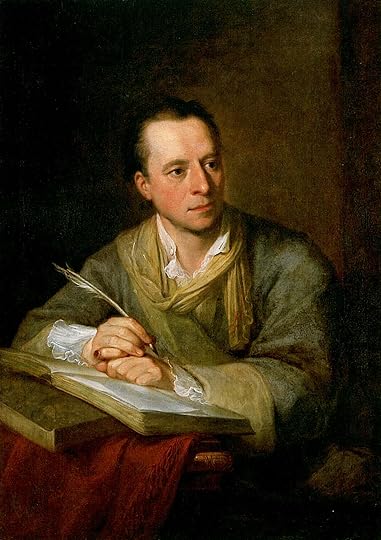
This continued the next year when they met the contemporary Art historian Johann Joachim Winckelmann, with his idea of “noble restraint”. Neoclassicism was born in Rome. He drew inspiration from the art and culture of classical antiquity, and it was largely due to his writings during the rediscovery of Pompeii and Herculaneum that its popularity expanded throughout Europe. Winckelmann influenced not only the new science of archaeology and art history, but Western painting, sculpture, literature and even philosophy. And Angelica Kauffman, her ambitious eye wide open to opportunity, painted Winckelmann’s portrait.
Winckelmann wrote that Angelica’s facility with languages – speaking Italian, German, French and English – was one of the reasons why she became such a popular portraitist for British visitors to Rome, writing: “She may be styled beautiful, and in singing may vie with our best virtuosi.”
But can we be sure of the veracity of Angelica Kauffman’s many self-portraits? She was so adept at promoting herself, and the history of portraiture is packed with paintings designed to appeal to the vanity of the sitter. How easy it would be to paint a flattering image of herself, in the fashionable style of the day.
After a few months the family moved again, to Naples. There Angelica studied works by the Old Masters and sent her first painting to a public exhibition in London. In 1765, her work appeared in England in an exhibition of the Free Society of Artists.
Joseph Kauffman also had commissions in Bologna and Venice. Wherever they were, Angelica was fêted for her talents and charm. Her father remained her protector for many years, devoting his life to looking after his increasingly famous daughter’s prospects and protecting her reputation. Her popularity among the community of British visitors and expatriates in Italy encouraged her to move to London in 1766.
Angelica Goodden stresses that Angelica Kauffman was supremely confident, throughout her life cleverly manufacturing her own image. Soon after arriving in London, she established a close friendship with the major portrait painter Sir Joshua Reynolds, who admired her and seems to have fallen in love with her. It was Sir Joshua Reynolds who coined the name everyone came to know her by – “Miss Angel”. However “Miss Angel” surprisingly turned his marriage proposal down. History does not record why, although Sir Joshua was a man of his time, so the paintings by any wife of his would be bound to take second place to his own. Soon Angelica had acquired enough money to purchase a house of her own, through her portrait paintings of aristocratic men and women.
Angelica Kauffman was considered a “Raphael among women”, and set to become the first major internationally recognised woman painter. She lived in England for 14 years, remaining good friends with Reynolds; they painted portraits of each other. In fact Reynolds persuaded John Parker of Saltram, later Lord Morley, to purchase all of her works in addition to 13 portraits of his own. This probably went a good deal towards Angelica Kauffman’s ability to continue as a history painter.
Angelica also associated with the famous visionary neo-classical architect Robert Adam, who redesigned so many of England’s stately homes and gardens. He would sweep away whatever had been there before regardless, in the sure knowledge that his designs would look even better in the future, when the trees were established. Angelica Kauffman was now well accepted in the highest echelons of society, gaining aristocratic commissions to paint Princess Augusta, sister of King George III, and subsequently Queen Charlotte.
By 1768, Angelica Kauffman was 26 years old. She was one of a group of artists who signed a petition seeking royal permission to “establish a society for promoting the Arts of Design”. They became the founding members of London’s new “Royal Academy of Arts”. Of these 36 members, just two were women: Angelica Kauffman and Mary Moser, whose striking paintings of flowers were much admired. Angelica Kauffman also produced designs for the decorative Arts, such as a china service with classical motifs, based on her paintings. However, she had no intention of keeping to the decorative work deemed appropriate for female artists.
Sir Joshua Reynolds did not like this at all, and forbade any more women from becoming members of the Royal Academy. He also made sure that as women, Angelica Kauffman and Mary Moser were still excluded from the Academy’s council meetings and governance. It would be over 150 years before another woman was elected a member.
On a visit from King Christian II of Denmark, she sent two paintings to the Royal Academy’s exhibition. These, along with two by the American artist Benjamin West, identified them as the initiators of the neoclassical style in England. She developed her own unique style based on neoclassical precepts, using transparent brushwork and rich colour to make a restatement of classical sources, but using subjects drawn from mediaeval history as well as from the antique.
Angelica’s dogged persistence, hard work, and a great amount of natural talent ensured her success. Angelica Goodden says that her international stature was “one part ethereal genius to two parts shrewd businesswoman” (although Angelica Kauffman cannily did not reveal any signs of the latter.) In the 1770s a London engraver remarked, “The whole world is Angelica-mad”. She exhibited history paintings each year at the Royal Academy’s influential annual exhibitions, choosing to depict scenes from a wide range of mythological, literary and historical sources, being praised for her “masculine energy“. But it was not always easy, maintaining her position as a celebrated artist in a man’s world.
In 1775 she threatened to leave the Royal Academy, due to a dispute about a satirical painting by Nathaniel Hone in the annual exhibition.
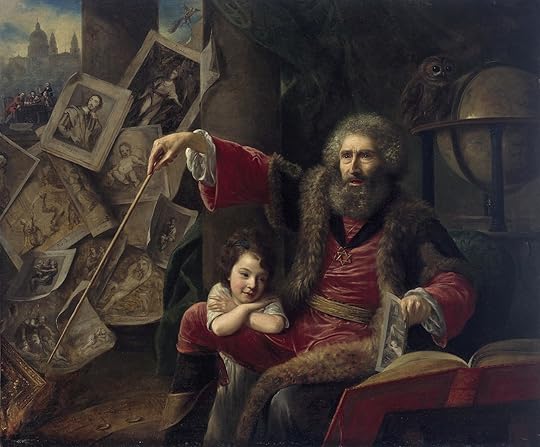
“The Conjuror” was a thinly-veiled satire on Sir Joshua Reynolds’ working methods, but it also took a sly dig at Angelica Kauffman too. The child at the conjuror’s knee resembles the figure in her painting “Hope” but worse than this, in the background Hone had painted a group of naked artists cavorting outside St Paul’s Cathedral. This scene referred to the painters who were part of a cancelled project to paint the cathedral. Therefore Angelica Kauffman knew that the only nude female figure in the group represented herself. The combination of a little girl and an old man was also seen as symbolic of Kauffman and Reynolds’s closeness, age difference, and rumoured affair. The Academy initially ignored her objection, but when she said she that she would leave the institution if the painting was not removed, the matter was put to a vote. Angelica Kauffman won, and Hone was asked to remove the offending painting.
In 1781 Angelica Kauffman left London to settle in Rome. She was now at the height of her career, and back in Italy again she established an international clientele in a salon which attracted celebrated visitors. These included the famous sculptor Antonio Canova, and Goethe, who both befriended her. She also kept up her connections with her many British friends and patrons, continuing to exhibit at the Royal Academy, sending commissions back to the UK and painting those visiting Rome on the Grand Tour. Angelica was much in demand with royals, noblemen, the landed gentry of many European countries, eccentrics and radicals. She continued to develop as both a portraitist and a history painter in Rome, demonstrating even greater confidence and skill in both genres. These are superbly executed and sometimes psychologically penetrating.
It has been said that the young males depicted by Angelica Kauffman are strangely androgynous, sexually ambivalent beings. Certainly they can look rather slight and feminine, but perhaps that is not surprisingly when one considers that as a young woman she was forbidden to study life drawing at the Royal Academy. Women were barred from attending life classes which would have enabled them to depict muscle and sinew with classical accuracy. Zoffany’s group portrait of the founder members of the Royal Academy is revealing. It sets the two female members: Kauffman and Moser apart. They are present only on the wall as blurry portraits, while the male members are recognisable and cluster around a life model.
One life model did later say that her father had employed him privately in their studio, and chaperoned his daughter, but it is not clear how many sessions this was for. It could have been a single instance.
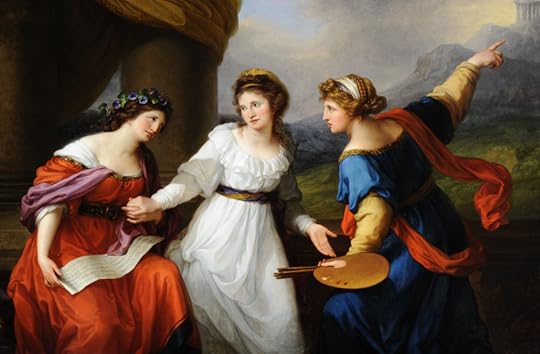
She painted several accomplished self-portraits during her years in Rome, including my favourite. Here she looks back on the choice she made as a young woman between pursuing a career in painting or in music: “Self-Portrait Hesitating Between Painting and Music” (1792) where as according to tradition, each of the Muses is personified:
When Angelica Kauffman died in 1807, her grand funeral in Rome was arranged by Antonio Canova. Her artistic reputation and status were now so high that a bust of her which had been sculpted by cousin Johann Peter Kauffman was subsequently placed in the Pantheon, beside that of the great Raphael. Angelica Kauffman was a woman in a man’s world, but she never let that stop her from following her dreams, and ultimately she fulfilled them.
Despite its scholarly approach, parts of this history read like an adventure story, because Angelica Kauffman’s life was so extraordinary. Take the Finnish Count whose servants spoke only in Livonian recitative, who gave all his orders in musical form, and who expected his visitors to converse by way of vocal improvisations. Or John Damer, whose aristocratic wife was painted by Angelica Kauffman. Although on the Grand Tour, he did not bother looking at the paintings in the Uffizi. Instead he “laid bets with his companion as to who could hop to the end of the gallery first”.
Or the astonishing story of Angelica’s marriage to a suave con-man in London in 1767. She met the so-called Count Frederick de Horn, who claimed to be a Swedish nobleman, at the house of Charles Burney. He clearly charmed the socially ambitious Angelica, by staying at Claridges, with a fine carriage and splendid footmen attired in green. She married him after he had claimed to have enemies who had slanderously accused him of conspiracy against the King of Sweden, and begged her protection as her husband and living in England. Angelica's father rightly did not believe a word of it, and the "Count" was quickly revealed to be be bogus, pretending to be his aristocratic master. Angelica hastily extricated herself from the marriage, fearing repercussions on her reputation. Later, travelling abroad in the 1780s she was marry the Venetian painter, Antonio Zucci, (1726–1795) and continued to send back historical canvases to London.
Although very little documentary evidence of her life survives, Angelica Goodden has researched thoroughly, using a multitude of sources to piece together this scholarly biography. There are extracts from letters, and newspapers, including poems written in her defence by Oliver Goldsmith and others. Ironically it was her public status and historical commissions which irked the newspapers. They were the focus of 18th century attacks, because she was painting large-scale canvasses unseemly for a female. Tellingly these scathing articles ignored her innovative style, and her role in the development of an aesthetic of “sentiment”.
This is probably now the definitive biography of Angelica Kauffman, telling of her life and times, assessing her significance in Art history, exploring the gender aspects, and also surveying the art world during the Enlightenment, with its emphasis on aristocratic patrons. We see not only that Angelica Kauffman was a professional woman in the age of the amateur, but also the first female painter to challenge the masculine monopoly over history painting exercised by the Academicians. And this leads me to the only quibble I have with this book ...
It is the lack of reproductions. Surely these place the works in context, helping the reader to understand both the artist's chosen matter, and their style. In the biography, many of Angelica Kauffman's key works have been analysed - but reproductions of the said paintings are not included. A reader would need to already be familiar with her canon to visualise key works at will. I personally often had to resort to hopefully trawling through internet images.
Within the 389 pages of close text, including an index, there are just 4 glossy pages, grouped together in the centre of the book. This in itself is unusual for a book published in the 21st century; it is the production standard one might expect of a mid-20th century non-fiction book. The 8 sides include full and quarter pages of oil portraits.
However, oddly, only one of her many historical and mythological paintings – her chosen important field – was included. This appears to be a random choice of one of the pair of paintings she submitted to the new Royal Academy, "Hector and Andromache" (1768).
I consider this smattering of reproductions is not only unbalanced in content, but extremely thin, for a book of such solidity. Therefore I leave this biography at my default of 3 stars. In future I will keep to my chosen type for artist bios: an oversize book of illustrations with accompanying text.