In these sometimes surprisingly gossipy letters (spanning the years 1869-1907) one finds echoes and precursors of many of James's great fictional characters and themes, insights into the glittering international society of his day, and opinions on the great Venetian painters.
Henry James was an American-British author. He is regarded as a key transitional figure between literary realism and literary modernism, and is considered by many to be among the greatest novelists in the English language. He was the son of Henry James Sr. and the brother of philosopher and psychologist William James and diarist Alice James. He is best known for his novels dealing with the social and marital interplay between émigré Americans, the English, and continental Europeans, such as The Portrait of a Lady. His later works, such as The Ambassadors, The Wings of the Dove and The Golden Bowl were increasingly experimental. In describing the internal states of mind and social dynamics of his characters, James often wrote in a style in which ambiguous or contradictory motives and impressions were overlaid or juxtaposed in the discussion of a character's psyche. For their unique ambiguity, as well as for other aspects of their composition, his late works have been compared to Impressionist painting. His novella The Turn of the Screw has garnered a reputation as the most analysed and ambiguous ghost story in the English language and remains his most widely adapted work in other media. He wrote other highly regarded ghost stories, such as "The Jolly Corner". James published articles and books of criticism, travel, biography, autobiography, and plays. Born in the United States, James largely relocated to Europe as a young man, and eventually settled in England, becoming a British citizen in 1915, a year before his death. James was nominated for the Nobel Prize in Literature in 1911, 1912, and 1916. Jorge Luis Borges said "I have visited some literatures of East and West; I have compiled an encyclopedic compendium of fantastic literature; I have translated Kafka, Melville, and Bloy; I know of no stranger work than that of Henry James."
'Every time I describe a city I am saying something about Venice.' Italo Calvino
How would you feel if you went to a U2 concert (you can substitute U2 with any singer or band you are fond of) and after half an hour Bono and the others disappeared from the stage, replaced by some groups you were not interested in? At first, you would probably hope that this is just a break but after some time frustration and disappointment might dominate your emotions.
Unfortunately, this is how I felt while reading Letters from the Palazzo Barbaro. I hoped for a collection of Henry James’ letters with Venice in the background. In reality, the book turned out to be a hybrid of a few different texts by various people and putting Henry James’ name on the cover as the only author seems to be a little exaggeration. Actually, his correspondence from 1869-1907 is just a part of the book, 42% to be exact. Letters from the Palazzo Barbaro consists of: * Acknowledgements by Rosella Mamoli Zorzi * Foreword by Leon Edel * Introduction by Rosella Mamoli Zorzi * Letters by Henry James * Letters by the Curtises (the American owners of the Palazzo Barbaro) * Notes by Ariana Curtis * Notes by Patricia Curtis Vigano
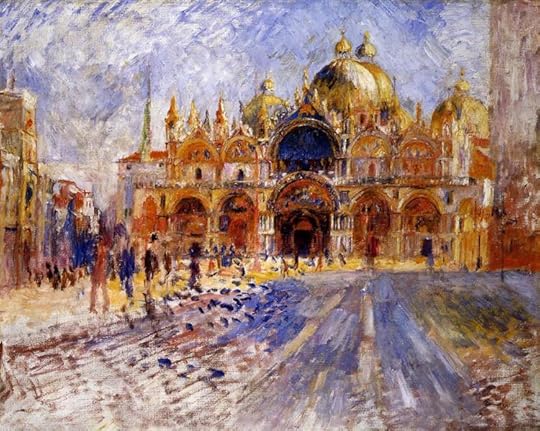
Pierre-Auguste Renoir, The Piazza San Marco
I hope I am wrong, but my impression is that Henry James might have been used as a kind of pretext to commemorate the Curtises. I do respect the fact that they have helped many famous people, Henry James included, but I would like to know in advance that more than half of the book is a tribute to them and their palace.
Henry James’ portrayal of Venice lived up to my expectations. Just imagine the combination of his exquisite style with the picturesqueness and the atmosphere of this unique city! No wonder he speaks of the inevitable 'ache of quitting Venice' afterwards. The clash of his 'inexorable Yankehood', as he put it, with Venice gave fascinating results. James often contrasts the calm of La Serenissima with England: 'that is the curse of London—it is the worst place in the world for reading.'.
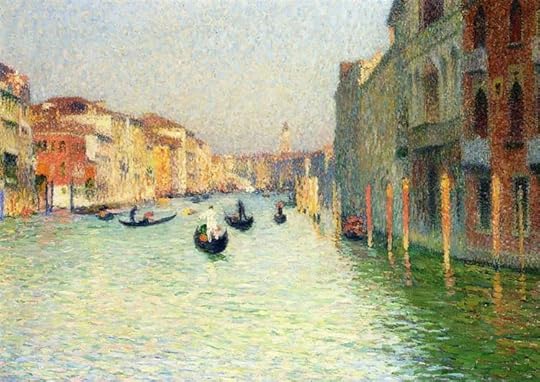
Henri Martin, Gondolas in Venice
You might be surprised to see how long and elaborate Henry James’ letters were, how much time and effort was put in them. In the SMS era, it is hard to believe. By the way, don’t you think it is weird: nowadays we own so many gadgets supposed to save time but in terms of interpersonal communication we seem to have much less of it anyway, compared to the epoch of Henry James and his contemporaries...
One episode of Henry James’ account of his stays in Venice turned out to be especially intriguing: his relationship with Constance Fenimore Woolson, an American writer. Despite the tragic ending, it was fascinating to see a different side of Henry James. He is quite vague about this friendship, by the way. As it seems, James is a good illustration of Arthur Symons' quote: 'A realist, in Venice, would become a romantic by mere faithfulness to what he saw before him.' More on Constance and Henry's complex relationship here.
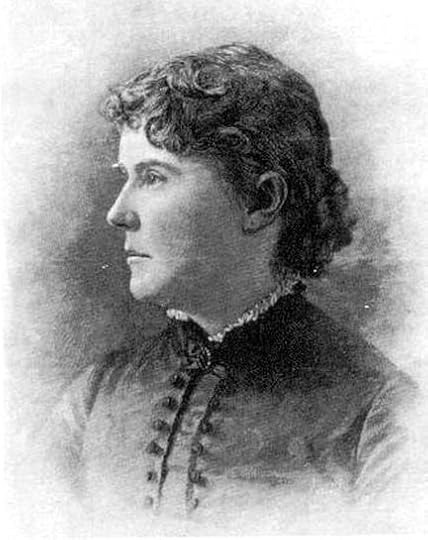
Constance Fenimore Woolson
Indulging in Henry James’ letters gave me a wider context and I do not mean only his books set in Venice (I loved The Aspern Papers!) but his works in general, his personality also. Nevertheless, the distance still exists. For me, Henry James is like a marble statue, basking in its perfectness. You admire it from afar but feel quite intimidated at the same time. And I think he prefers it to be like that.
Frankly speaking, I did not find the other parts of the book thrilling. The presentation of the Palazzo Barbaro, its history, the owners and temporary inhabitants could have been much more concise. However, my stay in Venice in Henry James’ company was unforgettable. 'If words were not so stupid and colorless, fratello mio, and sentences so interminable and chirography so difficult, I should like to treat you to a dozen pages more about this watery paradise.'
A book whose appeal depends on whether you are interested, in Venice, Palazzo Barbaro, or in Henry James. I wanted to read some letters concerning Venice, but in all honesty, the appeal was moderate.
Having just finished Colm Tóibín's novel about James, The Master, I determined to read some of James' work that I hadn't read before. So I was browsing at Powell's, and came across this little volume. I admit to being attracted by its physical beauty -- a small paperback with a heavy textured blue outer jacket, very simple typography, and a picture of Palazzo Ducale I by Roger de Montebello on a smooth paper.
Palazzo Barbaro was in James' day (and still was at the time of the publication of this book in 1997) the home of the expatriate American family, the Curtises, who were great patrons of the arts. They were painted by Sargent, and in their home Browning read his poems, and James finished writing The Aspern Papers.
These letters are primarily written by James but there are also some written by members of the Curtis family. James writes to the Curtis', to Isabella Steward Gardner, to Constance Woolson (and we see, in a later letter, the impact of her suicide on James and his view of Venice). The word "from" in the title is a bit misleading, as many are written from other parts of Italy, and a few from England and Switzerland. But to the extent that the Palazzo was a place in the heart, then the title is accurate.
The contrast between James' letters and the Curtis letters is revealing. The latter are pretty much the "today we did this" and "so-and-so's been to visit" type, while James' are full of gorgeous images and his usual insightful observations.
In addition to a foreword by Leon Edel (James' biographer), there is an introduction by Rosella Mamoli Zorzi, who has written extensively about the expatriate colony in Venice. There are end notes after each letter, but I do wish there had been more, as there are intriguing references in the letters to unexplained events (what did happen with Pen Browning's marriage? and what was Mrs. Ralph Curtis' "situation"?).
This lovely little volume provides a delightful glimpse into James' Italian world.
I don't read many collections of letters, so this was interesting. James's letters are here along with some from the Curtis family. James's were the most interesting; his writing style is colorful and fun to read. I wish I'd known to look at Palazzo Barbaro while I was in Venice. While any individual palazzo on the Grand Canal is beautiful, they tend to blur together unless there's a reason to pay more attention to one in particular. I read The Aspern Papers while I was reading this and the two together were interesting, as James mentions his fiction in the letters, and of course Venice is in the fiction.
I have to admit that it was the binding that first drew me to this book - there was a table of Pushkin Press books displayed at Daunt Books this past summer, and they caught my eye with how beautiful they all are. I settled on this one because of a long-standing fascination with Venice and a general enjoyment of reading historical figures' letters. This isn't the best collection I've read (that honour still stands with Van Gogh), but it was enjoyable and uncomplicated, with some lovely prose. I rather wish I'd've been able to get around to reading in the European sun somewhere while I was still over there, as I think this is one of those books that benefits from having a certain atmosphere. All the same, I enjoyed it, and I'd probably pick it up to dip into again.
Read as part of my Venice kick, this book is a enjoyable, small window into a particular time in the life of the Palazzo Barbaro, Henry James, and a few related friends. The size and lovely binding make it a good one to take along on a trip, as well.