Dans Les Cygnes sauvages, Kenneth White nous conte le récit d’un voyage qu’il effectua pour atteindre le nord rugueux et sauvage du Japon : Hokkaido, ses ports et ses montagnes. Dans un registre unique, alliant expérience physique, poésie dynamique, pensée vive, le texte rapide et à niveaux multiples de Kenneth White est plus qu’un livre de voyage, c’est un livre qui ouvre un espace de vie profond et intense.
Kenneth White was a Scottish poet, academic and writer. He spent his formative years in Fairlie in Ayrshire.
White obtained a double first in French and German from the University of Glasgow. From 1959 until 1963, he studied at the University of Paris, where he obtained a state doctorate. He purchased Gourgounel, an old farm in the Ardèche region of France, where he could spend the summers and autumns studying and working on what would become Letters from Gourgounel.
In 1963, White returned to the University of Glasgow, where he lectured in French literature until 1967. Then, disillusioned by the contemporary British literary and poetry scene, he resigned from the University and moved to the city of Pau, near the Pyrenees, in south-west France, where he lectured in English at the University of Bordeaux. He was expelled from the University after his involvement in the student protests of May 1968. After leaving the University of Bordeaux, White remained at Pau and lectured at the University of Paris VII from 1969 until 1983, when he left the Pyrenees for the north coast of Brittany, and a new position as the chair of 20th century poetics at Paris-Sorbonne.
In 1989, White founded the International Institute of Geopoetics to further promote research into the cross-cultural, transdisciplinary field of study which he had been developing during the previous decade.
White held honorary doctorates from the University of Glasgow, the University of Edinburgh and the Open University. He was an honorary member of the Royal Scottish Academy, and a visiting professor at Scotland's UHI Millennium Institute.
This is the first time that I’m venturing beyond Kenneth White’s poems and essays. ’The Wild Swans’ is one of his ‘waybooks’ in which he documents his geopoetic journeys, in this particular case to the north of Japan. It’s not a travel journal in the ordinary sense but a sediment from an episode of place-based intellectual nomadism. Or, in other words, a reflection of an attempt to establish an ‘intelligent contact’ with a particular habitat through movement, reflection, observation and articulation. "The nomadic intellectual travels through the history of cultures in search of energy centres and penetrates through the layers of time to the archaic. This is when the field of geopoetics begins to open up, which is the attempt to take culture back to its roots.” (quote translated from Le Lieu et la Parole: Entretiens 1987-1997). Hence the numerous references to Japanese lore and literature.
The booklet is slim and consists of about 30 very short chapters. The spirit that animates White’s ventures is that of the haiku, a distinctive form of Japanese poetry which marries extreme brevity to dense atmosphere. Probably, ‘haibun’ - a Japanese literary form that combines prose and haiku - was the model for White’s travelogue. It could explain why White adopted a very understated voice, somewhat elliptic, to narrate his journey. It contrasts with the vigour that speaks from his essays and poems. It doesn’t quite work for me. Something seems to be missing from this book. It’s too tame. I wish White had put a bit of Samurai spirit in it. A book in a similar vein - but more deeply questing, more existentially connected to the elements - is Werner Herzog’s Of Walking in Ice. I certainly recommend that.
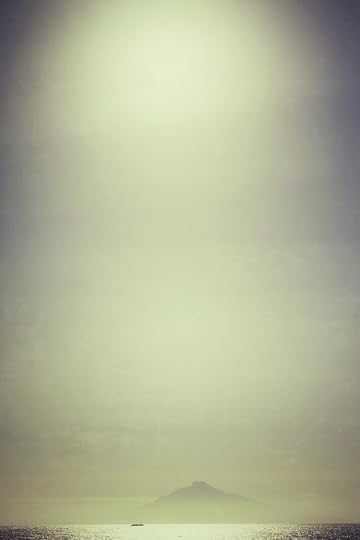
Rishiri Island, 2015. The very north of Japan. Not featured in White's book
C'est la première fois que je m'aventure au-delà des poèmes et essais de Kenneth White.’Les Cygnes Sauvages' est l'un de ses "carnets de route" dans lesquels il documente ses voyages géopoétiques, en l'occurrence dans le nord du Japon. Ce n'est pas un carnet de voyage au sens ordinaire du terme, mais un sédiment d'un épisode de nomadisme intellectuel basé sur un lieu. Ou, en d'autres termes, le reflet d'une tentative d'établir un "contact intelligent" avec un habitat particulier par le mouvement, la réflexion, l'observation et l'articulation. "L'intellectuel nomade traverse l'histoire des cultures à la récherche des foyers d'énergie et pénètre à travers les couches du temps jusque dans l'archaïque. C'est à ce moment-là que commence à s'ouvrir le champ de la géopoétique, qui est la tentative de reprendre la culture à la base." (citation de Le Lieu et la Parole: Entretiens 1987-1997). D'où les nombreuses références à la littérature et aux coutumes japonaises.
Le livret est mince et se compose d'une trentaine de chapitres très courts. L'esprit qui anime les aventures de White est celui du haïku, une forme particulière de poésie japonaise qui marie l'extrême brièveté à une atmosphère dense. Le "haïbun" - une forme littéraire japonaise qui combine prose et haïku - a probablement servi de modèle au récit de voyage de White. Cela pourrait expliquer pourquoi White a adopté une voix très discrète, quelque peu elliptique, pour raconter son voyage. Elle contraste avec la vigueur qui se dégage de ses essais et de ses poèmes. Cela ne fonctionne pas tout à fait pour moi. Quelque chose semble manquer à ce livre. Il est trop apprivoisé. J'aurais aimé que White y mette un peu d'esprit samouraï. Un livre dans la même veine - mais plus profondément en quête, plus existentiellement lié aux éléments - est le livre de Werner Herzog, Of Walking in Ice. Je le recommande vivement. (traduction Deepl.com)
3.5 This is my first geopoetic book, it took some time to get used to the style, but I like the simplicity and I think I prefer this type of books about travelling. Haiku parts were really beautiful. Still, it was hard to really emerge oneself into the travel story, I think some more editing would make this book excellent. Something different to read, at least, I think I would give a chance to more geopoetic books.