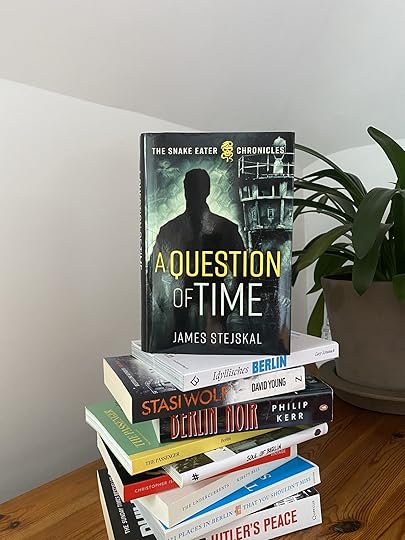
When the CIA's most valuable spy, MERLIN, is compromised, the Agency realizes it does not have the capability to bring him to safety. If he cannot evade the dreaded East German security service, the result will be chaos and a cascade of failures throughout the Agency's worldwide operations.
Master Sergeant Kim Becker lived through the hell of Vietnam as a member of the elite Studies and Operations Group. When he lost one of his best men in a pointless operation, he began to question his mission. Now, he is serving with an even more secretive Army Special Forces unit based in Berlin on the front line of the Cold War.
The CIA turns to Becker's team of unconventional warfare specialists to pull their bacon out of the fire. Becker and his men must devise a plan to get him out by whatever means possible. It's a race against time to prepare and execute the plan while, alone in East Berlin, MERLIN must avoid his nemesis and play for time inside the hostile secret service headquarters he has betrayed.
One question remains -- is the man worth the risk?
James Stejskal spent 35 years as a soldier and intelligence officer working in far off places with interesting people, which gives him inspiration for his writing.
As a novelist, he writes 'the Snake Eater Chronicles' tales of Cold War special operations and espionage carried out by an eclectic band of Green Berets.
He also is a military historian and author of "Special Forces Berlin" and "Masters of Mayhem," a study of Lawrence of Arabia and the inception of modern British unconventional warfare, a Military History Matters Silver Medal winner.
A chilling, tense and deeply poignant Cold War spy thriller! I haven’t read a Cold War espionage novel in a quite a while, preferring to focus more on military thrillers where the action is present day based, politically-twisted and the threat is crazy jihadists or smugglers, however when I read the intro for a Question of Time it immediately grabbed my attention. Offering an intoxicating blend of espionage, political treachery and outstanding military action, it immediately catapulted me back in time to 1979, when the Berlin Wall was still intact, and fear itself was a tangible, sentient entity that infested the lives of those in East Germany.
The author Mr Stejskal has an eye for absolute detail, and this book comes alive because of that. As a reader, you experience everything as if you were in the moment. The factual descriptions are so exact, and the story-telling so intricate and absorbing, you become instantly alert to changes in tempo within a scene, and you find yourself sensing, observing and interpreting, as if you were part of the team going on a mission. Unlike other military espionage thrillers books, which although super exciting, convey their main protagonists as being able to conduct feats that seem to go beyond human strength, Mr Stejskal’s heroes are grounded, strong and believable, and thus, are immediately accessible to the reader.
The story opens on a group of men accessing with supposed stealth, an apartment block to locate a person of interest. Just the initial interplay between Bruno Grossman and other inhabitants of the dour apartment block projects instant intimidation and underlines from the outset of the book - if there were ever any doubt in the reader’s mind - of the brutal power State Security, the Stasi, wielded over all East German people. Once the Stasi find the man, who had been acting as a ‘sub-agent or cut out’ for communications between their real target, the ‘traitor to the cause’ and a Western intelligence officer, he takes the option of being shot to death over capture and torture at the dreaded Bautzen prison. Such a decision, sets the tone for the book and without the need for explicit or graphic details, infers what destiny could await our brave heroes should their missions not have the positive results anticipated.
The main part of the story is an extraction operation of an high ranking Stasi officer and super spy for the West- Major General Max Fischer. For many years, via his team of cutouts, Fischer has supplied the CIA with key intelligence on foreign penetration operations run by the Stasi. In a twist of fate and bitter irony, Fischer’s activities are flagged up by a Russian penetration agent operating in West German intelligence agency BND. Although Fischer’s name does not come up singularly - there are other names warranting further investigation - just the fact that the type of intelligence transferred denotes only a small number of top Stasi officers could have had the requisite level of access to such material, and as a result, puts Fischer automatically at the top of the pile. Erich Mielke (Minister of State Security) authorizes surveillance on him, to gain the much needed evidence to arrest him. Once Fischer realizes surveillants are on his tail, he knows it’s just a ‘Question of Time’ as to when he will be caught.
There are many characters in the book, but all feel like they are real people; not caricatures or impressions of people from the author’s mind. It’s as if they’ve been ripped from intelligence reports so referenced throughout the book.
The main character, Master Sergeant Kimball ‘Kim’ Becker is an intriguing person, and personally, a character I warmed to immediately. He’s Spec Ops through and through, but he’s more than just a muscle-man action figure, following orders blindly. Becker is a man of principle, a natural leader who understands a mission is not about personal glory or gaining medals, but it’s about doing what’s right and bringing every one of his team home safe. His undeniable, quiet strength resonates throughout each page. He’s a deep thinker; a strategist playing several moves ahead, and although he has an immutable emotional resilience, there are slithers of cracks that show his inner vulnerability. For example, when Rohan, the girlfriend of Paul Stavros questions him whilst on an op together about whether he’s married, and whether his special operations life makes it hard to hold down a relationship, the reader sees he gently recalls a time, far away, long ago, in Monterey… Becker keeps everything compartmented, like a mission brief, but deep down within him, he harbors a pain so strong, even he is scared of it being released.
It’s clear that Specialist Sarah Rohan is a woman who is laden with a past filled with secrets and terrible agony of her escape from Czechoslovakia at the impressionable age of ten. The horrors she witnessed indelibly printed upon her young mind, but although haunted by her past, Rohan has not defined herself nor her future by it. Instead, she has used the experiences to engender resilience, compassion and courage. She’s a great character and I hope Mr Stejskal will bring her back in his next books. She has much story-mileage in her.
There is a deft way in which Mr Stejskal handles all the key characters backstories, weaving them seamlessly into trigger moments, making a reader surprised this is a debut novel. From Becker’s past missions where, despite all precautions and the best tradecraft and soldiering skills employed, lives were still lost, to that of General Grossman ‘head of counterintelligence in the Stasi’ known as ‘S’ and insights into his past, rounding up traitors, interrogating and killing them. Both time-drop windows into their lives demonstrate their true natures. A man who puts the lives of others ahead of his own, against a man who takes the lives of others to better his own.
The ‘snatch’ target Fischer is complex and cerebral. The superb crafting of his character makes it clear he once supported the ‘cause’, but as he rose further in the ranks, his commitment and belief began to waver. Fuelled by witnessing the blatant imbalance of an ideology claiming to spread the wealth and opportunity to all the people, when in fact that opportunity and chances of wealth were afforded to very few who held the power, Fischer flipped sides to spy for the West. Displays of wealth and dominance are never more pertinent than in the little descriptive nuances the author reflects in his prose. The poorly attired inhabitants of the bleak, falling apart tenements versus the Stasi’s Grossman - ‘a prosperous-looking man, portly in a long heavy woollen overcoat’. And yet the antagonists, the Stasi in the book scoff about ‘bourgeois freedoms’, but still seem to enjoy fine food, luxurious residences in areas away from the ‘people’ and vacationing in their countryside dachas. This is cruel hypocrisy writ large.
Marcus Wolf is another character who demands attention. He’s a Stasi officer, Head of Foreign Intelligence and Fischer’s boss. He’s a gentleman and a grand spymaster. He suffers Grossman whom he does not care for, and tolerates Minister Mielke, but it’s made apparent he sees his own work as the most critical to the success of East Germany. Like the master manipulator he portrayed in the book, Wolf didn’t come over as a brutally callous thug, like Grossman did. He had a debonair presence, aloof from Grossman and his dark activities. A consummate strategist and chess player, and someone for whom intelligence was as much about what was never said, as what was. A man who read constantly into everything and everyone, but who made decisions based on instinct. Wolf, for this reader, is a character with a wealth of backstory to be explored, and a mind to be plundered. I would certainly read a story with him as the main character!
As the plot plays out, with the key protagonists folding into the extraction mission, further tension is racked up by Grossman’s investigations, and his focus narrowing ever more on to his suspects, Fischer included. The last few chapters pelt at a rapid pace towards the finish line that is utterly atmospheric, tense and thrilling. If you want to be thrown back to time of Cold War spies, gray rain-slicked covert meetings in side alleys and hacking into telephone calls really meant having an induction loop antennae and transmitter hooked to physical cable, then you’ll find no better book to take you there, and I recommend Question of Time unreservedly
I’ve been wanting to read A Question of Time by James Stejskal, a member of the Spybrary community, and I am glad I finally did! I have to admit, I was a little afraid this was going to be a full-on military book, but this is 1979 Cold War espionage at its best!
A Question of Time starts off with an Berlin operation, led by East German State Security Bruno Großman that actually goes bust for the team as they mistakenly kill the operative they want to question. We then move to little bit of spying along the wall and giving us interesting insight into how the parties involved, the West and the East, interacted with each other. We quickly learn that another official high up in Stasi, Maximilian Fischer, is extremely concerned about being tracked and targeted as a spy for the West because—well, he is a spy for the West. Fischer’s an extremely valuable operative for the West that if he believes he has been targeted, the West will stand by their operative and do everything they can to extract him. This beginning has a bit more telling rather than showing and doing, but the story quickly picks up its pace, and once it does, it doesn’t slow down!
I’ve got to stop and say James Stejskal has clearly lived the life he writes about. He firmly and beautifully puts you on the streets of Berlin in 1980 the way Joseph Kanon puts his readers there in the 1940s and 50s. The U-Bahn and S-Bahn, the curry wurst, the streets and shops—I felt like I was walking the neighborhoods of Berlin again.
We quickly meet the team who is assigned to extract Oz, Fischer’s code name. The main character, Master Sergeant Kim Becker is a fully developed person, likeable and interesting. I trusted him, as in, if I were caught behind the lines, he’s the man I’d want coming to get me. Becker is an honorable man, a born leader. However, the interactions between Becker and Specialist Sarah Rohan at their first meeting seemed a bit forced as she asked him the questions the author wanted to reveal about Becker’s backstory. However, it became clear that just who she was and what she would do. Question, question, question. We know he is committed to bringing his men home. That was made clear early in his briefing. However, I wonder why we needed a short chapter that takes us from Berlin back to Vietnam. I understand that it was to show us who Kim Becker is as a man and as a soldier, and the operation cited left an impact on him and his planning for the current mission, but for the novel to leave Berlin and spend 10 pages in Vietnam slightly broke the flow of the Berlin story. The irony is in the fact that it was an engaging and interesting side bar, but it was necessary to place myself, as a reader, back in 1979 Berlin. In any event, Sarah Rohan has a past of her own, and plays well against Becker.
There was another point when I was wondering why we were pulled out of Berlin and placed in South Africa. “As Becker walked back to his team room, he mentally travelled back to a small room in one of the special warfare center buildings at Fort Bragg.” In this flashback scene, we are taken on an exciting mission with Becker to a nuclear test facility in the Kalahari Desert in South Africa. Again, my only problem with this 34-page scene was that it was so engrossing that I almost didn’t want to return to 1979 Berlin. I wanted to stay with this new cast of characters in the Kalahari Desert! All I can say is that I hope a future novel focuses on the South African adventure.
The ending—wow! Surprises left and right. We finally got our military action on an assisted operation, but it was a great fit. A full-on spy move, from the air. Personally, I’ve jumped out of C-130s, but I never heard of this kind of maneuver!
In conclusion, I’ll say damn you James Stejskal! Another series of books for me to buy!
A very solid 4.5 out of 5 My personal review ratings are based upon the following: 1 Star, “I did not like it or couldn’t finish it”; 2 Stars, “I think it is just Ok, but I’ll never think about it again”; 3 Stars, “I think it is an entertaining, enjoyable book, but it probably won’t warrant a reread”; 4 Stars, “I really love this book, and I may read it again”; 5 Stars, “I think this book is excellent, I will read it again, and it will likely stand the test of time.”
Former Special Forces soldier and CIA officer James Stejskal strikes gold with his first foray into fiction, A Question of Time. Set in the late 1970s, the central protagonists are Master Sergeant Kim Becker, the ODA team sergeant for an element of the secretive Special Forces Berlin detachment; and Max Fischer, a senior member of the Stasi's Main Reconnaissance Directorate and a tenured CIA asset. When the Stasi starts to close in on Fischer, Becker and his team are tasked with Fischer's extraction from draconian East Berlin. Success means doing right by the asset. Failure means the loss of a highly placed asset at best and turning the Cold War blazing hot at worst.
A Question of Time gets five stars from me because this appeals to the SOF/IC history nerd in me. Stejskal has walked the walk and he shows it with every page of this book. I was left wondering how much of this was fiction and how much of it was truth told through fiction. He does a fantastic job showing the trade of Special Forces Berlin (as well as highlighting what career life was like for a MACV-SOG guy who stayed in the Army post-Vietnam).
I also like how he weaved in bits of the German culture and food to help paint a picture for the reader. Definitely got me wanting to try German beer and currywurst!
I'm looking forward to the next edition of the Snake Eater Chronicles!
I read the author's nonfiction account of US Special Forces operations in Berlin during the Cold War with great interest, and was intrigued to now also see him put that insider knowledge to use in crafting a Cold War spy thriller around such an operation. That knowledge gives the setting a great feeling of authenticity that is too often lacking when the genre is tackled by outsiders. Stejskal knows his stuff, has come up with a gripping enough plot, and is, as the previous work of his I've read has shown, a good writer, too. What he is not, unfortunately, is a particularly good novelist, which requires a rather different skillset from that needed to write solid nonfiction. The detached writing style that is all telling and no showing works just fine for nonfiction, not so much for a novel. The characters have biographical data attached to them, but lack actual personalities. The dialogue feels often stilted, and any and all exposition reads like a textbook entry, while the insertion of random anecdotes, here recalled by characters for one reason or another at various points, might add interesting colour to a nonfiction book, but served no purpose other than interrupting the plot and clogging up the pace. That said, the story itself was enough incentive to keep me reading, and I might try another of his novels to see if the writing grows on me. If not, his other nonfiction works sound pretty interesting, too.
James Stejskal is an established non-fiction writer. I have read his previous works and was surprised to find this thriller.
Often, publishers put a comment on the jacket about how exciting the book is. In this case, it is no exaggeration. This book is hard to put down.
Set in Berlin in the late days of the Cold War, the story is filled with believable characters completing tasks that are very real. Readers will feel they are riding along with Special Forces operators on a mission in East Berlin that is critical to US intelligence. It is hard to put this book down as each chapter takes the reader deeper and deeper into the action.
This is more than a standard thriller. It is both an exciting read and a history lesson of the Cold War in Berlin.
James Stejskal’s debut espionage thriller takes place in 1979 in a divided Berlin. Located in the heart of then-Communist East Germany, Berlin was notoriously fertile territory for spies. In East Berlin and the country surrounding the city were the Soviets and the Stasi, East Germany’s repressive secret police. In West Berlin, some 180 kilometers behind the Iron Curtain, sat the Allies, with sectors of the city allocated to Britain, France, and the United States. Cold War tensions only intensified in this island of Western influence with the construction of the wall between east and west in 1961. By the time the novel begins, the written and unwritten rules governing the strange minuet between spies and diplomats have been largely formalized. One key practice is allowing “freedom of passage patrols” by the Western Allies and the Soviets to tour the other side’s occupied zones. By treaty, those patrols could not be stopped or searched. But what are rules for, except to be broken or at least bent? Chief rule-breaker here is Master Sergeant Kim Becker, a Vietnam veteran and now a member of the US army’s elite Studies and Operations Group. He has a team of creative and not-by-the-book operatives around him, and they receive a special assignment: A CIA asset, an East German high up in the Communist state’s security apparatus, believes he’s come under suspicion. He wants out. It’s up to Becker and his team to develop and implement a plan to extract him. Stejskal convincingly establishes the riskiness of the mission and its various ingenious stages, as well as the suspect-everyone mindset necessary for people living under such a difficult regime. He doesn’t spend a lot of time on literary flourishes and detailed description, but you will be turning pages too quickly to miss them. Despite the impressive number of contingencies Becker’s team is prepared for and their attention to espionage tradecraft, the unexpected still occurs. Even then, the rescuers aren’t victims of their plan, they have a powerful capacity to improvise. Modern warrior-hero stories are often either too far-fetched or too poorly written to recommend. In this one, though, the action is described with just enough detail to make it believable and not so much to bog the story down. The writing is clear and compelling and doesn’t get in the way of the telling. James Stejskal spent thirty-five years serving with the US Army Special Forces. After his military service, he was recruited by the CIA and served as a senior case officer in Africa, Europe, the Far East, and elsewhere. He is now a military historian who has written several nonfiction books. I’d definitely read another about Becker!
In James Stejskal’s realistic spy novel, A Question of Time, by the time I got to Chapter 3 (page 11), I was hooked. The book takes place in Berlin in 1979 and Stejskal takes you on a dangerous mission where his protagonist Kim Becker and his Special Forces team attempt to rescue an East Berlin case officer named Max Fischer, one of the CIA’s most important agents, in a bid to exfiltrate him to the West.
The book is full of spy tradecraft and is one of the best novels I’ve read that portrays what is involved in a real-life spy operation. Besides tidbits of history throughout, the book also offers some wise words.
“The act of recruiting a human being to do something that is against their laws and sense of decency can make the job unbearable for some. At the very least, it places a great strain on one’s conscience. For agents who can detach themselves from the emotion, espionage becomes a necessary fact for national survival. But the lies, the falseness of befriending someone just to ask them to risk their life, to betray their country: that slowly chews away at the soul.”
This page-turner book, the first in his Snake Eater Chronicles series, is a fast read. I highly recommend it.
At its core, James Stejskal's "A Question of Time" is a Cold War exfiltration story, sort of a later version (late 70s) of The Spy Who Came in from the Cold with a happier ending. Although Stejskal isn't a le Carre in the writing department, the story he weaves about the planning and execution of a mission to extract a high-value East German spy who had been compromised was superbly crafted.
Fischer, our East German spy, is at a very high level in espionage leadership. Disenchanted with the direction of his country, he decides to become a spy for the Americans. He successfully passes critical top secret information to his handler over a long period of time but a screw-up leads him to believe he's been compromised and must get across the wall before he ends up being tortured and killed by his own people. Becker, an experienced American operative, is given the task of getting Fischer out, but the timeline is very short and impediments such as "the Wall" are numerous. He assembles his team, a plan is developed, and although it wasn't 'smooth as silk' the project succeeded with some pretty amazing technology I didn't realize existed.
Stejskal does a great job keeping military-speak and jargon from interfering with the story. He's a highly experienced military/CIA guy who, I'm sure, could embed all sorts of arcane tech language in his novels but instead gives us just enough to lend credibility to the narrative. A Question of Time is a detailed, exciting look at how a successful mission was organized and completed by some very skilled folks. Loved it!
A Cold War thriller that focuses on the intricacies of one specific mission from start to end. The technical details behind the spycraft and the details of the setting do a great job of transporting you right into the story.
The mission, historical detail, and pacing carry the story, while the characters and their motives, feelings, and emotions are glossed over. This does not detract from the page-turning nature of the book; it works well as a procedural story rather than a character study. Consequently, when tension does build, the characters are not allowed to sit with it. The characters, as written, are all extremely competent at their jobs, so the story does fall into a documentary-style retelling at times, but everything is just about kept within the realms of believability.
In the end, the writing style is easy to follow, and the technical outlining serves as a bonus rather than something necessary to enjoy the book.
I really enjoyed reading this. I easily hopped into it and out of it. The book is easy to recommend to anyone who is a fan of military history, especially 20th-century military history, though it stops short of being a must-read for general fans of fiction.
The author brings his vast military experience and historical acumen to this novel. The book takes the reader back to divided Berlin, when spying activities were part of the fabric of the city and risk-taking was part of the Cold War experience.
A CIA officer working in East Berlin has seemingly been compromised and Kim Becker, Vietnam veteran and a member of a U.S crack team is tasked with extricating him in one piece. Their mission is to bring him out, but first they have to get across the Wall into East Berlin....
The author knows how to tell a story, one that seems well researched but I think there is a lot of 'telling' which is not really balanced by the 'showing', a lot of narrative that reads almost like a history book and consequently perhaps feels a little dry. It is nevertheless pacy and feels incredibly well researched and detailed and it will find its readership amongst those who like a snappy and taut tale of espionage and tactical handling.
I could not put this book down. Stejskal's debut novel is the definition of a page-turner, written by an author who clearly knows his stuff. As the East German security apparatus closes in on the traitor in its ranks, U.S. special forces engage in a race against time, flying blind on a perilous operation that may be completely for naught. Stejskal deftly takes us through the tradecraft of infiltrating the Iron Curtain, with a brisk pace that keeps the reader on edge and the outcome ever in doubt. Yet despite the book's suspense-driven narrative, Stejskal also takes pains to illuminate his numerous characters' backstories – and their motivations for doing the kind of thankless work that often went unrecognized during the Cold War. Fans of spy fiction and history will love this book, which illuminates another little-known corner of America's long struggle against the Communist Bloc.
I’ve read a lot of Cold War espionage books focusing on Germany and this is one of the best. It had my attention from the start and was hard to put down. For some reason the author found it necessary to have flashbacks to Viet Nam. I found that to be a distraction. The author demonstrated great tradecraft insight and was largely believable. His descriptions of East Berlin echoed my experience during visits to that dismal city. I think he painted a great picture of the challenges that East Berliners faced as well as the inner workings of the oppressive Stasi and Volkspolizei. This was a great read and I was sorry to see it end.
Ok - ish. I found the whole first half of the book a bit mixed, jumping around and not really enough development of the plot more about the background of the characters but at this point I still wasn't sure who the lead character was. Second half felt better but really I found it a chore to get to the end. Just started the second book to see if things get better because the author has a good rep. The problem is, now I've written this review, it's put me off reading the next!!
I'll leave it a while and see if it draws me back!
I needed to reference a map a few times and went down rabbit holes to remember the history of who, what, where; but nonetheless I need this made into a movie.
The number of times I caught myself holding my breath or on the edge of my office chair is an indicator of how wrapped up one gets in this novel, and I look forward to the rest of Stejskal's series.
I'll have a cigar and bottle of Basil Hayden ready for the next one.
I've just finished A Question Of Time and I'm wanting more of Kim Becker! James Stejskal has a talent for Cold War fiction that is riveting, yet rooted in reality. His portrayal of SF operators is finessed and refreshing. I literally could not put this book down. He even used vernacular that my Pop used when he was in the military and it screwed down for me how down to earth these people were with extraordinary jobs to perform. I'm looking forward to the next 2 missions!!
The period (late 1970s in Eastern Germany, mostly) is rendered very well - pity that it serves as a backdrop to a not quite preposessing story, one additionally banged about by indifferent formatting and numerous spelling errors. Couple days' work could improve this book a lot - "A Question of Time", yes indeed.
First of all, having served in the Army in Germany during the Cold War (and I visited East Berlin), I was thrilled with the accuracy of A Question Of Time in regards to the setting. But I was also captivated by a superb plot with this spy thriller. Stejskal definitely has a place within the military spy genre and I can’t wait to read the next of the Snake Eater Chronicles!! 5 we’ll deserved stars! Bravo!
Finally, a great military thriller that I don’t have to put down because it gets so many easily-researched facts wrong. I was in Germany in 1979, and Stejskal captures the atmospherics perfectly. Great plot, great pacing, authentic character development. Look forward to reading more by him.
Read James Stejskal if you enjoy military/spy thrillers. Berlin, 1979, Master Sergeant Kim Becker and his covert team try do the impossible...what a fantastic ride this book was. Full of old school spy tradecraft that I had to wonder if it was fact or fiction. The 1st book of the Snake Eaters Chronicles and definitely worth reading ...I Highly Recommend the series!!
very interesting details about life in the DDR. It was clearly well researched. The book was a bit too miliaristic for me, and a little too light on plot. I didnt really care too much about the details of the machines and guns used!!!!! but all in all, a good read.
Stejskal writes what he knows, and it shows. The tradecraft, the Berlin setting, the quiet desperation of men operating in the shadows, all of it feels real because it is. Kim Becker is a protagonist you trust because his creator earned that trust in the field.
Fast moving, very plausible tale of the exfiltration of an East German double spy. A mash up of Cold War espionage and Mission Impossible. Great stuff!
While not a review copy per se, I did receive a signed copy of A QUESTION OF TIME from the author through a social media giveaway. However, I purchased a copy on Kindle to make the reading easier on my senior eyesight, and enjoyed it and it's first sequel enough to happily offer a very positive review.
Feeling as much historical fiction with a bit of "secret history" as political thriller, A QUESTION OF TIME, first in the Snake Eater Chronicles (currently at three books in the series) takes us back to Cold War Berlin, a setting I haven't sought out much in recent years, leaning more toward modern depictions of covert warfare.
In A QUESTION OF TIME Stejskal introduces a unique irregular warfare outfit tasked with extracting a high level Stasi informer from walled off East Berlin.
Master Sergeant Kim Becker leads the covert unit, and serves as co-mc along with Major General Max Fischer, the Stasi figure he must find and bring back to the West.
Becker's military past is a mixed bag. Stejskal details a handful of missions throughout his career that suffered greatly from the old adage "No plan survives contact with the enemy". It's not uncommon in warfare for objectives to be met - technically - yet a real or imagined sense of failure dominates the memories of surviving participants. War is messy, after all. These episodes ratchet up the tension of Kimball's Berlin mission as he worries over past failures, fearing a left hook out of nowhere will once again mar a successful mission and etch another black mark on his career.
General Fischer, long estranged from the communist principles his colleagues and superiors hide behind to remain in power while their citizens languish in poverty, has agents in place assisting his efforts to pass information to the CIA but has, despite much care, aroused suspicions among his colleagues and superiors. This unfortunately cuts him off from risky contacts, and once he signals his handlers he's left alone to prepare for whatever plans they make to get him out of East Berlin safely.
While Becker and Fischer are the two personalities we see most, Stejskal's smooth use of omniscient narration takes us into the thoughts of many other characters to provide color, highlight the actions and insights of personalities on both sides, and occasionally ramp up suspense as the Soviet Bloc officials begin to suspect Fischer's treason and move to head off his impending escape, making the extraction mission especially tough for both Fischer and Becker.
A Question of Time is also one of the few depictions of irregular warfare to feature a significant part for a woman, who surprises Becker by proving a professional with an interest in furthering her covert career later.
While I have Mr Stejskal to thank for A QUESTION OF TIME, I've already picked up APPOINTMENT IN TEHRAN, next in the Snake Eater series, on my own and plan to continue with the third and most recent entry as well. Safe to say I'm hooked on Stejskal's series.
Comparisons for any book are always difficult for me, as I find most authors and stories unique enough to discount the usual comparisons. But I think A QUESTION OF TIME will definitely resonate with fans of Tom Clancy. In fact, the book I thought of most while reading QUESTION was Clancy's final collaboration with Mark Greaney, COMMAND AUTHORITY. If you liked that, and Greaney's work in general, you'll probably like both A QUESTION OF TIME and it's sequel, APPOINTMENT IN TEHRAN as well.