Every once in a while, a book is so special, I get verklempt in my attempt to review it.
This was the unlikeliest contribution to my 1970s project, not because I don't love poetry, but because my middle child randomly checked it out of her school library and brought it home for her own reading pleasure. It was not a part of my original project, but when I saw her holding this book, and then saw the publication date of 1973, I did a little happy dance in my kitchen.
When my daughter was obliged to return her library copy, I searched for this out-of-print collection and found a copy, easily, at thriftbooks.
I read a lot of poetry (I write a lot, too), but I rarely read anthologies. I typically prefer collections from individual poets and I generally avoid “complete works” of poets, too.
But this anthology was so different for me. It felt alive.
If you are a poet, a poetry lover, an historian, a sociologist, a person of color, or some combination of any of these things, I think you will find that this work, that encompasses 100 years of the evolution of Black poetry in America, to be among the most moving and the most dynamic compilations of poetry of all time.
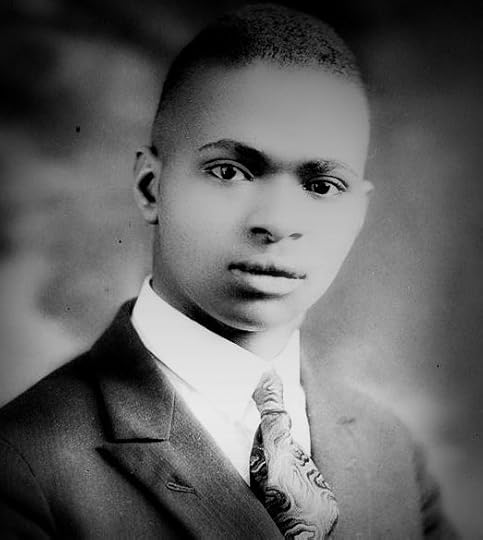
The collection begins with the work of W.E.B. Du Bois, who was born in 1868, and concludes with the work of Julianne Perry, who was born in 1952.
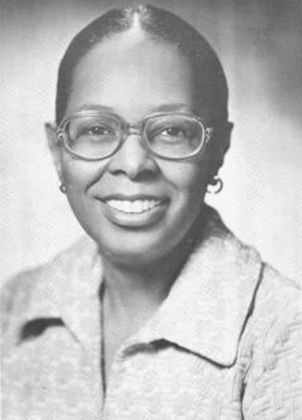
In between, you will find poets whose names you did not know, scattered throughout the bigger names: Paul Laurence Dunbar, Countee Cullen, Gwendolyn Brooks, Langston Hughes, Nikki Giovanni, and Alice Walker.
I found several of my past favorites and discovered so many new ones. I rejoiced with the early Black poets, recognizing their joy and confusion at their recent emancipation, then suffered with the impoverished poets at the turn of the last century, realizing how poverty, mixed with their devotion to their art, resulted in too many of their untimely deaths. I recognized the influence of jazz and beat as I walked with these poets in the 1920s and 1930s and became highly amused to witness what happened to punctuation. Then, as the late 1950s approached, I saw a complete shift in the emotional tone of the poems as the new poets mirrored the confusion of a dream deferred and reflected a people who were still living in abject poverty with limited rights. And then: political poems representing the anger and the upheaval so present in the 1960s, with the demand for civil rights and change.
I showed up for the poetry, and I wasn't disappointed, but I also found history, sociology, spirituality, and love.
I ate it up, every freaking page, and I will leave you with four very different poems, on four very different topics, to give you an idea of how diverse and multilayered this collection is.
Incident
Once riding in old Baltimore, Heart-filled, head-filled with glee, I saw a Baltimorean Keep looking straight at me.
Now I was eight and very small, and he was no whit bigger, And so I smiled, but he poked out His tongue, and called me, “Nigger.”
I saw the whole of Baltimore From May until December; Of all the things that happened there That's all that I remember. --Countee Cullen
Man White, Brown Girl and All That Jazz (Upon the Occasion of his Marriage)
It is essential I remember ours was a fair exchange. We were a happy consequence to paths of darkness in a world no less terrible or strange for all our years of toiling through it.
I valued you for what I took. That burning in you bright illumined our collision; your phosphorescence still must be reckoned with when night heretic with your memory trespasses.
God knows we were; though such love did not a kingdom come to us, each the other's wood of destiny has lit. You found your clearing; I fathom mine. We have had the best of it. --Gloria C. Oden
Coal
Some words are open like a diamond on glass windows singing out within the crash of passing sun Then there are words like stapled wagers in a perforated book—buy and sign and tear apart-- and come whatever wills all chances the stub remains an ill-pulled tooth with a ragged edge. Some words live in my throat breeding like adders. Others know sun seeking like gypsies over my tongue to explode through my lips like young sparrows bursting from shell. Some words bedevil me.
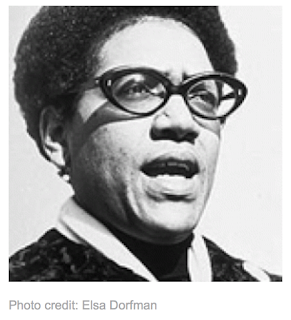
Love is a word another kind of open-- as a diamond comes into a knot of flame --Audre Lorde
Assassination
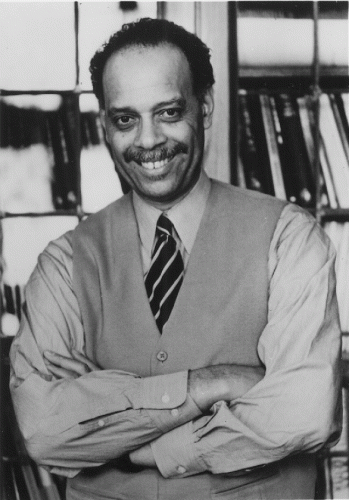
it was wild. the bullet hit high. (the throat-neck) & from everywhere: the motel, from under bushes and cars, from around corners and across streets, out of the garbage cans and from rat holes in the earth they came running. with guns drawn they came running toward the King-- all of them fast and sure-- as if the King was going to fire back. they came running, fast and sure, in the wrong direction. --Don L. Lee
Excellent selection of African American poetry from the first 70 years of the 20th century. Included many voices I have never heard before.
The volume I read, and now own, came from a library that was about to discard it because the book had been beaten up too badly to repair, from having been heavily read over the past 40 plus years. This fact made me feel good.
Fine old collection featuring earlier work by some big names like Lucille Clifton and Michael S Harper along with poetry by forgotten or simply lesser-known writers.
This Anthology is poetry from African American writers throughout history. Me personally, I loved this book due to many reasons; but one of them was my interest and passion for poetry. The other reason was learning and experiencing history and culture from a different perspective in which this Anthology does. I would most definitely recommend this book to anyone who is interested in phenomenal poetry and wants to take a trip back in time to witness a unique setting in time.