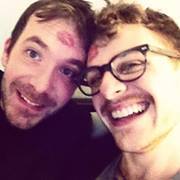
Karl Tierney was born in Westfield, Massachusetts, in 1956 and grew up in Connecticut and Louisiana. He became an Eagle Scout in 1973. Poetry fascinated him, even as a teenager. He received a Bachelor’s Degree in English from Emory University in 1980 and an MFA in Creative Writing from the University of Arkansas in 1983. That same year, he moved to San Francisco, where he dedicated himself to poetry. He was twice a finalist for the Walt Whitman Award, a finalist for the National Poetry Series, and a 1992 fellow at Yaddo. Though unpublished in book form during his lifetime, his poems appeared in many of the best literary magazines of the period, including the Berkeley Poetry Review, American Poetry Review, and Exquisite Corpse. He published more than 50 poems in magazines and anthologies before his death. In December of 1994 he became sick with AIDS and took his own life in October of 1995 by jumping from the Golden Gate Bridge. He was 39 years old.
The book that Karl Tierney didn't live to see has now been published nearly a quarter century after his tragic death. HAVE YOU SEEN THIS MAN? is a witty, biting, well-crafted time machine to another era and a reminder of the talent and promise of a generation of artists taken from us too soon by HIV/AIDS.
HAVE YOU SEEN THIS MAN? is the second title in the Arkansas Queer Poet Series as published by Sibling Rivalry Press.
I'm biased on this one, but let me tell you the story.
One morning last summer, I grabbed a book to read with my coffee. By chance, in the stacks and stacks of books in our home, I'd picked up a seven-year-old issue of Court Green, the literary journal based in Chicago. I was flipping through, and I wondered, almost out loud, if anyone ever gets a full-length book published simply on the strength of being in a single journal. It was an odd thought to have and jarred me in its randomness and the strength behind the thought. Now I realize it felt more like a whisper or a nudge than a thought. A second—really a second—later, I forgot my question when I saw a poem with "Arkansas" in the title, which of course grabbed my attention as I am from Arkansas:.
Here's the poem I saw.
Arkansas Landscape: Wish You Were Here
It’s windy outside, and red-nosed boys from the hills walk free from sin-shod shoes through the collegetown mall. Everywhere there’s hair blowing (brown mostly) and the bushes huddle together animated in conversations about the sea, what it might be. They gather that it’s full of weeds and smells. Here and there those long skirts fly, and the loud of car radios presses through the blows. It’s Wednesday outside, which is, of course, wonderful and the secrets of the world are unraveling here.
The poem was dated August 27, 1987. I didn't know the poet, whose name was Karl Tierney. I wondered what his Arkansas connection was and turned to his bio, which revealed he struggled with depression and committed suicide in the 90s. He lived in Fayetteville, Arkansas, and graduated from the University of Arkansas MFA program before moving to San Francisco. He was twice a finalist for the Walt Whitman Award, a finalist for the National Poetry Series, and a Yaddo fellow, but he never published a full-length book. The bio also said that a full-length was available to be considered if a publisher contacted the executor of his literary estate. To my surprise, the executor of his literary estate was a poet I'd published in my own literary journal: Jim Cory.
I reached out, knowing this issue of Court Green was published nearly a decade before I held it in my hands that morning. What were the odds the book was still available?
Two hours later, with Karl Tierney's manuscript in my hands, I knew I'd publish it. I fell in love, with the poems and the poet. The book comes out in October of this year, and Karl's mother, Karline, now in her 90s, has lived to see it, 24 years after her son ended his life. We already were able to get galleys into her hands.
Karl learned he had full-blown AIDS in San Francisco, and he'd watched his friends die one by one. He'd applied for a trial drug that would have saved his life. He'd been told he wasn't selected. When he received that message, he rode his bike to the Golden Gate and jumped. When his suicide note was found weeks later in his apartment, there was also a message on his answering machine. The rejection from the study had been in error, and he'd been accepted.
I feel like this book has landed in my hands for a reason, and on my shoulders for a reason. I feel a great responsibility to Karl's work and a great responsibility to writers lost to AIDS. Already, simply by getting this book in people’s hands, I call it a success. Let me introduce you to Karl Tierney.
I read the essay on Karl Tierney on the Poetry Foundation website. I was intrigued with the lines I read so I bought the book from the publisher. Two days later, the book arrived. It took me around 2 hours to do my first read through and I love the collection. My favorite is "You Remind Me A Little of Napolean." Definitely worth a read, but I would recommend reading the essay on Poetry Foundation first and go from there.
In reading “Have You Seen This Man?” I kept hearing a whisper; The human spirit will leap when it has gone missing. In the crack between taking issues head on and the interpretative meanings within Karl’s poetry, I became to know this whispering truth. I saw Karl’s story, my story, our story. The story of being human is to live a life where the pure heart of humanity unconditionally and enthusiastically bears witness to the alls of us. In a time when it seems the world has (again) forgotten this, we all need to meet Karl (ourselves) once again.
Hokis; former HIV community educator, now poet & senior editor, Headline Poetry
This piece aired worldwide this week on This Way Out (TWO), the syndicated LGBT radio show.
(TWO is the first international LGBTQ radio news magazine.)
When I began reading Have You Seen This Man? The Castro Poems of Karl Tierney (2019 Sibling Rivalry Press), I thought the poems of Karl Tierney might be tragic, but instead found them tragically funny – in a way that often makes the soul snicker. I thought the poetry might be tragic because they were brought to us by tragic circumstances. The editor was friend and literary executor of the author Karl Tierney who in 1994 became sick with AIDs and took his own life in 1995 when he was 39-years old. The editor, Jim Cory, is a noted poet and essayist in his own right.
Tierney never had a book published during his lifetime, but his poems were published in auspicious places such as the American Poetry Review and Exquisite Corpse.
Karl Tierney as a poet also had his serious side. In the poem “Gertrude Stein to Alice B. Toklas,” he adopts Gertrude’s voice and writes in part of the poem:
Our car is …beautiful and blue and we are beautiful and not blue and we are fast driving and do not feel a bit dangerous or dirty. We have the radio on…
In his poems about gay life in San Francisco where he lived, Karl turned his keen poetic observations on life around him. In “Adonis At The Swimming Pool,” Karl starts with: “Who dances his thighs across the pool’s water, spread on a mattress bloated from his breath. Whose ripe-with-sun skin cuts through the spray With the alingual grace of a kiss to my brow.”…. And ends with: “Whose wet curls stroke the evening’s earliest gasp into naughty tones and murmurs of lust. Who would have me discussed in seedy cafés and ruin me since I’m deaf to this hiss behind the teeth in that insipid smile.”
From Tierney’s take on “lipstick lesbians,” MacDonna, and gay life in the Castro at a certain point in time, I found Have You Seen This Man? The Castro Poems of Karl Tierney (from Sibling Rivalry Press) to be a page-turner of a good read.
Many of the seventy-four poems in Have You Seen This Man? The Castro Poems of Karl Tierney, edited by Jim Cory, teem with scathing criticisms of gay men and their culture. In his introduction to Have You Seen This Man? Jim Cory shows how Karl Tierney was influenced in his poetry by Catullus, the ancient Roman poet. As with Catullus’s poetry, no one and no thing is exempt from Tierney’s witty and sarcastic and sometimes just downright bitchy take-downs. Jim Cory gives Tierney’s poem “Whore” as a prime example of how Tierney uncannily channels Catullus.
I was devastated by the disappointment and sadness expressed in Tierney’s poems. Tierney found out that looking for love in the Castro, the supposed promised land of gay life, was not what it was cracked up to be. I don’t think Tierney was disillusioned, but he never, unless I missed it, gives us a poem about the joy of waking up next to a lover on a sunny morning or a poem celebrating the beauty of young men walking by on the street. Tierney arrived in San Francisco in 1983 just as AIDS was taking off. He gives us some of the most wrenching poetry about gay life, as he viewed it and experienced it, that I’ve ever read.
Following are several lines from Karl Tierney’s poems which I like, probably because humor peeks out between the words:
Half of beauty consists of a catchy walk and sincere smile” (“Act of God” May 18, 1992)
The rest of us, kids in a candy store, / / are essentially nincompoops at the core.” (A Social Creature” May 15, 1993)
Still, isn’t leaving your sexual fantasies on answering machines these days more desperate that the traditional lavatory wall?” (“Café Hairdo” March 16, 1991)
I can’t resist this quote:
A good Christian takes to all of humanity As brethren, then changes the sheets.” (“Bed Making” December 1, 1991).
A good example of Tierney’s Catullus-like writing is his poem “The Steam Room” January 8, 1994, in which he likens the denizens of the Y to various kinds of amphibians and reptiles:
Pockmarked crocodilians thrive on Pollyana looks
and
Oh San Francisco, I love you for being so cosmopolitan even the caecilians visit your Y’s!”
Karl Tierney refrains from being personal about his battle with AIDS. He doesn’t describe in detail his illness. He doesn’t give us excruciating accounts of his visits to doctors and his sojourns in hospitals. AIDS is most certainly there in his poetry, but more implicitly than explicitly. He expresses the tragedy of AIDS in mood and tone. Tierney hardly ever uses the word “AIDS,” but it’s there. It even lurks in his sarcasm:
The fool you met last night, when a risky wind pushed you into his orbit, has gathered his seedy self from your bed.” (“Summer Solstice” March 4, 1988).
In the following lines, Tierney touchingly describes going out after a lover has died:
Tonight you put on your best leather, Go out in a mantle of masculinity. You only know old habits. Who can say they’re bad ones?” (“After His Death” February 16, 1992).
In several poems, Tierney doesn’t shy away from the political. In “Easter 1981” May 31, 1993, he writes:
Ronald Reagan wishes Happy Easter, a Significantly Diminished Passover.
Tierney continues with these absolutely chilling lines:
I think of long freight trains that circumvent the city, a boxcar with my name on it, work that will soon set me free.
In “A Social Creature” May 15, 1993, Tierney uses the phrase Arbeit macht frei:
Don’t be arch, you might become aloof when really you desired to lick a Nazi’s boot, an endeavor in revival today as ‘safe’ sex. Unleash yourself to slavery and health! Arbeit macht frei, and the air is good.
As can be seen from the lines just quoted, Tierney can be dark as hell when the occasion warrants.
The poem, “Caligula or Nixon Leaving” June 23, 1993, although written over twenty-five years ago, evokes TFG. Read it and see if you agree with me.
Who were the dedicatees of Tierney’s poems? What roles did they play in his life?
After Tierney was diagnosed with AIDS in 1994, he was rejected for an experimental study. In 1995, his bicycle was found on the Golden Gate Bridge. His body was never recovered. Ironically, a message was left on his answering machine that said that there had been a mistake, that he was eligible for the study. Tierney was 39 at the time of his death.
Karl Tierney’s poems can withstand many re-readings. They take my breath away. Jim Cory and Sibling Rivalry Press have done a great service by collecting Karl Tierney’s poetry and bringing it to the attention of the world.
stumbled on this book pretty much by accident, and really enjoyed it. So many of these poems I read three times or more. Witty, charming, cutting. What a talent.