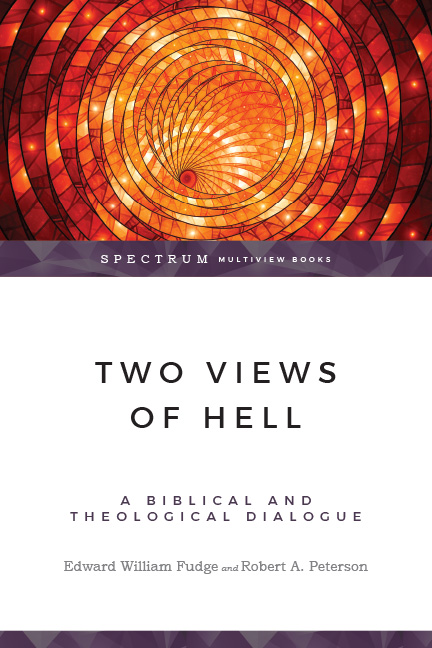
AN EXCELLENT WRITTEN DIALOGUE CONTRASTING HELL AND “CONDITIONAL IMMORTALITY”
Edward William Fudge (born 1944) is a theologian and lawyer (and former Church of Christ minister), who has written books such as 'The Fire That Consumes: A Biblical and Historical Study of the Doctrine of Final Punishment,' 'The Divine Rescue: The Gripping Drama of a Lost World and of the Creator Who Will Not Let It Go,' 'Hell: A Final Word,' etc.; Fudge is also the subject of the 2012 independent film 'Hell & Mr. Fudge.'
Robert A. Peterson is professor of Systematic Theology at Covenant Theological Seminary; he has also written books such as 'Hell on Trial: The Case for Eternal Punishment,' 'Salvation Accomplished by the Son: The Work of Christ,' 'Why I Am Not an Arminian,' 'Election and Free Will: God's Gracious Choice and Our Responsibility,' etc.
The authors state in the Introduction to this 2000 book, “We want to bring the debate into sharper focus by stating what is NOT the focus of this book. The debate is not over universalism, the view that all people will ultimately be saved… we reject [universalism] as contradicting the teaching of Scripture… Another topic that is not a subject of debate in this book is that of postmortem evangelism, the idea that persons have an opportunity after death to believe the gospel of Christ… We also agree that the Bible’s general picture of the end includes the second coming of Christ, the resurrection of the dead and the Last Judgment, followed by terrible suffering for the lost. We disagree, however, as to the nature of the eternal punishment of which Scripture speaks.”
The book begins with a 60-page presentation by Fudge, followed by a 30-page response by Peterson; they Peterson makes his presentation, and Fudge responds.
Fudge states, “Some writers have suggested that Sheol was a place of punishment for sin. The translators of the King James Version contributed to this misunderstanding by rendering Sheol as ‘hell.’ However, such faithful saints as Jacob, David, and Job all expected to go to Sheol when they died (Gen 37:35; Ps. 49:15; Job 14:13). Most importantly, Jesus Christ himself went to Sheol (Greek ‘Hades’) upon his death (Acts 2:27, 31).” (Pg. 23)
He asserts, “The writers of Scripture do emphasize the thoroughness of Sodom’s destruction. On the day after it was destroyed, Abraham went out to view the scene. Where once a bustling city had stood he saw only ‘dense smoke arising from the land, like smoke from a furnace’ (Gen 19:28). God had executed his judgment, and no sound was heard in its wake. The sinners were all gone. The silence was unbroken. Throughout Scripture from this point rising smoke symbolizes complete destruction (Is 34:10, Rev 14:11, 19:3).” (Pg. 28)
He argues, “Few serous interpreters attempt to take the details of the story [of the rich man and Lazarus in Luke 16:19-31] literally. To do so would require us to imagine the saved and the lost conversing with each other after death, in full view of each other and at close range. We also would have to think of literal tongues that burn with literal fire and literal water that does not cool them, not to mention physical bodies that can be tortured by fire but which somehow do not burn up. Even if this story were historical narrative… the parable… still would tell us absolutely nothing about the FINAL destiny of the damned. We should not misuse this parable by trying to make it teach the traditional doctrine of unending conscious torment. That notion is simply not there.” (Pg. 41)
He observes, “John 3:16, perhaps the most-memorized verse among evangelicals, contrasts the final alternatives beyond this present life. Some people will enjoy ‘eternal life’ but others will ‘perish.’ We ought to take these words at face value. There is no scriptural reason to explain them in any other way.” (Pg. 51) Of the “blasphemy against the Holy Spirit” [Mk 3:29], he suggests, “The ‘eternal sin’ is not a sin committed forever… Because this sin will never be forgiven, its CONSEQUENCES last forever. It is ‘eternal’ in its results... the outcome is everlasting, not the process. God will not be forever saving or judging or redeeming or punishing or destroying. He accomplishes each activity, then stops. But the results of each activity last forever.” (Pg. 51) Later, he adds, “Throughout the New Testament, ‘destruction’ is the opposite of being ‘saved.’ There is no reason to think of unending conscious torment.” (Pg. 67)
He says of 2 Peter 2:4, “Whatever one makes out of this passage and the angels in Tartarus, it adds nothing to our understanding of the final doom of human sinners, because it concerns angels, not people, and because it speaks of detention before the judgment rather than punishment following the judgment.” (Pg. 70)
He suggests about Revelation 14:9-11, “Some people have interpreted these expressions as if they require us to imagine the lost suffering endless in conscious agony. That is a possible interpretation---if we ignore how the Bible itself uses the same language elsewhere… this passage … provides us with an outstanding opportunity to let the Bible interpret itself rather than importing meaning into its symbolic language…” (Pg. 75)
He states, “In John’s visions in Revelation, two characters called the beast and the false prophet are thrown into the lake of fire (Rev 19:20; 20:10)… Whether we understand them to be specific persons or impersonal forces, the fate of the beast and false prophet does not define the final destiny of wicked human beings… sound biblical interpretation requires us to explain the mysterious sayings of Scripture in light of its many plain statements, and not the other way around. Revelation 20:7-10 seems to be the strongest biblical picture supporting the traditional view of unending conscious torment…” (Pg. 78)
Peterson states, “I agree that New Testament writers commonly use the vocabulary of destruction to refer to the final fate of the wicked. But I do not agree with Fudge that these passages teach annihilationism… It is not necessary … to interpret the New Testament vocabulary of destruction literally as teaching annihilationism. Rather, it is possible to understand it figuratively as teaching traditionalism.” (Pg. 94)
He argues, “the word ‘destruction’ cannot bear Fudge’s meaning in Revelation 17:8, 11. There ‘destruction’ is prophesied for ‘the beast.’ … Furthermore, John teaches that the beast, the false prophet and Satan ‘will be tormented day and night for ever and ever’ (Rev 20:10). The beast’s ‘destruction,’ therefore, is not annihilation for eternal punishment!... The Bible … does not teach annihilation at all. It does use the vocabulary of destruction, and it would be POSSIBLE to read annihilationism into many passages that simply mention ‘death,’ ‘being destroyed’ and the like. Nonetheless, we ought not to do so, because other passages---even other passages using the vocabulary of destruction---are incompatible with annihilationism.” (Pg. 95)
He points out, “Matthew 25:41 records Jesus’ teaching that unsaved human beings will suffer the same fate as the devil and his angels. This text prompts the question: Does the Bible indicate what that fate will be? It does, in Revelation 20:10. There we read that ‘the devil’ … ‘will be tormented day and night for ever and ever.’ … The conclusion is irresistible. Unsaved human beings also will suffer conscious torment… But fudge employs a strategy of avoidance and skips this crucial verse.” (Pg. 107)
He explains, “Along with the majority of evangelical interpreters, I understand hellfire figuratively rather than literally. It was not Jesus’ intention to teach concerning the chemistry of hell. Instead, he sought to alert us of its terrible eternal reality that we might believe in him and be saved. No one interprets all the biblical pictures of hell literally. Jesus speaks of hypocrites’ being ‘cut to pieces’ before being cast into hell (Mt 24:51). Should we understand that the resurrected wicked will be drawn and quartered? Of course not. Rather, God employs images taken from our earthly life to teach us about the pains of hell.” (Pg. 147)
Fudge says of Revelation 14:9-11, “If this passage is talking about hell, it is one of only two texts in the whole Bible that makes hell sound anything like the traditionalist description of it. (The other passage is Revelation 20:10.) … Examined phrase by phrase, even Revelation 14:9-11 is consistent with conditionalism. Even if I could not explain this passage, however, we would be wrong to build a doctrine on it that flies squarely in the face of dozens of plain passages of Scripture from both the Old and the New Testament.” (Pg. 200-201)
This is an excellent, detailed, and cordial exchange of views; and the two participants have adequate space to deal with each other’s arguments in their own “responses.” This book will be “must reading” for anyone seriously studying the doctrines of Conditional Immortality/Annihilationism or Hell.