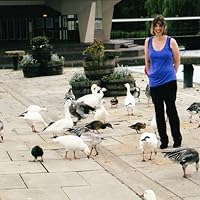
Конрад Лоренц (1903-1989 ) хорошо известен во всем мире тем, кто любит животных и интересуется загадками их поведения. Его по праву считают основателем науки о поведении животных - этологии. Исследования австрийского ученого принесли ему славу этолога "номер один" в мире. Заслуги К. Лоренца были высоко оценены научным сообществом. В 1973 году ему вместе с коллегой Николасом Тинбергеном была присуждена Нобелевская премия "за открытия, связанные с созданием моделей индивидуального и социального поведения животных". Широкую известность К. Лоренцу принесли также его научно-популярные книги. Именно из его рассказов о поведении животных отечественные читатели впервые узнали о существовании такой науки, как этология. "Меня часто спрашивают, почему для столь широких исследований мы выбрали именно серого гуcя. Причин много, но важнейшая заключается в том, что его поведение в семейных группах во многих аспектах аналогично поведению человека в семейной жизни. Мы совершенно объективно - и не без удивления - установили, что образование пары ("брак") у серых гусей происходит почти так же, как у нас. Молодой гусак внезапно увлекается какой-то юной гусыней и начинает за ней бурно ухаживать - в чем ему порой очень мешает ее рассерженный отец. Ухаживание это кое в чем до смешного походит на ухаживание влюбленного молодого человека. Если гусыня отзывается на его ухаживание, они вместе совершают ритуальную брачную церемонию, так называемую церемонию торжествующего крика. Затем, если не случается ничего непредвиденного, пара хранит верность друг другу до конца жизни".
Konrad Zacharias Lorenz was an Austrian zoologist, ethologist, and ornithologist. He shared the 1973 Nobel Prize in Physiology or Medicine with Nikolaas Tinbergen and Karl von Frisch. He is often regarded as one of the founders of modern ethology, developing an approach that began with an earlier generation, including his teacher Oskar Heinroth. Lorenz studied instinctive behavior in animals, especially in greylag geese and jackdaws. Working with geese, he investigated the principle of imprinting, the process by which some nidifugous birds (i.e. birds that leave their nest early) bond instinctively with the first moving object that they see within the first hours of hatching. Although Lorenz did not discover the topic, he became widely known for his descriptions of imprinting as an instinctive bond. In 1936 he met Dutch biologist Nikolaas Tinbergen, and the two collaborated in developing ethology as a separate sub-discipline of biology. A Review of General Psychology survey, published in 2002, ranked Lorenz as the 65th most cited scholar of the 20th century in the technical psychology journals, introductory psychology textbooks, and survey responses.
The Austrian zoologist Konrad Lorenz is recognised as one of the founding fathers of the field of ethology: the study of animal behaviour. Along with Nikolaas Tinbergen and Karl von Frisch, he shared the 1973 Nobel Prize in Physiology or Medicine. He studied instinctive behaviour in animals, especially in greylag geese and jackdaws. Tinbergen summarised Lorenz’s major contribution to ethology as making behaviour a topic of biological inquiry, and considering behaviour as a part of an animal’s evolutionary equipment. Konrad Lorenz showed that the behaviour of imprinting is what allows the goose to learn to recognise members of its own species, enabling them to be the object of subsequent behaviour patterns such as mating.
Konrad Lorenz found that after they have hatched, geese follow the first moving object they see. A young goose instinctively bonds with the first moving stimulus it perceives, whether it be its mother, or a person …
I have had personal experience of this in the largest mute swannery in the world, during the hatching season when many dozens of cygnets were getting their first view of the world. Like geese, swans are nidifugous birds (i.e. birds that leave their nest early) and cygnets venture out of the nest following their parents sometimes within hours of hatching, and certainly within a day or two. Visiting the swannery to wander among the hundreds of mute swans is a rewarding experience at any time, but during May and June it is particularly special.
It was pointed out to me as I happily ambled along, that I had four or five little attendants, and the pen and cob who were their parents were looking decidedly fluffed up and flustered, getting ready to hiss (or worse). Perhaps my white jeans were the attraction (mute swans are pure white) … at any rate discretion seemed the better part of valour. I got as close to what I judged to be the true mother (the smaller adult) as I dared, made sure the cygnets were able to latch back on to their proper parents, and hot-footed it out of there. Being a swan care-giver is a full time job!
Those particular cygnets could not have been hatched for more than a day or so, to have become confused. Konrad Lorenz believed that once imprinting has occurred, it cannot be reversed, nor can a young bird imprint on anything else. This process of imprinting, or attachment is innate and programmed genetically.
The Year of the Greylag Goose records one year in the life of Konrad Lorenz’s science station on the lake in the Alm Valley, and the research station in a “delightful old mill” called Auingerhof. The researchers on whom the geese became imprinted stayed close to their adopted feathered offspring. Come rain or shine they stayed alongside their charges, sometimes sleeping out in the rain, or needing to “swim” next to their family group of goslings lying on a plastic inflatable raft.
All the photographs are taken here on Lake Alm, or on the artificial ponds which were dug out to facilitate breeding, or the river Alm. It is the glorious photographs which are the main reason for this book. This is not my opinion, incidentally, but in the words of Konrad Lorenz:
“This is not a scientific book.”
Such words do rather belie the excellent narrative, which in itself teaches a lot about animal behaviour in its careful observation of up to a hundred greylag goose individuals. All the geese are named and tagged (on the leg) so we follow their life journeys over the year. Whether they are newly hatched, competing for a partner, mating, rearing their young or grieving for a lost mate, each goose has their own story. When Konrad Lorenz says this is not scientific, he is speaking here solely with his academic’s hat on, as it is certainly detailed and informative about all aspects of greylag geese behaviour. However it is not presented in charts, calibrated measurements or reports, as you might expect to find in a scientific academic journal, but in a readable narrative. The Year of the Greylag Goose is, as the author says, a kind of byproduct of that meticulous research.
Sybille Kalas took “innumerable” photographs of greylag geese for the purposes of behavioural study, but in doing so she also captured hundreds of photographs which were not just records of this research, but aesthetically beautiful. It was evident that these would be appealing not only to researchers in the field, but also to the general public. That is how this book came about, led by the photographs:
“its plan was predetermined in every detail by the photographs”.
We see closeup details of geese at every age, exhibiting all sorts of behaviour, and in every season. We see eggs, hatched and entire, and Konrad Lorenz himself interacting with the geese. We see distance shots of geese in flight, singly, or showing various flock flight patterns. And most of all we are aware of the greylag goose in its natural environment, with just a few stunning landscape shots; the quality of the natural light revealing the sheer beauty of this peaceful haven. As Konrad Lorenz says:
“Far too much of civilized mankind today is alienated from nature. Most people seldom encounter anything but lifeless, man-made things in their daily lives and have lost the capacity to understand living things or to interact with them. That loss helps explain why mankind as a whole exhibits such vandalism toward the living world of nature that surrounds us and makes our way of life possible. It is an important and worthy undertaking to try to restore the lost contact between human beings and the other living organisms of our planet. In the final analysis, the success or failure of such a venture will determine whether or not mankind destroys itself along with all the other living beings on earth.”
This English edition of The Year of the Greylag Goose was translated from the German in 1979. It is a stunning oversize book, and one of the heaviest I have encountered, as it is is produced on such good quality art paper. Most of the photographs are double page spreads, with subtle natural colours, rather than the garish ones you find in “too good to be true” tourist guides. Buy, or borrow The Year of the Greylag Goose for the images, but make sure you read the accompanying narrative too! Then if you wish for a more rigorous study, “Comparative Studies on the Behaviour of Anatinae” (anatinae are swans, geese and ducks) is available on kindle in English.
Krasne fotografie a krasne fakty o husiach. O ich spolocenstve, v ktorom ziju, o vpecateni - na koho sa teraz pozriem...., je moja mama 🙂 Tento s laskou k husiam pisany text, nie odborny, ale skor na zamyslenie vas pomaly priblizuje k zamilovaniu sa do husi, ktore su fascinujuce tvory, ako sa postupne dozvedame z pozorovania p. Lorenza a jeho kolegov.
A fascinating account of a year in the life-cycle of the greylag goose, from egg to adult, with lots of beautiful colour photos. Geese are observed in a variety of situations, and are shown fighting, courting, nesting and raising goslings. Their interaction with the researchers involved in the study of the birds over the course of the year is also described.
The researchers took their duties as 'goose parents' extremely seriously, to the extent of sleeping out in the rain next to the group of goslings they were leading, and 'swimming' with the aid of a plastic lilo to lay on, followed by a flotilla of greylag goslings, just as they would follow their 'real' parents.
Individual birds are fitted with leg bands, and are also given names. The stories of some of the key characters of the lake are told, with tales of jealousies between birds coveting one another's partners, bravely protecting their offspring, and mourning the loss of a beloved mate.
The researchers involved in this study were given a unique opportunity to gain a deep understanding of these beautiful birds.
Quite touching. Couldn't help smiling in reading. Best animal non-fiction for me. The narrations were so vivid that I felt I was standing with the scientists observing such wonderful creatures.
Netušila som, že existuje takýto nádherný skvost. Jasné, že som si najprv povedala, že čo už len môže byť zaujímavé na husi divej. No a VŠETKO. Ale úplne najfascinujúcejší je spôsob, ako sme sa to všetko vďaka Lorenzovi dozvedeli.