Jump to ratings and reviews
Rate this book

Reynard the Fox

Rate this book
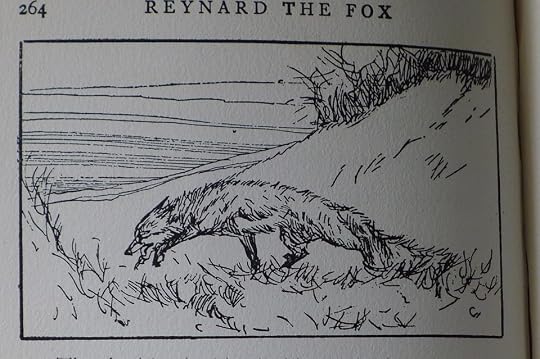
A phenomenal bestseller after its publication in 1919, this work was widely seen as a masterful poetic response to the horrors of World War I. A long narrative poem about a foxhunt, the work also evokes the beauty of English countryside and considers the meaning of courage. The poem was recorded by the author and adapted as a radio play much-beloved by the British public, and although the poem does not overtly criticize foxhunting, it prompted national debate on the subject. Out of print for years, the poem is now newly corrected from the original manuscript and presented alongside other pastoral writing by Masefield, including the essay "Fox-Hunting."

272 pages, Paperback

First published October 1, 1919

Loading...
Loading...

About the author

John Masefield

793 books106 followers
Masefield was born in Ledbury, a rural area in England to George Masefield, a solicitor and Caroline. His mother died giving birth to his sister when Masefield was only 6 and he went to live with his aunt. His father died soon after. After an unhappy education at the King's School in Warwick (now known as Warwick School), where he was a boarder between 1888 and 1891, he left to board the HMS Conway, both to train for a life at sea, and to break his addiction to reading, of which his Aunt thought little. He spent several years aboard this ship and found that he could spend much of his time reading and writing. It was aboard the Conway that Masefield’s love for story-telling grew.

In 1894, Masefield boarded the Gilcruix, destined for Chile. He recorded his experiences while sailing through the extreme weather. Upon reaching Chile, Masefield suffered from sunstroke and was hospitalized. He eventually returned home to England as a passenger aboard a steam ship.

In 1895, Masefield returned to sea on a windjammer destined for New York City. However, the urge to become a writer and the hopelessness of life as a sailor overtook him, and in New York, he deserted ship. He lived as a vagrant for several months, before returning to New York City, where he was able to find work as an assistant to a bar keeper.

For the next two years, Masefield was employed in a carpet factory, where long hours were expected and conditions were far from ideal. He purchased up to 20 books a week, and devoured both modern and classical literature. His interests at this time were diverse and his reading included works by Trilby, Dumas, Thomas Browne, Hazlitt, Dickens, Kipling, and R. L. Stevenson. Chaucer also became very important to him during this time, as well as poetry by Keats and Shelley.

When Masefield was 23, he met his future wife, Constance Crommelin, who was 35. Educated in classics and English Literature, and a mathematics teacher, Constance was a perfect match for Masefield despite the difference in age. The couple had two children (Judith, born in 1904, and Lewis, in 1910).

In 1930, due to the death of Robert Bridges, a new Poet Laureate was needed. King George V appointed Masefield, who remained in office until his death in 1967. Masefield took his appointment seriously and produced a large quantity of verse. Poems composed in his official capacity were sent to The Times. Masefield’s humility was shown by his inclusion of a stamped envelope with each submission so that his composition could be returned if it were found unacceptable for publication.

On 12 May 1967, John Masefield died, after having suffered through a spread of gangrene up his leg. According to his wishes, he was cremated and his ashes placed in Poets’ Corner in Westminster Abbey. Later, the following verse was discovered, written by Masefield, addressed to his ‘Heirs, Administrators, and Assigns’:

Let no religious rite be done or read
In any place for me when I am dead,
But burn my body into ash, and scatter
The ash in secret into running water,
Or on the windy down, and let none see;
And then thank God that there’s an end of me.

Ratings & Reviews

What do you think?
Rate this book

Friends & Following

Create a free account to discover what your friends think of this book!

Community Reviews

5 stars
8 (26%)
4 stars
10 (33%)
3 stars
5 (16%)
2 stars
6 (20%)
1 star
1 (3%)
Displaying 1 - 6 of 6 reviews
Profile Image for Mir.
5,014 reviews5,380 followers
Read
April 25, 2015
I am not the audience for this book. Long, narrative poetry is not my preferred sort, and I am not a sport-hunting enthusiast. I certainly don't valorize fox-hunting the way Masefield does, calling it a "beauty and delight" -- in his introduction he writes that "Hunting makes more people happy than anything I know. When people are happy together, I am quite certain that they build up something eternal, something both beautiful and divine, which weakens the power of all evil things upon this life." That's a pretty philosophy but I doubt the fox would sympathize. Also, "makes more people happy than anything I know," really? More people are made happier by fox-hunting than by reading or writing or romantic love or playing with their children or travel or art or good meals with friends? Hmm. I guess Masefield and I know very different sorts of people.

I got this because I had enjoyed some of Masefield's stories when I was a child. I was expecting this to be a version of the Reynard the Fox folktale, not a description of an English fox-hunt. I'm sufficiently uninterested in this subject to not really feel able to evaluate the book as to quality. The verse writing is competent, certainly. Stylistically it seems on the simple and repetitive side. It would be easy to read aloud. Once in a great while comes an interesting image such as
His eyes rapt back on some far place,
Like some starved, half-mad saint in bliss
In God's world through the rags of this
but that's the end of it, and it doesn't even have any real relevance to what he's talking about, which is a description of an old man with an ash stick who will be working the hunt. I suspect Masefield just had an inspired moment and was too pleased with the line to cut it. Otherwise we have a pretty straight-forward descriptive narrative:
The meet was at "The Cock and Pye
By Charles and Martha Enderby,"
The grey, three-hundred-year-old inn
Long since the haunt of Benjamin
The highwayman, who rode the bay.
The tavern fronts the coaching way,
The mail changed horses there of old.
It has a strip of grassy mould
In front of it, a broad green strip.
A trough, where horses' muzzles dip,
Stands opposite the tavern front,
And there that morning came the hunt.
Yawn.


Carton Moorepark
Profile Image for Taro.
114 reviews19 followers
March 30, 2011
Delightfully entertaining.
The story of a fox-hunt in England, feels and smells English, all the weird British geographic descriptors (what the heck's a 'copse'?), makes you feel either on the hunt or on the run.
Some parts hilariously funny, some parts tense and nerve-wracking. Run, little fox, run!
And some really great parts were where he would describe the fox 'seeing' scents, as foxes have great sense of smell.

ETA
I found Disney made a short about fox hunting, which is basically the same thing. And some of the people in this poem do talk very much like Donald.
http://youtu.be/XbLNQZdVk9E
Profile Image for Michael Spring.
30 reviews3 followers
April 10, 2013
Don't bother with the first half where the people gather for the hunt. Cut to the chase, as they say, and if you can, read this poem out loud to someone, preferably in front of an open fire, with a glass of something to lubricate the vocal chords.
Profile Image for Jan.
713 reviews17 followers
June 3, 2021
I was first introduced to this book by my school teacher when I was thirteen. He was very military, right out of the RAF and waiting to get his next position as an English Literature teacher at the prestigious Harrow. In the meantime, he had to work with the unruly English working class children of the London masses. He was determined to teach us about poetry and an England. He marched into class and had one book. He threw it down on his desk and told us, that with this one book he would teach us about England, English Literature, English and poetry. We would go around the whole class, read one stanza each, and then discuss this in length, what it meant, what our thoughts were, and how did we feel about that. We all groaned! What a long year this was going to be!

However, instead of being dreadful, after a few classes we started to look forward to "Sir" asking us each questions. Listening to our thoughts, and asking why we thought this. What about the fox? No-one had asked us what did WE THINK before. I had forgotten about Reynard, until a few weeks ago when watching two British murder mysteries, and Reynard the Fox was mentioned in both of them. Both mysteries dealing with Fox Hunts. Memories came flooding back. I had to find this poem.

Author John Masefield, at this time, was the Poet Laureate. Our unruly form, had no idea what a Poet Laureate was, we learned, and we also learned a little of Mr. Masefield. There were no computers at this time, and to go look up anything in a library was unheard of by this bunch. But learn we did.

Obviously this poem made a huge impression on a class of thirteen year olds. Londoners who had never seen a Hunt, or even a fox, many had never even been to the country! This was an England none of us knew about.

And then.....it was my turn to read, the fox was nearly "DONE". The fox was on his last legs. "For a minute he ran and heard no sound, Then a whimper came from a questing hound, Then a "This way, beauties," and then "Leau Leu, The floating laugh of the horn that blew. Then the cry again and the crash and the rattle, Of the shrubs burst back as they ran to the battle. Till the wood behind seemed risen from root, Crying and crashing to give pursuit. Till the trees seemed hounds and the air seemed cry, And the earth so far that he needs but die, Die where he reeled in the woodland dim, With a hound's white grips in the spine of him: For one more burst he could spurt, and then Wait for the teeth, and the wrench, and men.

He made his spurt for the Mourne End rocks, The air blew rank with the taint of fox; The yews gave way to a greener space, Of great stones strewn in a grassy place. And there was his earth at the great grey shoulder, Sunk in the ground, of a granite Boulder. A dry deep burrow with rocky roof, Proof against crowbars, terrier-proof, Life to the dying, rest for bones.

The earth stopped; it was filled with stones. (I remember the class gasping there, the foxes home was closed with stones, we knew those dogs were going to be on that fox any moment)!

continued..... Then for a moment, his courage failed, His eyes looked up as his body quailed, Then the coming of earth, which all things dread, Made him run for the wood ahead.

The taint of fox was rank on the air, He knew, as he ran, there were foxes there. His strength was broken, his heart was bursting, His bones were rotten, his throat was thirsting, His feet were reeling, his brush was thick from dragging the mud, and his brain was sick. He though as he ran of his old delight, In the woods in the moon in an April night, His happy hunting, his winter loving, The smells of things in the midnight roving; The look of his dainty-nosing, red Clean-felled dam with her footpad's tread, Of his sire, so swift, so game, so cunning With craft in his brain and power of running, Their fights of old when his teeth drew blood. Now he was sick, with his coat all mud.

He crossed the covert, he crawled the bank, to a meuse in the thorns and there he sank, With his ears flexed back and his teeth shown white, In a rat's resolve for a dying bite".

And....there my stanza ended, only one book the teacher had it. Would Reynard beat those dogs? We had to wait until the next week, what was going to happen to that fox? Would the dogs get him, would he escape. Not one of us thought to go to the library and find that book!

The year, when I read this poem, must have been 1958-1959. I still have never seen a fox hunt, and yet, on my walls are pictures of the hunt. I use table mats of the hunt, and my prize birthday gift (at the age of 16 years) has been all over the world with me. A small upright Fox, looking proud all done up in full attire of the hunt. Reynard the Fox...the winner, the fighter, the survivor!

It is now early morning, not quite dawn, and I look out over the Appalachian mountains, should I let out the cat? Light is just appearing over the top, is it safe? Reynard is here, mummy fox lives across the road with her new litter. They set off the alarm last night as the pups played in the driveway. Watch out for Reynards pups, here there are no hunt dogs!

Did this one book have an affect on my life? Obviously it did! Why, because us children of the working class were introduced to literature by an amazing teacher. Oh Harrow, how lucky you are..... and how lucky were we to have had an introduction to Reynard the Fox by a brilliant man, who thought we should. Reynard the Fox by John Masefield, so happy to have you on my shelf with all my other books of poetry. Note: This was not the Kindle version.
185 reviews
January 6, 2019
Probably the first poem that really ignited interest in poetry as a youngster. Marvellous material.
Profile Image for Nettle.
180 reviews64 followers
Want to Read
September 28, 2013
Picked this up off carboot earlier, 1923 edition.
Displaying 1 - 6 of 6 reviews