This study looks at the lives of the most famous "wild children" of eighteenth-century Europe, showing how they open a window onto European ideas about the potential and perfectibility of mankind. Julia V. Douthwaite recounts reports of feral children such as the wild girl of Champagne (captured in 1731 and baptized as Marie-Angélique Leblanc), offering a fascinating glimpse into beliefs about the difference between man and beast and the means once used to civilize the uncivilized.
A variety of educational experiments failed to tame these feral children by the standards of the day. After telling their stories, Douthwaite turns to literature that reflects on similar experiments to perfect human subjects. Her examples range from utopian schemes for progressive childrearing to philosophical tales of animated statues, from revolutionary theories of regenerated men to Gothic tales of scientists run amok. Encompassing thinkers such as Rousseau, Sade, Defoe, and Mary Shelley, Douthwaite shows how the Enlightenment conceived of mankind as an infinitely malleable entity, first with optimism, then with apprehension. Exposing the darker side of eighteenth-century thought, she demonstrates how advances in science gave rise to troubling ethical concerns, as parents, scientists, and politicians tried to perfect mankind with disastrous results.
I love stumbling upon gems like Julia Douthwaite's book The Wild Girl, Natural Man and the Monster: Dangerous Experiments In the Age of Enlightenment, even when they are a little dry. I'm very interested in the foundational myths of modern society regarding the erroneous split between the “civilized” and the “wild,” so the title alone was enough to catch my attention.
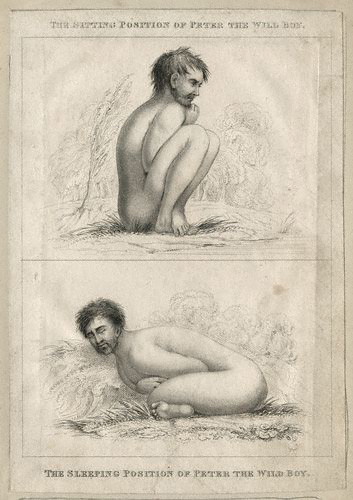
Three “wild children,” Peter of Hanover, Marie-Angèlique Leblanc and Victor de l'aveyron, give us a glimpse into the emerging sciences and what were seen as the fundamental differences between man and beast, and how (or if) these sub-humans could be civilized through educational methods. These theories led to some whacky and cruel ideas of not only how to cure “wildness,” but also create a “natural” being by isolating them from the world. Throughout the book, Douthwaite brings us back to these children while discussing the literature that surrounded the experimentalism that was hugely popular among the educated classes. With a backdrop of the tumultuous French revolution she examines the citizen that was being sculpted out of the carnage, and these questions of the human were central to theories of this “regenerated man.” As the title suggests, these distinctions were gendered, and Douthwaite devotes much of the book to the civilizing of women, and their perceived role as childrearers of the nation, relegated to the private, domestic sphere.
I highly recommend The Wild Girl for insight into Western ideas of human nature and the civilizing process. Despite its scholarly intentions, I found it an absorbing read. The idea of human perfectibility through education and scientific advancement is of course still with us today in the ideas of developed versus developing countries and notions of human progress, ever projecting outward into space consuming all. This is a book that will make you question concepts central to our notions of civilized society and yet so taken for granted.
This is a deeply academic book written for deeply academic people. It's kinda a pity, because the stories herein would make such great pop non-fiction. That's why I read it. I was looking for details on Richard Lovell Edgeworth's educational experiment on his own son. Reading about feral children was a bonus.
Unfortunately, the details of most stories were skimpy and buried in dry chapters of jargon. I admit I skimmed the later chapters where there was no story to carry me through.
I will add that I didn't really understand her conclusion from feral children that nature is stronger than nurture. If a child misses being educated during a key portion of life (toddlerhood to tweens), and they literally cannot talk, exhibit impulse control, or observe basic social niceties for the rest of their life as a result, what I hear is that nurture during childhood is insanely important.
As somebody with zero educational background, I found this easy to understand and follow along. The way real world events affect literature, and then how the literature affects the real world is something I never really thought of before.