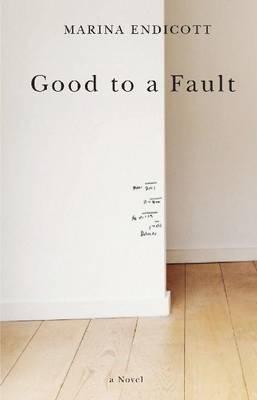
Finalist Scotiabank Giller Prize 2008
One of Globe & Mail’s Top 100 Books of 2008
Marina Endicott has come up with an original concept: Is her character Clara (Clary) acting out of goodness, or guilt, or a sense of responsibility? Is she selfless or selfish? Or do all of these come into play? Clara herself questions her motives, as will the reader, given the conflicting hints along the way.
The story opens with a collision: Clara Purdy, 43, a divorced, childless woman, is “thinking about herself and the state of her soul” when it happens. From out of the other car, the “Dart”, tumbles a whole family. “The old woman was stupidly plucking her bloody shirt away from her body, bits of flesh falling. Wherever Clara turned there were more. A boy, bleeding, holding his head.” Since they had been living in their car, now totaled, they are homeless, but they are not seriously injured. It wasn’t blood: Mrs. Pell, the grandmother, had been eating from a big bag of cherries. The father, Clayton (Clay), the daughter, Darlene (Dolly), Mrs. Pell, and baby Pearce, are fine. The boy, Trevor, suffered a minor scalp wound, but the mother, Lorraine, turns out to have a fever, and bruising. Not from the accident, though: she has cancer.
Whose fault is it all? We’re not sure. Is it Clayton, for driving too fast? Lorraine thinks it’s Mom Pell, since stopping for cherries meant Clayton had to drive fast, to make up the time. Clara feels she was at fault, feels sorry for Lorraine, and deep down, she’s dissatisfied with her life, so she takes the whole family into her home.
Before committing to this, Clara first tries to explain to Paul Tippett, the priest:
“I see what they need,” she finally said. “But I am unwilling to help.” But that was not it, she was not unwilling – she was somehow stupidly ashamed of wanting to help….
“I don’t want them in my house,” she said. But maybe she did.
“No one could plausibly expect you to take them in,” the priest said. ‘There are agencies…”
“It’s not what’s plausible; it’s what I ought to do.”
“You’ve visited them,” he commended her. “Many would not think to do as much.”
Many would not think to do as much, she thought, almost laughing…. “Visiting the hospital is – nothing! My whole life does not seem very worthwhile,” she said. “Or even real.” (p.25)
As it turns out, neither Clayton nor Lorraine live with Clara. Lorraine will remain in hospital for treatment, and Clay, the children inform Clara, is gone, taking with him her mother’s car, the stereo, the silver clock and teapot, some food, and money from her wallet. But not her credit cards, or so she thought at the time. Later, she discovers he’d taken her phone card, when she receives a whopping phone bill. It appears, that to absolve himself from responsibility, he’s phoned everywhere in an attempt to track down Darwin, Lorraine’s brother who “goes where the wind blows”.
And through all this, Clara, as a character, is surprisingly believable, although not necessarily likable. Yes, there is a measure of selfishness in her actions; she wants a family:
“When baby Pearce starts crying, Mrs. Pell shows no signs of going to see to him. So Clara went. Mine, she thought.” (pp. 29-30)
(Clayton wins, in close contest with his mother, as the most unsympathetic character in the book.)
The point-of-view switches from Clary, who has finally found some sense of purpose in her life; to Dolly, who struggles between her gratefulness for the physical comforts Clary provides, and her love for her mother; to Priest Paul, who grieves for his wife, seems capable only of speaking in Pulpit Prose, yet becomes intimately involved with Clara; to Lorraine, powerless to do anything but accept Clara’s help, and while acknowledging the impossibility of repaying her, does not feel indebted to her.
Through these characters, we understand that Trevor can’t even admit to himself that he loves Clary, because of his loyalty and love for his mother; and that baby Pearce regards Clara as his mother – Clary is ecstatic when Pearce’s first word is “Clah!”
Each of the characters in Good to a Fault is extremely well drawn, including minor characters not mentioned here. My favourites were actually Darwin and Dolly. Darwin is responsible – when he needs to be: he spends his nights in the hospital with Lorraine, and is a wonderful uncle to the children. He also becomes a good friend to Clary. Dolly is a treasure; I loved it when the perspective switched to her.
And we have a nice, tight ending, too, with all threads of the story pulled together, all characters’ true feelings and roles revealed in a very ingenious way. Good to a Fault begins with a compelling premise, and finishes with a fine flourish.